




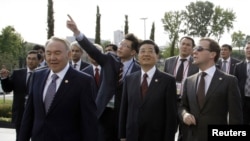
As the Shanghai Cooperation Organization gathers in Tashkent for its annual summit on June 10-11, what isn’t discussed might be more telling than what is.
The situation in Afghanistan has become a regular talking point among the grouping's six full members -- China, Russia, and the Central Asian countries of Kazakhstan, Kyrgyzstan, Tajikistan, and Uzbekistan.
Political stability in Kyrgyzstan, where protests led to the ouster of President Kurmanbek Bakiev in April, is also on the agenda. So are cooperative efforts -- the SCO's stated reason for being -- in areas including antinarcotics measures, thwarting the designs of Islamic militants, and the traditional avenues of education, legal matters, science, and culture.
But the elephant in the room during the two-day summit will be relations between the SCO's two anchors -- Russia and China -- whose ties have been slowly deteriorating, with the potential to greatly affect Central Asia.
This is due to the common view Russia and China have of Central Asia, according to James Nixey, an analyst on Central Asia and the Caucasus at London's Chatham House.
"The Central Asian countries are still looked upon by Russia and China as a quarry -- a quarry from which to extract hydrocarbons," Nixey explains.
Instrument Of Influence
The SCO was originally formed in 1996 as a confidence-building measure between China and the CIS states that border China (Russia, Kazakhstan, Kyrgyzstan, and Tajikistan). The initial task for the group was to move their militaries away from their common border, and they succeeded so well in doing this that the group expanded their cooperation into trade and economic matters.
The second Chechen war, an Islamic insurgency in Central Asia, and an energized campaign for autonomy by Uyghurs in western China at the end of the 1990s led the group to take on security cooperation and, after adding Uzbekistan to the group, the SCO was widely viewed as a Eurasian security organization -- a "NATO of the East."
Nixey said that aspect of SCO cooperation is less important now than it was just a few years ago.
"I think the security aspect is certainly there, but it's really more of an aside and it's more of an excuse than anything else. At the end of the day the SCO is about gaining influence -- it's an instrument [for Russia and China] to gain influence,” Nixey says.
“If it were truly about security we would see proper treaties, we'd see more [military] exercises, we'd see a sharing of intelligence, a sharing of information, exchanges of one sort or another, new military doctrines coming out of the some of the Central Asian states,” Nixey continues. “None of that happens."
The SCO did hold a large and much publicized military exercise in 2007 involving thousands of troops. That was the last such exercise held, and since then the Russian-led CIS Collective Security Treaty Organization, which also includes Kazakhstan, Kyrgyzstan, Tajikistan, and Uzbekistan, has stepped up exercises in Central Asia, holding separate drills in Kazakhstan and Tajikistan in recent months.
China is still very active in Central Asia, but more in terms of investment in huge energy export projects. That fact was obvious during the last two years when Russia was hit hard by the economic crisis and scaled back its investments, while China increased its presence, especially in oil-rich Kazakhstan and natural gas-rich Turkmenistan.
Chinese Footprint
Nixey said the new realities of Central Asia are becoming obvious in the Kremlin.
"I think privately, the Russians are far more worried about the Chinese than they are about the West,” Nixey says. “They say that they're worried about the West; that NATO is the greatest threat to its security. They suggest that the U.S. is a large threat, they're worried about the U.S. influence in Central Asia, but ultimately they believe that the U.S. influence in Central Asia is a temporary phenomenon.”
Chinese influence and physical presence in Central Asia, by contrast, appear to be long-term -- or permanent, according to Nixey.
“If you look at the new Russian military doctrine, China isn't mentioned once but it is there, it's between the lines,” Nixey continues. “You can almost take out the words NATO and the West and insert China. And that is what sensible Russians...are beginning to realize."
They are indeed. On June 7 the Russian newspaper "Vzglyad" (View) reported on Chinese efforts to shift the Ussuri River that serves as part of the border between the two countries. And earlier articles have alleged that China has slowly moved troops back to the Russian border, despite those agreements of more than a decade ago that created the SCO.
For its part China, perhaps with an eye on Tibet and the Uyghur region of Xinjiang, appears uncomfortable with Russia's recognition of the separatist regions of South Ossetia and Abkhazia as independent states.
Nixey noted that relations between Russia and China are still good, but he said signs are appearing now that are leading the two countries down different paths.
Many people point out that Russia regards Central Asia as its backyard, and Russia has troops in Kyrgyzstan and Tajikistan. But China, greatly in need of Central Asian energy resources to fuel its economic growth, could also claim Central Asia was once its backyard, though its presence there dates back centuries.
The situation in Afghanistan has become a regular talking point among the grouping's six full members -- China, Russia, and the Central Asian countries of Kazakhstan, Kyrgyzstan, Tajikistan, and Uzbekistan.
Political stability in Kyrgyzstan, where protests led to the ouster of President Kurmanbek Bakiev in April, is also on the agenda. So are cooperative efforts -- the SCO's stated reason for being -- in areas including antinarcotics measures, thwarting the designs of Islamic militants, and the traditional avenues of education, legal matters, science, and culture.
But the elephant in the room during the two-day summit will be relations between the SCO's two anchors -- Russia and China -- whose ties have been slowly deteriorating, with the potential to greatly affect Central Asia.
This is due to the common view Russia and China have of Central Asia, according to James Nixey, an analyst on Central Asia and the Caucasus at London's Chatham House.
"The Central Asian countries are still looked upon by Russia and China as a quarry -- a quarry from which to extract hydrocarbons," Nixey explains.
Instrument Of Influence
The SCO was originally formed in 1996 as a confidence-building measure between China and the CIS states that border China (Russia, Kazakhstan, Kyrgyzstan, and Tajikistan). The initial task for the group was to move their militaries away from their common border, and they succeeded so well in doing this that the group expanded their cooperation into trade and economic matters.
The second Chechen war, an Islamic insurgency in Central Asia, and an energized campaign for autonomy by Uyghurs in western China at the end of the 1990s led the group to take on security cooperation and, after adding Uzbekistan to the group, the SCO was widely viewed as a Eurasian security organization -- a "NATO of the East."
Nixey said that aspect of SCO cooperation is less important now than it was just a few years ago.
"I think the security aspect is certainly there, but it's really more of an aside and it's more of an excuse than anything else. At the end of the day the SCO is about gaining influence -- it's an instrument [for Russia and China] to gain influence,” Nixey says.
“If it were truly about security we would see proper treaties, we'd see more [military] exercises, we'd see a sharing of intelligence, a sharing of information, exchanges of one sort or another, new military doctrines coming out of the some of the Central Asian states,” Nixey continues. “None of that happens."
The SCO did hold a large and much publicized military exercise in 2007 involving thousands of troops. That was the last such exercise held, and since then the Russian-led CIS Collective Security Treaty Organization, which also includes Kazakhstan, Kyrgyzstan, Tajikistan, and Uzbekistan, has stepped up exercises in Central Asia, holding separate drills in Kazakhstan and Tajikistan in recent months.
China is still very active in Central Asia, but more in terms of investment in huge energy export projects. That fact was obvious during the last two years when Russia was hit hard by the economic crisis and scaled back its investments, while China increased its presence, especially in oil-rich Kazakhstan and natural gas-rich Turkmenistan.
Chinese Footprint
Nixey said the new realities of Central Asia are becoming obvious in the Kremlin.
"I think privately, the Russians are far more worried about the Chinese than they are about the West,” Nixey says. “They say that they're worried about the West; that NATO is the greatest threat to its security. They suggest that the U.S. is a large threat, they're worried about the U.S. influence in Central Asia, but ultimately they believe that the U.S. influence in Central Asia is a temporary phenomenon.”
Chinese influence and physical presence in Central Asia, by contrast, appear to be long-term -- or permanent, according to Nixey.
“If you look at the new Russian military doctrine, China isn't mentioned once but it is there, it's between the lines,” Nixey continues. “You can almost take out the words NATO and the West and insert China. And that is what sensible Russians...are beginning to realize."
They are indeed. On June 7 the Russian newspaper "Vzglyad" (View) reported on Chinese efforts to shift the Ussuri River that serves as part of the border between the two countries. And earlier articles have alleged that China has slowly moved troops back to the Russian border, despite those agreements of more than a decade ago that created the SCO.
For its part China, perhaps with an eye on Tibet and the Uyghur region of Xinjiang, appears uncomfortable with Russia's recognition of the separatist regions of South Ossetia and Abkhazia as independent states.
Nixey noted that relations between Russia and China are still good, but he said signs are appearing now that are leading the two countries down different paths.
Many people point out that Russia regards Central Asia as its backyard, and Russia has troops in Kyrgyzstan and Tajikistan. But China, greatly in need of Central Asian energy resources to fuel its economic growth, could also claim Central Asia was once its backyard, though its presence there dates back centuries.