

The administration of U.S. President Barack Obama has sharply criticized Beijing’s policy of censoring access to the Internet and pursuing Chinese dissidents who try to use it as a tool for social change.
In a speech on Internet freedom on January 21, U.S. Secretary of State Hillary Clinton stated that “countries that restrict free access to information or violate the basic rights of Internet users risk walling themselves off from the progress of the next century."
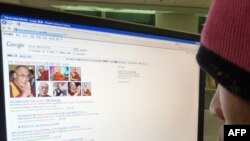
The immediate reason for Clinton’s remarks was the quarrel between Beijing and Google, the U.S. company which operates one of the largest Internet search engines.
Google has threatened to withdraw from the Chinese market because of Beijing’s hacking the accounts of human rights activists who use its e-mail service, Gmail.
Google also says it is “no longer willing to continue censoring” Chinese users’ search results for subjects such as the Tiananmen Square massacre, which Beijing considers taboo.
The dispute sounds a bit like any trade issue: a case of the United States defending an American company’s interests in a foreign land.
But in fact, Clinton’s criticism of China breaks new ground.
It is the first time the Obama administration has brought this much firepower to defending the freedom of the Internet or criticized Beijing so bluntly over its suppression of Internet-based dissent. And this suggests Washington views the Internet as such an effective democracy-building tool that it needs to be defended as a matter of U.S. foreign policy.
Antigovernment Networks
That view has grown with the ever increasing role the Internet, and social networking sites in particular, have played in protests against repressive governments around the world.
Dissidents in places as diverse as Belarus, Moldova, and Iran have used sites like Facebook and Twitter to build communities of like-minded people and share information and goals. Combined with other media, like mobile phone-based text messaging, those resources have helped bring thousands of protestors onto the streets, like during Iran’s postelection protests in June.
On January 21, Clinton not only defended the freedom of the Internet but also announced new U.S. investments to expand access to it. She promised $15 million in funding for new grassroots efforts to “expand civic participation and increase the new media capabilities of civil society in the Middle East and North Africa.”
But not everyone is convinced that the Internet is as positive a force for democracy as Clinton’s support of it suggests.
Evgeny Morozov, an expert on political repression online at Georgetown University in Washington, D.C., says that if enthusiasm for “digital revolutions” abounds, so do the dangers for the digital revolutionaries.
“Mainstream thinking on this issue is that somehow the activists will use the secure technologies provided by the Internet and social networking, they will organize groups, and collectively they will then oppose and challenge the regime, which itself is perceived as somewhat of a laggard,” he told Britain’s "Prospect” magazine in November. “So, the common misperception about authoritarian states is that their governments are usually very bad at technology and that all they do is just censor and filter.”
But censoring and filtering, as China’s own hacking of dissidents’ Gmail accounts shows, can be just the beginning of how repressive governments themselves use the Internet to crack down on dissidents.
Morozov, a native of Belarus who has worked widely with civic groups in the region, says people often overestimate their ability to protect their anonymity when they join social networking sites. That puts them at risk of being monitored.
At the same time, governments are becoming better at profiling the online behavior of targeted Internet users, with the goal of predicting if they will pose a future threat to the state. China, for example, has contracted Western data-mining companies to help them do so.
Other tricks authoritarian governments use are to hire proxies to sabotage online discussion forums by leaving comments on articles that twist their meaning or stigmatize the authors. And that -- just like the Internet’s widespread use by militant groups like neo-Nazis, Hizballah, or Al-Qaeda -- simply underlines how little the web is exclusively democracy’s preserve.
Still, if skeptics express caution regarding the Internet’s current ability to advance democracy, few question its potential to do so. What is needed is for the global providers of the social networking and similar services to do more to make such sites secure and to protect users’ data.
That means that Washington’s call to Beijing this week may represent only half the fight between democratic and authoritarian governments over the Internet.
Washington is making it a foreign policy priority to keep the window for the Internet as wide-open as possible in repressive states.
But it will be up to companies like Google, Facebook, and others to get better at protecting prodemocracy users if the Internet is to realize its full potential for challenging authoritarian regimes.
In a speech on Internet freedom on January 21, U.S. Secretary of State Hillary Clinton stated that “countries that restrict free access to information or violate the basic rights of Internet users risk walling themselves off from the progress of the next century."
The immediate reason for Clinton’s remarks was the quarrel between Beijing and Google, the U.S. company which operates one of the largest Internet search engines.
Google has threatened to withdraw from the Chinese market because of Beijing’s hacking the accounts of human rights activists who use its e-mail service, Gmail.
Google also says it is “no longer willing to continue censoring” Chinese users’ search results for subjects such as the Tiananmen Square massacre, which Beijing considers taboo.
The dispute sounds a bit like any trade issue: a case of the United States defending an American company’s interests in a foreign land.
But in fact, Clinton’s criticism of China breaks new ground.
It is the first time the Obama administration has brought this much firepower to defending the freedom of the Internet or criticized Beijing so bluntly over its suppression of Internet-based dissent. And this suggests Washington views the Internet as such an effective democracy-building tool that it needs to be defended as a matter of U.S. foreign policy.
Antigovernment Networks
That view has grown with the ever increasing role the Internet, and social networking sites in particular, have played in protests against repressive governments around the world.
Dissidents in places as diverse as Belarus, Moldova, and Iran have used sites like Facebook and Twitter to build communities of like-minded people and share information and goals. Combined with other media, like mobile phone-based text messaging, those resources have helped bring thousands of protestors onto the streets, like during Iran’s postelection protests in June.
On January 21, Clinton not only defended the freedom of the Internet but also announced new U.S. investments to expand access to it. She promised $15 million in funding for new grassroots efforts to “expand civic participation and increase the new media capabilities of civil society in the Middle East and North Africa.”
But not everyone is convinced that the Internet is as positive a force for democracy as Clinton’s support of it suggests.
Evgeny Morozov, an expert on political repression online at Georgetown University in Washington, D.C., says that if enthusiasm for “digital revolutions” abounds, so do the dangers for the digital revolutionaries.
“Mainstream thinking on this issue is that somehow the activists will use the secure technologies provided by the Internet and social networking, they will organize groups, and collectively they will then oppose and challenge the regime, which itself is perceived as somewhat of a laggard,” he told Britain’s "Prospect” magazine in November. “So, the common misperception about authoritarian states is that their governments are usually very bad at technology and that all they do is just censor and filter.”
But censoring and filtering, as China’s own hacking of dissidents’ Gmail accounts shows, can be just the beginning of how repressive governments themselves use the Internet to crack down on dissidents.
Morozov, a native of Belarus who has worked widely with civic groups in the region, says people often overestimate their ability to protect their anonymity when they join social networking sites. That puts them at risk of being monitored.
At the same time, governments are becoming better at profiling the online behavior of targeted Internet users, with the goal of predicting if they will pose a future threat to the state. China, for example, has contracted Western data-mining companies to help them do so.
Other tricks authoritarian governments use are to hire proxies to sabotage online discussion forums by leaving comments on articles that twist their meaning or stigmatize the authors. And that -- just like the Internet’s widespread use by militant groups like neo-Nazis, Hizballah, or Al-Qaeda -- simply underlines how little the web is exclusively democracy’s preserve.
Still, if skeptics express caution regarding the Internet’s current ability to advance democracy, few question its potential to do so. What is needed is for the global providers of the social networking and similar services to do more to make such sites secure and to protect users’ data.
That means that Washington’s call to Beijing this week may represent only half the fight between democratic and authoritarian governments over the Internet.
Washington is making it a foreign policy priority to keep the window for the Internet as wide-open as possible in repressive states.
But it will be up to companies like Google, Facebook, and others to get better at protecting prodemocracy users if the Internet is to realize its full potential for challenging authoritarian regimes.