




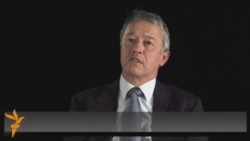

WATCH: Amnesty's Middle East & North Africa Program Director Malcolm Smart says the recent Arab uprisings have been sending the message that people will no longer tolerate repression. (Video courtesy of Amnesty International)
By Daisy Sindelar
Imagine a world that is "flat" -- that is, a world where every person has access to information and can participate in decisions affecting their lives with no fear of persecution.
In its latest annual report, released on May 13, rights watchdog Amnesty International says the past year offered a hopeful glimpse of just such a world -- but that many governments are more determined than ever to fight dissent.
Angry street protests in Tunisia in January led to the overthrow of the country's leadership and sparked a wave of demonstrations still reverberating throughout the Middle East and North Africa.
The Tunisian revolution got its start with the self-immolation of an impoverished street vendor, Mohamed Bouazizi, in December 2010. Amnesty International says Tunisia capped off a year when repressive governments first "faced the real possibility that their days were numbered."
But it was not only the start of protests against corruption and economic disparity that distinguished 2010 from other years.
WATCH: Europe & Central Asia Program Director Nicola Duckworth says Azerbaijan, Belarus, Russia, and parts of Central Asia are seeing a continuing trend of repression and rights violations:
Salil Shetty, secretary-general of Amnesty International, says it was also a year that saw information revealed and shared more openly than ever before.
"The coming together of people, standing up against oppression, is what we are all about," Shetty says. "And we are truly inspired by what's happened, and we are going to really focus our energies on strengthening and growing the movement, the human rights movement, across the world in this important year."
Moment Of Opportunity
Amnesty says the mounting demands for reform across the Middle East, combined with unparalleled access to information and community organizing, have laid the ground for an era of unprecedented change across much of the world.
But it also warns that this moment of opportunity is at risk of being rolled back by repressive and corrupt governments eager to prevent similar revolutions on their own turf.
WATCH: Asia-Pacific Program Director Sam Zarifi says 2010 was the worst year for civilians in Afghanistan since the beginning of the conflict there, and that women have suffered in particular:
Political repression deepened in Iran, while security concerns continued to dominate life in Iraq, Pakistan, and Afghanistan. Across the Balkans and the former Soviet Union, human rights violations remain a day-to-day standard, with governments systematically repressing free speech, freedom of assembly, and the rights of women, activists, refugees, and minorities.
In its new 400-page report, which comes out just ahead of Amnesty's 50th anniversary on May 28, the group says dozens of countries continue to muzzle, imprison, and torture human rights defenders. And across the globe, governments are attempting to seize control of access to information, blocking Internet access and cutting mobile-phone networks.
John Dalhuisen, Amnesty's deputy director of its Europe and Central Asia program, says the world stands on a "knife's edge" between unprecedented freedoms and a wave of harsh repressions.
He says that while many people may be tempted to see the Arab protests as a sign of imminent change in other parts of the world, regions like Central Asia remain as tightly controlled as ever, and are likely to see still-harsher repressions as their leaders look nervously to the collapsing regimes in the Middle East and North Africa.
"Translating this to the former Soviet Union, to Central Asia, it's very important not to make false parallels and false connections," Dalhuisen says. "We've seen in Central Asia, really, a period of stagnation rather than flux and change over the last year. And really, while we are seeing dawns elsewhere in the world, we're really not seeing that in Central Asia. And really there's a big push that still needs to be made to see the respect for human rights and the empowerment of peoples really take off in that part of the world."
By Daisy Sindelar
Imagine a world that is "flat" -- that is, a world where every person has access to information and can participate in decisions affecting their lives with no fear of persecution.
In its latest annual report, released on May 13, rights watchdog Amnesty International says the past year offered a hopeful glimpse of just such a world -- but that many governments are more determined than ever to fight dissent.
Angry street protests in Tunisia in January led to the overthrow of the country's leadership and sparked a wave of demonstrations still reverberating throughout the Middle East and North Africa.
The Tunisian revolution got its start with the self-immolation of an impoverished street vendor, Mohamed Bouazizi, in December 2010. Amnesty International says Tunisia capped off a year when repressive governments first "faced the real possibility that their days were numbered."
But it was not only the start of protests against corruption and economic disparity that distinguished 2010 from other years.
WATCH: Europe & Central Asia Program Director Nicola Duckworth says Azerbaijan, Belarus, Russia, and parts of Central Asia are seeing a continuing trend of repression and rights violations:

Salil Shetty, secretary-general of Amnesty International, says it was also a year that saw information revealed and shared more openly than ever before.
"The coming together of people, standing up against oppression, is what we are all about," Shetty says. "And we are truly inspired by what's happened, and we are going to really focus our energies on strengthening and growing the movement, the human rights movement, across the world in this important year."
Moment Of Opportunity
Amnesty says the mounting demands for reform across the Middle East, combined with unparalleled access to information and community organizing, have laid the ground for an era of unprecedented change across much of the world.
But it also warns that this moment of opportunity is at risk of being rolled back by repressive and corrupt governments eager to prevent similar revolutions on their own turf.
WATCH: Asia-Pacific Program Director Sam Zarifi says 2010 was the worst year for civilians in Afghanistan since the beginning of the conflict there, and that women have suffered in particular:

Political repression deepened in Iran, while security concerns continued to dominate life in Iraq, Pakistan, and Afghanistan. Across the Balkans and the former Soviet Union, human rights violations remain a day-to-day standard, with governments systematically repressing free speech, freedom of assembly, and the rights of women, activists, refugees, and minorities.
In its new 400-page report, which comes out just ahead of Amnesty's 50th anniversary on May 28, the group says dozens of countries continue to muzzle, imprison, and torture human rights defenders. And across the globe, governments are attempting to seize control of access to information, blocking Internet access and cutting mobile-phone networks.
John Dalhuisen, Amnesty's deputy director of its Europe and Central Asia program, says the world stands on a "knife's edge" between unprecedented freedoms and a wave of harsh repressions.
He says that while many people may be tempted to see the Arab protests as a sign of imminent change in other parts of the world, regions like Central Asia remain as tightly controlled as ever, and are likely to see still-harsher repressions as their leaders look nervously to the collapsing regimes in the Middle East and North Africa.
"Translating this to the former Soviet Union, to Central Asia, it's very important not to make false parallels and false connections," Dalhuisen says. "We've seen in Central Asia, really, a period of stagnation rather than flux and change over the last year. And really, while we are seeing dawns elsewhere in the world, we're really not seeing that in Central Asia. And really there's a big push that still needs to be made to see the respect for human rights and the empowerment of peoples really take off in that part of the world."