






ARENI, Armenia -- Researchers this month announced that the world's oldest-known winery has been found in caves outside a small mountain village in what is now Armenia, prompting one village woman to pour a celebratory glass of her own homemade vintage.
Kima, a village woman who declined to give her last name, sells her homemade wines at kiosks in Areni, a small village about 100 kilometers southeast of the capital, Yerevan. She thinks the discovery will be a source of pride and inspiration for locals, for whom wine is still a main source of income.
"Yes, you do get excited when you know that this was the place where they made wine first. This really gets you excited," Kima says. "You want to make it good and of high quality. This really matters. You feel proud. Soon we'll also have a good tourist spot. People will come visit."
The discovery, announced on January 11 by a team of international researchers, details evidence of large-scale winemaking going back some 6,000 years. That's about 3,000 years after the world's oldest known fermented drink, a mixed beverage of rice, honey, grapes, and hawthorn fruit, was being served in China. The earliest chemical evidence of a Eurasian grape wine, meanwhile, was found in Iran's Zargos Mountains and goes back 7,400 years.
"We have discovered the earliest wine-making unit in the world ever known," says Boris Gasparian, an Armenian archaeologist who led the team that found the ancient winery. "If the people were making wine 6,000 years ago, it means that the grape was domesticated at this time."
Stronger Foothold
Domesticated grapes are hermaphroditic, meaning they contain both male and female parts in the same flower. These grapes can produce significantly more fruit than wild grapes, which have separate male and female plants. A domesticated grape, then, demonstrates advanced agricultural techniques for the period.
Researchers say the ancient wine produced in the Armenian winery is likely close to a varietal still being produced in the Caucasus.
 Kima, a local villager, sells her homemade wine at kiosks in the village of Areni. "You want to make it good and of high quality," she says.
In Armenia, local winemakers see the discovery as a chance to gain a stronger foothold in the international wine market.
Avag Harutiunian, the chairman of the Armenian Union of Winemakers, thinks winemakers should take advantage of the find's publicity to market their products more aggressively.
"We could occupy the high-value niche in the international wine market," Harutiunian says. "Our resources are so scarce that we have no right to produce cheap wine."
Modern wine production in the country began to fall dramatically in the last years of the Soviet Union under a series of laws that ordered the destruction of large swaths of vineyards in a push to limit hard drinking.
The country lost over half its total vineyard area in 30 years, going from 36,000 hectares in 1970 to 15,800 hectares in 1999.
Scant Development
The country's winemaking industry has seen little development in the post-Soviet years. Few winemakers can purchase the advanced technological equipment called for by today's competitive wine market, while Armenia's economy struggles to recover from the global economic downturn.
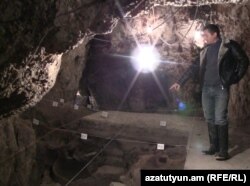 A guard points to the oldest known wine-making facility in the world, deep within a cave in southeastern Armenia.
During the Cold War, the Areni area was surveyed by Soviet defense planners in a search for caves deep enough to protect against a nuclear attack. Archaeologists began to explore the 39 caves carved out of a steep canyon in the region three years ago.
They discovered a well-preserved room containing various artifacts -- including a 5,500-year-old leather shoe that made international headlines in June -- amid evidence of burial sites, preserved textiles, and other artifacts.
Last week's discovery in the Areni-1 cave includes a 60-centimeter-deep vat that scientists believe was used to ferment grapes after they had been crushed the old-fashioned way -- by foot. They also found remains of crushed grapes, seeds, and vine leaves in the cave. The production equipment was also located near a burial site, suggesting that the wines were used during funeral rites.
The Origins Of Wine
Patrick McGovern is scientific director of the Biomolecular Archaeology Laboratory at the University of Pennsylvania Museum and author of "Ancient Wine: The Search for the Origins of Viniculture." He says the Areni discovery falls in line with wine's believed historical trajectory.
Seven years ago, McGovern teamed up with researchers in Europe, the Middle East, and the United States to collect modern grape varietals in eastern Turkey, Armenia, and Georgia, and compare nuclear microsatellite sequences of their DNA with wines available around the world today. They found that several Georgian varietals appear to be closest to the original domesticated grapevine, but the database needs to be expanded.
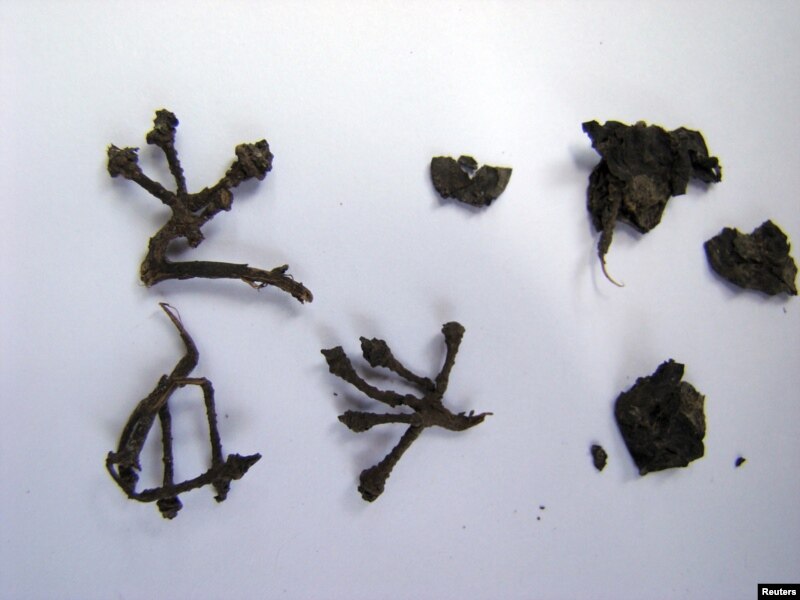
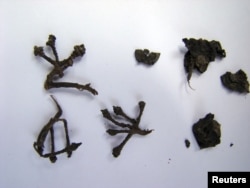 A range of 6,100-year-old desiccated grape stems and dried pressed grapes that were found on and around the wine press in the Armenian cave.Georgia and eastern Turkey, countries that border present-day Armenia, also seems to be where the proto-Indo-European word for “wine” originated. This root was adopted in many other ancient and modern languages, including Latin and Hebrew.
The spoken word for wine in modern Georgia is believed to be closest to the original proto-Indo-European word, implying that grape domestication first occurred in the greater region. Different forms of the early word for wine, McGovern explains, began to surface in numerous languages as the “wine culture” spread from East to West.
"In Georgian, there's one [word] that's like 'ywin,' I believe...And that's similar to our [English] word for wine," McGovern says. "But then if you look at languages throughout the region, that root for wine...is found all over. For instance, even in ancient Egyptian.
"So then, of course, it's found in Eastern European languages, all the languages of Europe, whether it's French or Scandinavian or whatever...That kind of broad spectrum of the use of the same word, and it does have these proto-Indo-European links, it suggests that winemaking begins in that mountainous region where the winery's been found."
But wherever wine originally came from, its enjoyment stands the test of time. One Areni villager passes on a local proverb that may have originated from the famed winery itself:
Kima, a village woman who declined to give her last name, sells her homemade wines at kiosks in Areni, a small village about 100 kilometers southeast of the capital, Yerevan. She thinks the discovery will be a source of pride and inspiration for locals, for whom wine is still a main source of income.
"Yes, you do get excited when you know that this was the place where they made wine first. This really gets you excited," Kima says. "You want to make it good and of high quality. This really matters. You feel proud. Soon we'll also have a good tourist spot. People will come visit."
The discovery, announced on January 11 by a team of international researchers, details evidence of large-scale winemaking going back some 6,000 years. That's about 3,000 years after the world's oldest known fermented drink, a mixed beverage of rice, honey, grapes, and hawthorn fruit, was being served in China. The earliest chemical evidence of a Eurasian grape wine, meanwhile, was found in Iran's Zargos Mountains and goes back 7,400 years.
"We have discovered the earliest wine-making unit in the world ever known," says Boris Gasparian, an Armenian archaeologist who led the team that found the ancient winery. "If the people were making wine 6,000 years ago, it means that the grape was domesticated at this time."
Stronger Foothold
Domesticated grapes are hermaphroditic, meaning they contain both male and female parts in the same flower. These grapes can produce significantly more fruit than wild grapes, which have separate male and female plants. A domesticated grape, then, demonstrates advanced agricultural techniques for the period.
Researchers say the ancient wine produced in the Armenian winery is likely close to a varietal still being produced in the Caucasus.

In Armenia, local winemakers see the discovery as a chance to gain a stronger foothold in the international wine market.
Avag Harutiunian, the chairman of the Armenian Union of Winemakers, thinks winemakers should take advantage of the find's publicity to market their products more aggressively.
"We could occupy the high-value niche in the international wine market," Harutiunian says. "Our resources are so scarce that we have no right to produce cheap wine."
Modern wine production in the country began to fall dramatically in the last years of the Soviet Union under a series of laws that ordered the destruction of large swaths of vineyards in a push to limit hard drinking.
The country lost over half its total vineyard area in 30 years, going from 36,000 hectares in 1970 to 15,800 hectares in 1999.
Scant Development
The country's winemaking industry has seen little development in the post-Soviet years. Few winemakers can purchase the advanced technological equipment called for by today's competitive wine market, while Armenia's economy struggles to recover from the global economic downturn.

During the Cold War, the Areni area was surveyed by Soviet defense planners in a search for caves deep enough to protect against a nuclear attack. Archaeologists began to explore the 39 caves carved out of a steep canyon in the region three years ago.
They discovered a well-preserved room containing various artifacts -- including a 5,500-year-old leather shoe that made international headlines in June -- amid evidence of burial sites, preserved textiles, and other artifacts.
Last week's discovery in the Areni-1 cave includes a 60-centimeter-deep vat that scientists believe was used to ferment grapes after they had been crushed the old-fashioned way -- by foot. They also found remains of crushed grapes, seeds, and vine leaves in the cave. The production equipment was also located near a burial site, suggesting that the wines were used during funeral rites.
The Origins Of Wine
Patrick McGovern is scientific director of the Biomolecular Archaeology Laboratory at the University of Pennsylvania Museum and author of "Ancient Wine: The Search for the Origins of Viniculture." He says the Areni discovery falls in line with wine's believed historical trajectory.
Seven years ago, McGovern teamed up with researchers in Europe, the Middle East, and the United States to collect modern grape varietals in eastern Turkey, Armenia, and Georgia, and compare nuclear microsatellite sequences of their DNA with wines available around the world today. They found that several Georgian varietals appear to be closest to the original domesticated grapevine, but the database needs to be expanded.
The spoken word for wine in modern Georgia is believed to be closest to the original proto-Indo-European word, implying that grape domestication first occurred in the greater region. Different forms of the early word for wine, McGovern explains, began to surface in numerous languages as the “wine culture” spread from East to West.
"In Georgian, there's one [word] that's like 'ywin,' I believe...And that's similar to our [English] word for wine," McGovern says. "But then if you look at languages throughout the region, that root for wine...is found all over. For instance, even in ancient Egyptian.
"So then, of course, it's found in Eastern European languages, all the languages of Europe, whether it's French or Scandinavian or whatever...That kind of broad spectrum of the use of the same word, and it does have these proto-Indo-European links, it suggests that winemaking begins in that mountainous region where the winery's been found."
But wherever wine originally came from, its enjoyment stands the test of time. One Areni villager passes on a local proverb that may have originated from the famed winery itself:
"If you drink wine a lot, it is too bad. If you don't drink wine, it is much worse. But if you do take it moderately, it is excellent."

