



With the dust still settling, four key issues have already emerged to frame subsequent events -- stability, the leadership of the opposition, the opposition's political program, and the effect of Kyrgyzstan's revolutionary change on its Central Asian neighbors.
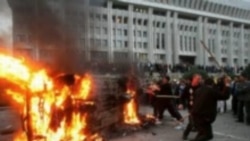
Whatever new government emerges, its most urgent task will be to establish its control over the country and prevent any slide into disorder. While the takeover of government buildings in Bishkek occurred after scuffles that left several dozens injured, no confirmed fatalities were reported, as was the case with the previous seizure of provincial administrative offices in Jalal-Abad and Osh.
Nevertheless, the extent of opposition leaders' control over the crowd was not entirely clear. According to RFE/RL's Kyrgyz Service, Kurmanbek Bakiev, leader of the People's Movement of Kyrgyzstan, told protestors after the takeover: "We didn't have the slightest idea [that things would turn out this way]. Just today in the morning we had no idea that people would take the White House."
As night fell in Bishkek, RIA-Novosti reported, citing a law-enforcement source in Bishkek, that looters had struck several stores. Opposition leaders have delivered televised calls for restraint, but the first real test of any new government will be to ensure that those calls are heeded.
Fragmented Opposition
The second issue involves the selection of an actual government from the ranks of Kyrgyzstan's notoriously fragmented opposition. At an emergency session late on 24 March, lawmakers from the previous parliament -- the newly elected parliament having lost its powers after the Supreme Court revoked its mandate -- named Ishenbai Kadyrbekov acting president, RIA-Novosti reported.
Kadyrbekov, an opposition candidate in recent parliamentary elections whose disqualification sparked protests, is likely a temporary figure for the top post. For now, the Coordinating Council of Popular Unity, headed by former Prime Minister Kurmanbek Bakiev, will assume the duties of a government.
Bakiev, who has increasingly taken on the mantle of opposition leader during recent protests, is a serious contender for the presidency, but Feliks Kulov's release from prison introduces another authoritative figure into the equation. Although Kulov has already said that he does not intend to become president, the situation remains fluid.
Leaving aside the various regional and biographical factors that would speak in favor of splitting the posts of president and prime minister in some fashion between Bakiev and Kulov, or other combinations involving other figures, the lack of an obvious choice to lead an opposition government underscores the first hurdle the various figures who make up the opposition will have to overcome.
Once a new government is in place, its members will face a dilemma familiar to all political figures who have defined themselves in opposition to an entrenched regime. When the regime's hold on power is firm enough to stymie real political competition, the out-of-power opposition's program inexorably devolves to a rejection of the status quo. Now that the status quo has changed so suddenly and so radically, the opposition, left to its own devices without the foe against which it has framed itself for so long, faces the task of fashioning concrete policies to govern a country mired in pressing social, economic, and political problems.
Finally, while it is difficult to gauge the regional implications of events in progress, 24 March in Kyrgyzstan is already setting in motion a regional paradigm shift. Even as momentous changes in Georgia and Ukraine brought to light unexpected possibilities in post-Soviet politics, Central Asia stood firm as the one place where democracy's inroads seemed too torturous to lead to a different, let alone better, future. Kyrgyzstan now finds itself at the beginning of a road paved with uncertainties, but it has at least demonstrated the power of unexpected possibilities in a region where they have too long been denied.
Whatever new government emerges, its most urgent task will be to establish its control over the country and prevent any slide into disorder. While the takeover of government buildings in Bishkek occurred after scuffles that left several dozens injured, no confirmed fatalities were reported, as was the case with the previous seizure of provincial administrative offices in Jalal-Abad and Osh.
Nevertheless, the extent of opposition leaders' control over the crowd was not entirely clear. According to RFE/RL's Kyrgyz Service, Kurmanbek Bakiev, leader of the People's Movement of Kyrgyzstan, told protestors after the takeover: "We didn't have the slightest idea [that things would turn out this way]. Just today in the morning we had no idea that people would take the White House."
As night fell in Bishkek, RIA-Novosti reported, citing a law-enforcement source in Bishkek, that looters had struck several stores. Opposition leaders have delivered televised calls for restraint, but the first real test of any new government will be to ensure that those calls are heeded.
Fragmented Opposition
The second issue involves the selection of an actual government from the ranks of Kyrgyzstan's notoriously fragmented opposition. At an emergency session late on 24 March, lawmakers from the previous parliament -- the newly elected parliament having lost its powers after the Supreme Court revoked its mandate -- named Ishenbai Kadyrbekov acting president, RIA-Novosti reported.
Kadyrbekov, an opposition candidate in recent parliamentary elections whose disqualification sparked protests, is likely a temporary figure for the top post. For now, the Coordinating Council of Popular Unity, headed by former Prime Minister Kurmanbek Bakiev, will assume the duties of a government.
Bakiev, who has increasingly taken on the mantle of opposition leader during recent protests, is a serious contender for the presidency, but Feliks Kulov's release from prison introduces another authoritative figure into the equation. Although Kulov has already said that he does not intend to become president, the situation remains fluid.
Leaving aside the various regional and biographical factors that would speak in favor of splitting the posts of president and prime minister in some fashion between Bakiev and Kulov, or other combinations involving other figures, the lack of an obvious choice to lead an opposition government underscores the first hurdle the various figures who make up the opposition will have to overcome.
Once a new government is in place, its members will face a dilemma familiar to all political figures who have defined themselves in opposition to an entrenched regime. When the regime's hold on power is firm enough to stymie real political competition, the out-of-power opposition's program inexorably devolves to a rejection of the status quo. Now that the status quo has changed so suddenly and so radically, the opposition, left to its own devices without the foe against which it has framed itself for so long, faces the task of fashioning concrete policies to govern a country mired in pressing social, economic, and political problems.
Finally, while it is difficult to gauge the regional implications of events in progress, 24 March in Kyrgyzstan is already setting in motion a regional paradigm shift. Even as momentous changes in Georgia and Ukraine brought to light unexpected possibilities in post-Soviet politics, Central Asia stood firm as the one place where democracy's inroads seemed too torturous to lead to a different, let alone better, future. Kyrgyzstan now finds itself at the beginning of a road paved with uncertainties, but it has at least demonstrated the power of unexpected possibilities in a region where they have too long been denied.