




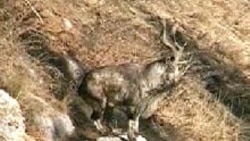
Prague, 12 October 2005 (RFE/RL) -- The markhor is recognized by its unusual spiraling horns that can grow more than a meter long. Horns may be straight or flare outward, depending on the subspecies.
Southern Central Asia is home to several hundreds of Bukharan markhor, most of them found in three nature reserves: Kugitang in Turkmenistan, Surkhan in Uzbekistan, and Dashti Jum in Tajikistan.
Small herds are also reported in other fragmented areas in Tajikistan, including in the eastern Gorno-Badakhshan region.
Mamadshoh Qamshoev, director of the zoological laboratory in Badakhshan, tells RFE/RL that the markhor population in the region was estimated at 200 half a century ago. But he says the number has since dropped to several dozen.
“Every year the number of [markhors] is decreasing," Qamshoev says. "In 2003, a group of specialists counted only nine of them in the Yakhch area. Two of them were very big adult males, and the others were females and young animals. According to that, I think the total number is not higher than 25 or 30 [in Gorno-Badakhshan]. And still they are in danger.”
Markhor hunting has been prohibited since Soviet times in Tajikistan, Uzbekistan, and Turkmenistan.
But local populations have indiscriminately continued killing them for trophies and meat. Horns have reportedly fetched up to $1,000 per kilogram in China, where they are used in traditional medicine.
The same phenomenon has touched markhor populations in neighboring countries. Overall, the number of markhor is believed to have decreased to just a few thousand.
In Indian-administered Kashmir, wildlife experts have recently sighted 155 Pir Panjal markhor in 35 herds, raising hopes that the animal was not as close to extinction in the area as previously thought.
But Vivek Menon, the executive director of the Wildlife Trust of India, an environmental group that took part in the survey, says poaching and overgrazing by flocks of migrant grazers continue to pose threats to the markhor population.
“Any species that is numbering in the low hundreds from a biological point of view is already gravely threatened," Menon says. "There is no rejoicing possible when we’re talking [about] 200-300 animals in any case.”
In Afghanistan, the present range of the Kabul markhor is unknown, and no recent population figures are available. Both figures are likely to be extremely limited.
The markhor is mainly found in the sparsely wooded mountainous regions in northern and western Pakistan.
Innovative projects there have shown that trophy hunting can effectively contribute to protect the animal if they create financial incentives for the local communities.
The Society for Torghar Environmental Protection is a nonprofit organization that administers such a conservation project in the Baluchistan Province.
The chairman of the organization, Naseer Tareen, explains how the Torghar Hills population of Sulaiman markhor has increased from fewer than 100 animals to nearly 2,000 in the past 20 years: “These animals were really on the decline, local hunting was the main reason, and also the government felt that [it] would not be able to control the poachers. Then with tribal people, the elders, we decided that we will protect [them] ourselves and that we will approach the problem through the sustainable use of the resources, meaning there’ll be limited trophy hunt and money coming through that will create jobs and other help to the community. What they had to do was to stop hunting the animals.”
This was back in the 1985, when the first local tribesmen were hired as guards.
The government has since issued hunting permits for markhor annually which are sold to foreign hunters. Five permits were delivered this year for a total of $150,000.
Eighty percent of the fees are deposited in the community’s account. The money is spent on salaries, infrastructure, and development programs.
Communities in other Pakistani provinces have adopted a similar approach.
Tareen says the Torghar conservation project could serve as a model for conservation initiatives in Central Asia.
“[Central Asian] governments still have that total protectionist approach, but the species [are] badly threatened by poaching and hunting," Tareen says. "And that’s not only true of the markhor. It’s true of the Marco Polo [sheep]. The only way is to involve the community and if there is economic incentive, obviously they’ll be protecting it.”
In Central Asia, hunting species threatened with extinction, like the Bukharan markhor and the Bukharan deer, is prohibited.
However, hunting other endangered species, such as the Marco Polo sheep, is restricted only to the extent that governments impose quotas and high trophy fees for each animal killed. And those fees go directly to the government budget, not the local communities, which continue poaching the animals.
(Normahmad Kholov, from RFE/RL’s Tajik Service, contributed to this report).
Southern Central Asia is home to several hundreds of Bukharan markhor, most of them found in three nature reserves: Kugitang in Turkmenistan, Surkhan in Uzbekistan, and Dashti Jum in Tajikistan.
Small herds are also reported in other fragmented areas in Tajikistan, including in the eastern Gorno-Badakhshan region.
Mamadshoh Qamshoev, director of the zoological laboratory in Badakhshan, tells RFE/RL that the markhor population in the region was estimated at 200 half a century ago. But he says the number has since dropped to several dozen.
“Every year the number of [markhors] is decreasing," Qamshoev says. "In 2003, a group of specialists counted only nine of them in the Yakhch area. Two of them were very big adult males, and the others were females and young animals. According to that, I think the total number is not higher than 25 or 30 [in Gorno-Badakhshan]. And still they are in danger.”
Markhor hunting has been prohibited since Soviet times in Tajikistan, Uzbekistan, and Turkmenistan.
But local populations have indiscriminately continued killing them for trophies and meat. Horns have reportedly fetched up to $1,000 per kilogram in China, where they are used in traditional medicine.
The same phenomenon has touched markhor populations in neighboring countries. Overall, the number of markhor is believed to have decreased to just a few thousand.
In Indian-administered Kashmir, wildlife experts have recently sighted 155 Pir Panjal markhor in 35 herds, raising hopes that the animal was not as close to extinction in the area as previously thought.
But Vivek Menon, the executive director of the Wildlife Trust of India, an environmental group that took part in the survey, says poaching and overgrazing by flocks of migrant grazers continue to pose threats to the markhor population.
“Any species that is numbering in the low hundreds from a biological point of view is already gravely threatened," Menon says. "There is no rejoicing possible when we’re talking [about] 200-300 animals in any case.”
In Afghanistan, the present range of the Kabul markhor is unknown, and no recent population figures are available. Both figures are likely to be extremely limited.
The markhor is mainly found in the sparsely wooded mountainous regions in northern and western Pakistan.
Innovative projects there have shown that trophy hunting can effectively contribute to protect the animal if they create financial incentives for the local communities.
The Society for Torghar Environmental Protection is a nonprofit organization that administers such a conservation project in the Baluchistan Province.
The chairman of the organization, Naseer Tareen, explains how the Torghar Hills population of Sulaiman markhor has increased from fewer than 100 animals to nearly 2,000 in the past 20 years: “These animals were really on the decline, local hunting was the main reason, and also the government felt that [it] would not be able to control the poachers. Then with tribal people, the elders, we decided that we will protect [them] ourselves and that we will approach the problem through the sustainable use of the resources, meaning there’ll be limited trophy hunt and money coming through that will create jobs and other help to the community. What they had to do was to stop hunting the animals.”
This was back in the 1985, when the first local tribesmen were hired as guards.
The government has since issued hunting permits for markhor annually which are sold to foreign hunters. Five permits were delivered this year for a total of $150,000.
Eighty percent of the fees are deposited in the community’s account. The money is spent on salaries, infrastructure, and development programs.
Communities in other Pakistani provinces have adopted a similar approach.
Tareen says the Torghar conservation project could serve as a model for conservation initiatives in Central Asia.
“[Central Asian] governments still have that total protectionist approach, but the species [are] badly threatened by poaching and hunting," Tareen says. "And that’s not only true of the markhor. It’s true of the Marco Polo [sheep]. The only way is to involve the community and if there is economic incentive, obviously they’ll be protecting it.”
In Central Asia, hunting species threatened with extinction, like the Bukharan markhor and the Bukharan deer, is prohibited.
However, hunting other endangered species, such as the Marco Polo sheep, is restricted only to the extent that governments impose quotas and high trophy fees for each animal killed. And those fees go directly to the government budget, not the local communities, which continue poaching the animals.
(Normahmad Kholov, from RFE/RL’s Tajik Service, contributed to this report).

