



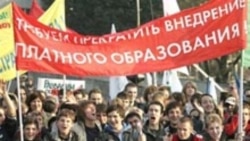
Moscow, 13 October 2005 (RFE/RL) -- Protests began in Russia's Far East region and stretched across the country throughout the day.
In Yuzhno-Sakhalinsk, the capital of the Pacific Ocean island of Sakhalin, thousands of state-paid workers gathered on the central square to demand hefty wage increases, as well as more respect for their profession.
Employees of the local history museum said they earned as little as 1,500 rubles ($55) a month, although the region is dotted with oil fields.
Amid record-high world oil prices, impoverished public-sector workers are increasingly frustrated that Russia's oil wealth largely fails to trickle down to them.
Some of the rallies called for the resignation of Andrei Fursenko, Russia's education and science minister.
The wave of demonstrations reached Moscow later during the day, with some 2,500 protesters gathering outside the Russian government headquarters under heavy police control.
Inna Bogdanova, a nurse in a Moscow hospital, said she had to work a triple shift just to be able to feed her two children.
"I'm a nurse in a emergency room. I get a salary of 5,000 rubles per month for three shifts. I have two children, and an utility bill of 2,000 rubles. Just imagine how much I have left to feed my children. We took the Hippocratic oath and we respect this oath. Just as we take care of people, we want to be taken care of, to be paid accordingly. We want justice," Bogdanova said.
This is not the first time public sector workers have staged countrywide protests and strikes. In October 2004, they managed to pressure authorities into granting them a wage increase.
Bogdanova's salary was raised by 11 percent last year. But she says this has done little to improve her living standards.
Education Minister Fursenko downplayed yesterday's protests as pointless. The government, he said, is already doing its best to aid state workers.
"I think that protests and demonstrations are appropriate when the authorities refuse to enter dialogue, when they refuse to listen to teachers' propositions and demands," Fursenko said. "It seems to me that this is not the situation today. We are in constant dialogue with trade unions, with society. The executive and legislative powers are doing everything they can, regardless of protests."
Authorities have promised to raise the wages of state-paid workers by roughly 20 percent next year.
But trade unions say the increase will still fail to meet their basic needs and accuse the government of going back on its pledge to substantially improve the lot of public sector employees.
Galina Merkulova, president of the trade union of education and science employees, says the salaries of state-paid workers need to be tripled or even quadrupled.
Speaking to protesters in Moscow, she vehemently dismissed Fursenko's assurances that the government seeks dialogue with trade unions.
"The government has chosen a very interesting and convenient tactic. Without the agreement of trade unions, they violate all principles of civilized partnership and approve the budget's parameters at their meetings, pass them on to the State Duma, which in turn approves these parameters unanimously. This does not suit us," Merkulova said.
Many students joined the protests to demand that their stipends be raised to the level of the minimum wage of 800 rubles per month.
"Destroy education and we'll lose the future," read one banner at the Moscow rally.
The average monthly wage for teachers in Russia ranges between $50 and $140 -- barely enough to feed a single person, particularly in Moscow.
Health workers earn between $70 and $175 a month, while surgeons can hope for a monthly salary of about $400.
In Yuzhno-Sakhalinsk, the capital of the Pacific Ocean island of Sakhalin, thousands of state-paid workers gathered on the central square to demand hefty wage increases, as well as more respect for their profession.
Employees of the local history museum said they earned as little as 1,500 rubles ($55) a month, although the region is dotted with oil fields.
Amid record-high world oil prices, impoverished public-sector workers are increasingly frustrated that Russia's oil wealth largely fails to trickle down to them.
Some of the rallies called for the resignation of Andrei Fursenko, Russia's education and science minister.
The wave of demonstrations reached Moscow later during the day, with some 2,500 protesters gathering outside the Russian government headquarters under heavy police control.
Inna Bogdanova, a nurse in a Moscow hospital, said she had to work a triple shift just to be able to feed her two children.
"I'm a nurse in a emergency room. I get a salary of 5,000 rubles per month for three shifts. I have two children, and an utility bill of 2,000 rubles. Just imagine how much I have left to feed my children. We took the Hippocratic oath and we respect this oath. Just as we take care of people, we want to be taken care of, to be paid accordingly. We want justice," Bogdanova said.
This is not the first time public sector workers have staged countrywide protests and strikes. In October 2004, they managed to pressure authorities into granting them a wage increase.
Bogdanova's salary was raised by 11 percent last year. But she says this has done little to improve her living standards.
Education Minister Fursenko downplayed yesterday's protests as pointless. The government, he said, is already doing its best to aid state workers.
"I think that protests and demonstrations are appropriate when the authorities refuse to enter dialogue, when they refuse to listen to teachers' propositions and demands," Fursenko said. "It seems to me that this is not the situation today. We are in constant dialogue with trade unions, with society. The executive and legislative powers are doing everything they can, regardless of protests."
Authorities have promised to raise the wages of state-paid workers by roughly 20 percent next year.
But trade unions say the increase will still fail to meet their basic needs and accuse the government of going back on its pledge to substantially improve the lot of public sector employees.
Galina Merkulova, president of the trade union of education and science employees, says the salaries of state-paid workers need to be tripled or even quadrupled.
Speaking to protesters in Moscow, she vehemently dismissed Fursenko's assurances that the government seeks dialogue with trade unions.
"The government has chosen a very interesting and convenient tactic. Without the agreement of trade unions, they violate all principles of civilized partnership and approve the budget's parameters at their meetings, pass them on to the State Duma, which in turn approves these parameters unanimously. This does not suit us," Merkulova said.
Many students joined the protests to demand that their stipends be raised to the level of the minimum wage of 800 rubles per month.
"Destroy education and we'll lose the future," read one banner at the Moscow rally.
The average monthly wage for teachers in Russia ranges between $50 and $140 -- barely enough to feed a single person, particularly in Moscow.
Health workers earn between $70 and $175 a month, while surgeons can hope for a monthly salary of about $400.

