





Prague, 16 December 2005 (RFE/RL) -- The swastika may be known the world over as the symbol of Nazi Germany and it may be banned in some states for that reason, but in Tajikistan it appears on placards, banners, and billboards with the blessing of the state.
For officials in Dushanbe, the swastika is above all a symbol of national identity. Most Tajik historians now maintain that Tajiks are of Aryan origin, and argue that Aryan or Indo-European civilization must therefore be studied and promoted. It is an argument now accepted by the state. Indeed, the revival of Aryan culture is now official policy of Dushanbe: 2006 will be celebrated in Tajikistan as the year of Aryan civilization.
Changing Interpretations
The authorities say the swastika’s now widespread adoption in Tajikistan has nothing to do with Nazism and fascism. “Throughout history, interpretations of this symbol have changed,” notes Abduhakim Sharipov, head of a department in the Soghd regional administration. He, like other officials, emphasizes the swastika is a symbol of Aryan culture that has existed for many centuries. “We all know that fascism used this symbol for its purposes. This symbol therefore carries negative connotations for many…[but] we should not limit ourselves to only one interpretation.”
When the swastika first appeared, in India, it was as a sign of eternity and eternal motion. The newer, positive connotations that the Tajik authorities want the swastika to gain were outlined two years ago by President Imomali Rakhmonov when he declared 2006 the year of Aryan culture: the aim of the year is, he said, to “study and popularize Aryan contributions to the history of the world civilization; to raise a new generation [of Tajiks] with the spirit of national self-determination; and to develop deeper ties with other ethnicities and cultures.”
Linguistically, the Tajiks are closely tied to the Persians, who since ancient times have used the term Aryan to describe themselves and their language.
The Tajik historian and ethnographer Usto Jahonov supports both the state’s desire to raise awareness of Tajikistan’s Aryan heritage and the use of the swastika. Using an argument employed by Tajik officials in numerous speeches, Jahonov contends that it is an inherent part of Aryan culture and a key to building national identity. A stronger national identity is itself “needed now because we live among [non-Aryan,] Turkic nations” that are, he says, rewriting “their history by claiming that they emerged in this area [Central Asia]. We should therefore go back to Aryan history, demonstrate and prove to others where our place is. Each nation should know its place.”
An Ancient Symbol In The Shadow Of A Modern Taboo
But it is hard to rid the swastika of its negative associations. For many people in the West, the swastika is a taboo, synonymous as it is with Nazism, fascism, and white supremacy in general. Post-war Germany outlawed the swastika and other Nazi symbols for all but scholarly purposes.
Continued sensitivities were highlighted earlier this year when Britain’s Prince Harry was criticized for wearing a Nazi swastika armband and a Nazi uniform to a fancy-dress party. The incident led to calls from German politicians for a ban on all Nazi symbols across the European Union, which was then followed by a debate in the European Commission in Brussels.
For similar reasons, the new prominence of the swastika is touching on sensitivities in Tajikistan, recently prompting a group of Tajik World War II veterans to write a letter to Rakhmonov asking him to end the use of the swastika.
The Tajik president has so far not responded.
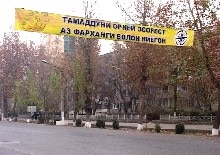
The use of the swastika by skinheads has made the symbol even more controversial in recent years.
Due to high levels of unemployment and poverty, many Tajiks have had to work as illegal migrant laborers abroad, overwhelmingly in Russia. Many have been subjected to harassment and intimidation. Several have been killed by racist groups in recent years.
The most prominent case was the murder, in February 2004, of a 9-year-old Tajik girl in St. Petersburg by a group of teenagers armed with chains, metal rods and knives. Khursheda Sultanova’s father and her 11-year-old cousin were also savagely beaten.
Divided Opinions
This and other cases have provoked public outrage in Tajik society.
For one woman interviewed, both objections to the swastika originate close to home. “My grandfather died in a battle against Nazi Germany,” she told RFE/RL, and “last year, my neighbor’s son was killed by a group of skinheads in Russia.”
“I am amazed to see [the swastika]. Why does our government recover and propagate the [hooked] cross now?”
This Tajik woman says she welcomes a rediscovery of the Tajik nation’s history. But, she argues, historians should not forget the nation’s recent past just to revive its ancient heritage.
(RFE/RL’s Uzbek Service correspondent in Tajikistan, Alisher Akhmedov, contributed to this report.)
RFE/RL Central Asia Report

SUBSCRIBE For regular news and analysis on all five Central Asian countries by e-mail, subscribe to "RFE/RL Central Asia Report."