

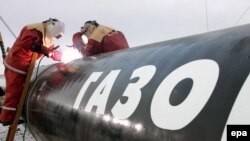
Brussels, 12 January 2006 (RFE/RL) -- The European Commission, mindful of the sensitivity of the issue, remained relatively tight-lipped during the Russian-Ukrainian standoff at the end of 2005.
It described the issue as a bilateral one, although it was clearly relieved when gas deliveries to the EU were restored after a brief interruption starting on 1 January.
The commission's reticence is easy to understand. Russia's importance as a supplier of energy can only increase.
Foreign policy -- and energy policy -- remains a matter for individual member states in the EU. And given the EU's complicated internal structure, the European Commission, the bloc's executive, has been reluctant to tread on anyone's toes.
However, the commission clearly has concerns. This was made plain by Hilde Hardeman, a senior commission official, in an address to the European Parliament's delegation for Ukraine on 11 January.
Hardeman said she trusts further gas debates between Russia and Ukraine will not affect the EU, which receives the bulk of its Russian gas supplies via Ukrainian pipelines. Still, she said it is not fully clear what last week's gas deal will mean in the long term.
"While we note that the agreement contains a fixed agreement on the pricing for transit of gas through Ukraine for a period of five years, we note that the agreement as regards the price that needs to be paid for gas entering Ukraine and consumed by Ukraine is set for a period of six months," Hardeman said. "This is something that we will continue to watch closely."
Under the deal, Ukraine this year is to receive 34 billion cubic meters for $95 per 1,000 cubic meters from an intermediary, RosUkrEnergo, which in turn will purchase gas from Russia's Gazprom as well as Turkmenistan, Uzbekistan, and Kazakhstan.
The deal guarantees the price of $95 per 1,000 cubic meters for Ukraine only for the first six months of 2006, while simultaneously setting a stable tariff for Russian gas transit for five years.
Charles Tannock, a British Conservative member of the European Parliament, was outspoken in his observations. He claimed the contents of the Russian-Ukrainian deal had been purposefully kept secret, and credited ousted Ukrainian Prime Minister Yuliya Tymoshenko with making its details public.
Tannock also noted a decision has yet to be made on transit fees for the gas that Ukraine will receive from Turkmenistan, which comprise nearly half of its deliveries from Russia.
But, Tannock said, what was most troubling was what he described as the "opaque" nature of the future intermediary, RosUkrEnergo. "Regrettably, Gazprom's export is giving up all of its interests to a very opaque company called RosUkrEnergo, which will be the sole seller of gas to Ukraine," he said. "This company is 50 percent owned by an entity Raffeisen International, which has anonymous owners, [and is] open therefore to allegations by minority shareholders in Gazprom and the Western political classes that there is the possibility of political corruption here as a result of this secret deal."
Tannock welcomed, however, the fact that Ukraine had managed to fight off Russian attempts to seize control of its pipelines. He also said Ukraine had managed to fill its considerable storage facilities with gas at 2005 prices of $50 per 1,000 cubic meters.
Russia had initially pushed for Ukraine to pay $230 per 1,000 cubic meters, arguing Kyiv should pay market rates. Hardeman said, in principle, a switch to market prices was a good step -- but should be made gradually.
"The fact that for the first time, in the issue of the transit of gas going from Russia to Ukraine and further, we see a transition from a barter system to a market-based pricing system -- we believe that this is a positive development, and a development that we should welcome," Hardeman said.
Some European Parliament deputies described the events as a "blessing in disguise" for the EU that forced it to seek to decrease its energy dependence on Russia.
The commission is now preparing a draft paper for the EU's March summit looking at the possibility of a joint pan-European energy policy that would strengthen its position in dealing with energy partners like Russia.
Hardeman said Ukraine, too, should now think of "serious reforms" in its energy sector. She noted that to produce one ton of steel, Ukraine expends five times more energy than the EU average. She promised EU help with the reforms.
However, most deputies sought to keep the spotlight on Russia. Toomas Ilves, a deputy chairman of the parliament's Foreign Affairs Committee, said the relatively positive resolution should not disguise the fact that the crisis was caused by Russia breaking an existing contract with Ukraine.
"Nonetheless, [the positive lessons do] not excuse Russian behavior and I hope that we do not look at the pedagogical and reform-instigating aspects of this breaking of a contract to justify Russian behavior, and I would hope that that part of the [EU's] rhetoric is toned down," Ilves said.
Many parliamentarians present for the 11 January debate said Russia is wielding an "energy weapon" against its neighbors, and urged a tough EU stance in response. The European Parliament, however, has no direct decision-making powers in EU foreign policy.
Gas Facts

Click on the map for an enlarged image.
- Ukraine consumes 70 billion cubic meters (bcm) of gas per year. It produces 20 bcm of its own gas, has a signed contract to import 40 bcm from Turkmenistan, and in 2005 was getting 29 bcm from Russia as payment for transit of Russian gas.
- Ukraine sells some 7 bcm of gas a year to the West and places some in underground storage facilities. These facilities can hold 34.5 bcm.
- Ukraine is the sixth-largest consumer of gas in the world and uses more gas than Poland, the Czech Republic, Hungary, and Slovakia combined.
- Russia has proven gas reserves of 47 trillion cubic meters (tcm) -- the largest in the world ahead of Iran and Qatar.
- Russia sells approximately 160 bcm to Europe each year. By 2015, Europe is expected to import 300 bcm, or 40 percent of its projected needs from Russia.
- Russia's Gazprom is the world's largest gas company. It is the only company allowed by Russian law to export gas outside the borders of the CIS. It also owns the gas-transportation system and most of the gas fields in Russia.
- The Russian state is Gazprom's majority shareholder , with a 51 percent share. The company's ownership rights changed as of the beginning of 2006, with Gazprom stock being sold on the open market. The Russian state, however, will continue to hold the majority stake.