


Prague, 15 January 2006 (RFE/RL) -- Tehran said today that diplomacy is the only way to resolve its impasse with the West over its nuclear program.
Iranian Foreign Ministry spokesman Hamid-Reza Assefi insisted openly today that Tehran will not reverse its widely criticized decision to resume nuclear research after a break of more than two years.
Assefi dismissed the threat of possible UN Security Council action against Iran. He says there is no legal basis for referring Iran to the Security Council.
Talks Are 'Dead End'
The United States and the three largest EU countries -- Germany, France, and Great Britain, or the EU-3 -- have already described negotiations with Iran as a dead-end process.
U.S. State Department spokesman Sean McCormack said it is time for diplomacy that includes the threat of economic sanctions.
"We are entering a new phase, new diplomatic phase," he said. "The EU-3 negotiations, in their own words, had reached a dead end. And they had reached a dead end because of Iranian intransigence, their failure to come clean with the [UN's International Atomic Energy Agency] IAEA, and their defiance of the international community. So that diplomatic phase has ended. We are now in a new diplomatic phase. And the elements of this phase that we see right now before us are the IAEA board of governors -- and then a subsequent referral to the [UN] Security Council."
Tehran raised the stakes in the dispute last week by removing security seals that had been placed by UN nuclear monitors on controversial Iranian equipment.
That equipment can be used to produce uranium for peaceful civilian purposes. But it also can be used to produce the kind of highly enriched nuclear material needed for weapons.
The move has prompted Britain, France, and Germany to declare that the time has come to refer Iran's case to the UN Security Council for possible sanctions.
'Tools To Defend Ourselves'
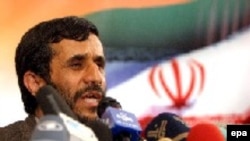
Iranian President Mahmud Ahmadinejad on 14 January held a rare press conference in Tehran aimed at reassuring the world about the recently resumed nuclear program.
Ahmadinejad said it is the right of Iran to engage in research for peaceful nuclear technology. He denied several times that Iran has any need or desire to produce nuclear weapons.
Ahmadinejad also hinted that Iran could cut or limit its oil exports to retaliate against possible moves by the United States and the European Union to seek UN sanctions.
"We have the necessary tools to defend ourselves. Those who use harsh and illegal language against Iran need relations with Iran 10 times more than we need relations with them," Ahmadinejad said.
The West fears that enriched uranium could be diverted to a nuclear-weapons program.
In Washington, U.S. President George W. Bush and visiting German Chancellor Angela Merkel on 13 January said that a country with a president like Ahmadinejad -- who says Israel should be wiped off the map -- should not be allowed to have any kind of nuclear program.
Iran's Nuclear Program

THE COMPLETE PICTURE: RFE/RL's complete coverage of controversy surrounding Iran's nuclear program.