


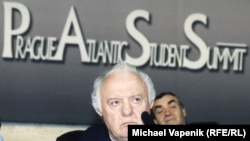
RFE/RL: Mr. President, could you please tell us about the circumstances that surrounded the signing of the Sochi [Dagomys] agreement on 22 June 1992. Critics say Georgia was forced to sign this agreement because its position at the time was very weak. Is that correct?
Eduard Shevardnadze: There was, indeed, no other way out. At the time relations between Georgia and South Ossetia had become very complicated. By the time I returned to Georgia [from Moscow in early 1992], the South Ossetians had already declared their independence. [Georgia's] Supreme Council had, of course, overturned the decision and abolished the autonomy of the South Ossetian district. This caused complications and [then Georgian] President Zviad Gamsakhurdia decided to invade the region. He had decreed general mobilization and people had started entering [South Ossetia], some with weapons, others unarmed.
To put it briefly, the Georgians were not ready for war and they were defeated. Fighting went on for a while. As you know, there is a tunnel that links South Ossetia to [Russia's southern republic of] North Ossetia. Guerillas were using this tunnel to reach South Ossetia, which was thus able to gather a large number of troops. The situation was made even more complicated by the fact that there was a rather large Russian battalion -- a helicopter battalion -- stationed in [South Ossetia's main city of] Tskhinvali. Russia had also one or two other, smaller units, in the region. There was a danger that Russian troops would interfere in the conflict. So when [President Gamsakhurdia] escaped from Georgia and I returned to the country, our main purpose was to stop military operations. I then met with [Russian] President [Boris] Yeltsin in Dagomys, near Sochi, and we agreed to put a halt to hostilities. A [Joint Control] Commission made of Georgian, Russian, and Ossetian representatives was set up to monitor the implementation of the agreement, and that was it.

RFE/RL: Shortly after, peacekeepers were sent into South Ossetia. Were you then aware of the imbalance that would exist between Georgian peacekeepers and troops from Russia, North Ossetia, and South Ossetia?
Shevardnadze: There was no other way out for us. This was the result of negotiations that had taken place between the presidents of Russia and Georgia. The main purpose [of these negotiations] was to stop the war. We stopped the war and we set up this Joint Control Commission.
RFE/RL: Fourteen years into the peace agreement, how would you assess the 3+1 format of the joint peacekeeping mission?
Shevardnadze: At any rate, peace was better than war at the time. We couldn't afford to be at war any longer. We had lost the war. My predecessor, President Gamsakhurdia, had lost the war. We did not argue about whether the peace meant a loss or a gain because we had been defeated.
RFE/RL: What do you think should be done with the existing format of the joint peacekeeping mission? Don't you think the situation has changed now?
Shevardnadze: Well, this is something that should be agreed upon with Russia. I believe the agreement with Russia is not enough now and that [the Georgian government] should now negotiate with the Ossetian side on the basis of the [Sochi] agreement. How can this be done? Where should we place our hopes? I don't know, I'm not familiar with these issues. [In August 2004] -- I think it was in [South Ossetia's ethnic Georgian village of] Tamarasheni [in Tskhinvali's suburbs] -- a Georgian unit fought South Ossetian forces and our soldiers were literally brought to their knees. This shows that we need to be seriously prepared, whether for peace or war. Frankly speaking, it is our fault. We shouldn't have entered South Ossetia in the first place.
RFE/RL: Going back to the Sochi agreement, how is it that no one thought about a withdrawal mechanism before the treaty was signed? Was it just an oversight, or [something else]?
Shevardnadze: No one was thinking about that at the time. The most important thing was to stop the war and we managed to achieve this. We also managed to set up a Joint Control Commission to regulate all this and monitor the implementation of the agreement. We couldn't have done better at the time.
RFE/RL In Russian

UPDATED CONSTANTLY: Visit RFE/RL's Russian-language website, featuring news, analysis, features, streaming audio, and more, in Russian, from RFE/RL's Russian Service.