



PRAGUE, March 7, 2006 (RFE/RL) -- Critics cite a list of minority groups that face discrimination from Turkmenistan's authorities -- including being forced to study in Turkmen language, adopt Turkmen national clothing, and essentially foresake their own ethnic roots. Such groups make up an estimated 15 percent of the country's 5 million people.
But foreign diplomats -- especially from Western countries -- are generally wary when visiting Turkmenistan. Aside from common protocol for dealing with the country's authoritarian leadership, there are other concerns. Turkmenistan is located in a politically strategic area -- neighboring Iran, Afghanistan, Uzbekistan, Kazakhstan, and the energy-rich Caspian Sea. Turkmenistan itself is also rich in oil and natural gas.
Its strategic geopolitical location and its wealth of hydrocarbon resources has prompted some to question whether foreign officials have not been giving the Turkmen government a free ride.
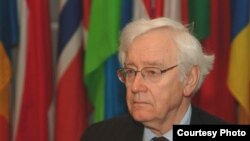
OSCE minority-rights monitor Ekeus's words on the first day of his visit were similarly cautious.
"I think we have started very well, and I hope we can continue the matter of the integration of the society, development of the state language, [and] protection also of the smaller languages," Ekeus said. "So we think we can move forward in this area."
Ekeus later hinted that President Niyazov might have sought to sidetrack the OSCE from the stated purpose of his visit.
"The president [Niyazov] has discussed very important issues of energy, [and] of security, and we have discussed issues of significance also concerning the minority situation, and education and language issues."
Looking For More
Farid Tuhbatullin is a former environmental activist in Turkmenistan whose criticism of the government helped land him in jail. International rights groups publicized his case, and he was eventually released. Tuhbatullin is now the head of Turkmenistan section of the International Helsinki Foundation for Human Rights.
He contends that Turkmen authorities have prevented Ekeus from seeing the true situation of ethnic minorities through selective access to those groups and their representatives.
"Unfortunately he has been in Turkmenistan several times, but our information [suggests] that they practically haven't let him meet freely with representatives of ethnic minorities," Tuhbatullin says.
Lack Of Respect?
Tuhbatullin points out basic indications that minority rights are not respected in Turkmenistan -- beginning with schooling for two of the country's largest ethic minority groups, ethnic Uzbeks and Kazakhs.
"The largest national diaspora [in Turkmenistan] is of course the Uzbeks, who live in the north and east of Turkmenistan," Tuhbatullin says. "We know that Uzbek schools are closed now; there is no possibility of studying in Uzbek language. It is the same situation with the [ethnic] Kazakhs -- that is, Kazakh schools also do not work anymore, and that has forced many representatives of the Kazakh nationality from the country."
Tuhbatullin also mentions the small Baluchi minority in Turkmenistan. He notes that when Turkmenistan was still a Soviet republic, that group had a greater opportunity to use its native language.
Ethnic Russians have complained of their official treatment, as well. The Turkmen government's decision to cancel a dual-citizenship agreement with Russia in 2003 led many ethnic Russians to leave Turkmenistan. It also drew the attention of the Russian State Duma over the plight of ethnic Russians who chose to remain in Turkmenistan.
Turkmenistan's ethnic Russians have since encountered considerable obstacles to studying -- and even enjoying entertainment, in the Russian language. Russian television is difficult to receive in Turkmenistan, and Russian-language radio station Mayak was taken off the air.
International Effectiveness
Tuhbatullin argues that while groups like the OSCE raise the topic of discrimination, the Turkmen government seems to ignore such concerns with impunity.
"Unfortunately, I haven't seen any results from these visits from the OSCE or any other intergovernmental organizations," Tuhbatullin says. "They haven't produced any [critical] documents."
Ekeus, meanwhile, encouraged Turkmen officials to afford greater respect for minorities. His wording was delicate, however, suggesting simply that "there is always more to be done."
(RFE/RL's Turkmen Service contributed to this report.)
Central Asia In Focus

THE COMPLETE STORY: Click on the icon to view a dedicated webpage bringing together all of RFE/RL's coverage of Kazakhstan, Kyrgyzstan, Tajikistan, Turkmenistan, and Uzbekistan.