




Milosevic was facing trial at the war crimes court on more than 60 counts, including genocide and crimes against humanity for his role in the Balkan wars, including the 1995 massacre of 8,000 Muslims at Srebrenica.
The International Criminal Tribunal for the former Yugoslavia said Milosevic, in the fifth year of his trial on charges of war crimes, crimes against humanity and genocide, died in his cell, apparently of natural causes. (For comment on Milosevic's health, click here.)
Milosevic's trial began on February 12, 2002 , but a heart condition and high blood pressure have repeatedly interrupted the proceedings.
The Defense Was Nearly Finished
Milosevic was defending himself and had refused to cooperate with court-appointed lawyers.
He pleaded not guilty to all counts, saying that he wasn't responsible for ordering killings and rapes. He had used up more than four-fifths of the 150 days allotted for his defense, suggesting the case could be wrapped up in the next few months barring any new delays.

A Bosnian Serb at a cemetery for 3,000 people killed during the Bosnian war in the town of Bratunac in 2005 (epa)
Russian Foreign Ministry spokesman Mikhail Kamynin said in January that Russia was ready to provide all necessary guarantees:
"Russia has presented the International Tribunal for the former Yugoslavia with the necessary package of documents, on the basis of which the tribunal should decide to free Milosevic temporarily for a trip to Russia for treatment," Kamynin said. "Besides, Milosevic himself has given guarantees to the tribunal that he will return to The Hague immediately after the completion of his treatment."
Medical Care In Jail Reported Adequate
Chief UN war crimes prosecutor Carla del Ponte said in January Milosevic had good doctors in the Hague.
"Milosevic has very good doctors in The Hague and all that he needs for his health," del Ponte said. "He can have it even in the detention unit...."
Milosevic's brother lives in Russia, and prosecutors suspect his wife and son do too. The prosecution had opposed his release, fearing he could say his health stopped him from traveling back to The Hague.
Milosevic used delaying tactics in The Hague. and they seem to have worked. He was never sentenced for the crimes he had allegedly committed.
Initial Reaction
French Foreign Minister Philippe Douste-Blazy said today just after news of Milosevic death was confirmed that "one of the main actors, if not the main actor, in the Balkan wars of the late 20th century" has died.
Serbia-Montenegro Foreign Minister Vuk Draskovic said today it was a shame that Milosevic did not face justice in his homeland, considering that he had harmed many Serbs.
Milorad Vucelic, vice president of Milosevic's Serbian Socialist Party (SPS) told RFE/RL today from Belgrade the the ICTY itself is to blame for Milosevic's death.
"It is clear that those who killed him confirmed his death," Vucelic said. "It is not my exaggeration. As you know, according to medical evidence, he asked to go for medical treatment in Russia. The Hague tribunal refused his request and killed Slobodan Milosevic."
Who Was Milosevic?
Slobodan Milosevic dominated Balkan politics throughout the 1990s, and since February 2002, he has been on trial for crimes against humanity and war crimes during the 11 years of his rule.
Just six years after he became president of Yugoslavia, in May 1989, Milosevic was instrumental in initiating, continuing, or guiding conflicts in Croatia (1991) and Bosnia (1992). Many thousands died, over 8,000 of them on the site of the worst massacre in Europe since World War II, at Srebrenica. Those wars ended when the Dayton peace agreement was signed in 1995, and for a time it seemed he might be overthrown.

Milosevic during a visit to Kosovo in 1997 (epa)
Milosevic became a test case for an international justice system eager to hold accountable some of those guilty of genocide in the Balkans and in Rwanda, but it was only in March 2001 that the new Serbian government allowed him to be brought to court. Milosevic was charged with 66 counts of genocide, crimes against humanity, and war crimes. In Serbia, he was also suspected of the murder of many of his critics, including that of Ivan Stambolic, his one-time mentor and Serbian president.
See also:
Interview: Analyst Comments On Milosevic's Health
UN War Crimes Tribunal Statement On Milosevic's Death
Croatia's President Comments
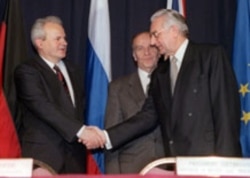 Slobodan Milosevic (left) shakes hands with Croatian President Franjo Tudjman after the signing of the Dayton peace accord in Paris on 21 November 1995 (epa)
NO COMPROMISES: On September 20, 2004, Croatian President STIPE MESIC gave an extensive interview to RFE/RL's South Slavic and Albanian Languages Service in which he discussed the history of the collapse of Yugoslavia, as well as the 1990s Balkans conflicts and Slobodan Milosevic's role in them (the complete interview in Croatian).
During this period, Mesic enjoyed a stormy relationship with Franjo Tudjman, who was Croatia's president at the time. Mesic was one of several prominent moderate Croats who did not hide his disapproval of the 1993-94 Croatian-Muslim conflict in Bosnia. Many observers held Tudjman responsible for that conflict, since he seemed bent on partitioning Bosnia with Serbian President Slobodan Milosevic and establishing a greater Croatia.
Asked whether he, as the last president of the second or communist-era Yugoslavia, feels some responsibility for the demise of that state, Mesic told RFE/RL that it was clear to him when he arrived in Belgrade in 1991 to try to take up the rotating chair of the eight-member Yugoslav presidency that federal Yugoslav institutions had ceased to function. The solution, he felt, was to reach a new political agreement. The presidency consisted of representatives of the six republics -- Slovenia, Croatia, Bosnia, Serbia, Montenegro, and Macedonia -- plus the Serbian autonomous provinces of Kosovo and Vojvodina, which enjoyed a legal status close to that of the republics under the 1974 constitution.
But, Mesic argued, Milosevic did not want such a compromise. Instead, Milosevic sought to break up Yugoslavia and create a greater Serbia. In the course of carrying out his plan, Mesic charged, Milosevic indulged in genocide and other war crimes, and for that he was brought before the Hague-based war crimes tribunal.
Milosevic never gave Mesic the opportunity to lead the country to a compromise solution, because the Serbian leader and his three allies on the presidency prevented the Croat from taking over the rotating chair.
Mesic was supported by the representatives of Slovenia, Bosnia, and Macedonia, all of which were to declare their independence in the following months when it became clear that Milosevic was interested in controlling the federation and would destroy it if he could not dominate it. (Patrick Moore)
See also:
Timeline: The Political Career Of Slobodan Milosevic
Slobodan Milosevic's Life And Legacy

THE COMPLETE PICTURE: An archive of RFE/RL's coverage of the trial of former Yugoslav President Slobodan Milosevic.
Of related interest: