



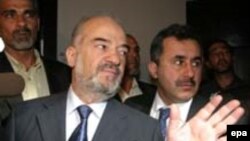
Opposition to Ibrahim al-Ja'fari's nomination to serve another term as prime minister is growing within his own alliance, RFE/RL's Radio Free Iraq (RFI) reported on April 2. Rumors swirled for weeks over growing opposition to al-Ja'fari's nomination among some factions within the United Iraqi Alliance (UIA). Now, it appears that four out of seven factions within the UIA have come out against al-Ja'fari. In a bold move, two high-profile Shi'ite leaders broke the silence and called on al-Ja'fari to step aside in the interest of national unity.
Qasim Dawud, an independent parliamentarian aligned with the UIA, told RFI in an April 2 interview that al-Ja'fari's refusal to step aside is derailing efforts to form a national unity government.
Dawud said talks are under way within the UIA to nominate a new candidate. "I represent a very broad stream within the Alliance that supports this policy [of choosing nominees other than al-Ja’fari]. A number of friends have expressed their attitudes, and I await a clear official stance to be formed in a few coming days. That should lead to a revised choice of a new nominee [instead of al-Ja’fari] who would form the Iraqi cabinet," claimed Dawud.
Shi'ite parliamentarian Jalal al-Din al-Saghir also called on al-Ja'fari to step aside in an April 2 interview with Reuters, saying the nominee to the premiership "ought to secure a national consensus from other lists and also international acceptance."
Islamic Virtue Party member and parliamentarian Hasan al-Shammari said on April 2 that the UIA has formed a committee that will survey the opinions of the parties to the alliance and present a report to the UIA detailing the best way to proceed.
According to Iraqi media reports over the past week, the UIA is considering three options: maintaining its nomination of al-Ja'fari; nominating another candidate; or leaving the nomination of a candidate to the Council of Representatives.
For his part, al-Ja'fari has maintained that he will not cede the nomination. UIA parliamentarian and al-Ja'fari supporter Haidar al-Abadi told Al-Arabiyah television in an April 1 interview that the UIA continues to support the prime minister. "Two days ago, all the blocs comprising the UIA met and unanimously expressed adherence to the mechanism which led to the nomination of Dr. Ibrahim al-Ja'fari for the prime minister's post," said al-Abadi. "These blocs adhere to the nomination and consider al-Ja'fari the UIA's only candidate."
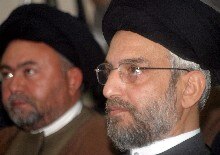
Abd al-Aziz al-Hakim, the head of the Supreme Council for the Islamic Revolution in Iraq (SCIRI)
The UIA, which comprises the two main Shi'ite political parties -- the Supreme Council for the Islamic Revolution in Iraq (SCIRI) and al-Ja'fari's Islamic Al-Da'wah Party -- as well as five smaller political factions, fractured under transitional rule, prompting several prominent party members to leave and form their own parties ahead of the parliamentary election in December.
With control over Iraq's first permanent post-Saddam Hussein government at stake, and all that comes with that – federalism, possible amendments to the constitution, determining the status of Kirkuk, and the status of multinational forces – al-Ja'fari's supporters within the UIA may defect in protest if the UIA repeals its nomination.
Should al-Ja'fari's Islamic Al-Da'wah Party leave the UIA, he would likely be joined by the supporters of the cleric Muqtada al-Sadr and a few independents, which would equal a loss of about 70 seats for the UIA, roughly more than half its current number in parliament.
Should that happen, an alliance comprised of the Kurdistan Coalition List, Iyad Allawi's Iraqi National List, and the Sunni-led Iraqi Accordance Front and five smaller political parties would be left holding a plurality -- and possibly a majority -- in parliament, controlling between 122 and 143 of the 275 seats.
SCIRI, led by Abd al-Aziz al-Hakim, would fight a breakup of the UIA, as it would weaken the party's ability to influence the political scene. In light of the statements against al-Ja'fari, the damage may already be done.
