



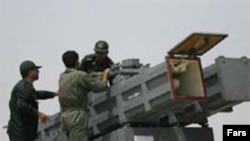
Iran's long coastline -- approximately 2,400 kilometers in the south -- affects its military outlook, Defense Minister Mustafa Mohammad Najjar said during an early January visit to the southern port city of Bandar Abbas.
"One of the strategies of the Defense Ministry is to promote our operation and combat forces' capabilities in the sea," he said. It would achieve this, he said, by building ships and submarines and through cooperation with the gulf's littoral states. Najjar went on to say that the navy applies creative and innovative methods, uses asymmetric warfare, and depends on domestically-made products.
Later that same month, an Iranian military official stressed "denial of access" and said the United States is very vulnerable at sea. Mujtaba Zolnur, a high-ranking official at the Islamic Revolution Guards Corps (IRGC), continued: "This is another weak point of the enemy because we have certain methods for fighting in the sea so that war will spread into the Sea of Oman and the Indian Ocean," "Aftab-i Yazd" reported on January 23. "We will not let the enemy inside our borders."
General Yahya Rahim-Safavi, IRGC commander, said in summer 2005 that the plans of the corps' navy include confronting aggressors by using asymmetric warfare and by improving power- projection capabilities, "Siyasat-i Ruz" and "Kayhan" reported on June 8.
Protecting Bases And Oil Fields
A total of 38,000 men serve in Iran's conventional navy and the Islamic Revolution Guards Corps navy, and these forces are believed to have a significant capacity for regular and asymmetric naval warfare.
Rahim-Safavi added that the navy wants to improve its missile systems and its surveillance capabilities, and it wants to strengthen its defense of Persian Gulf islands.
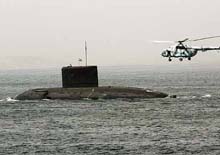
An Iranian submarine participating in exercises in the Persian Gulf this month (Fars)
Tehran has occasionally threatened to use mines to block the Straits of Hormuz, described by the U.S.'s Energy Information Administration as "By far the world's most important oil choke point." In February 2005 congressional testimony, the Defense Intelligence Agency director, Vice Admiral Lowell Jacoby, addressed this possibility by saying that Iran would rely on a "layered strategy" that uses naval, air, and some ground forces to "briefly" close the straits. Iran's purchase of North Korean fast-attack craft and midget submarines improved this capability, he said.
Missiles are important for "area denial" as well. Iran compensates for limited air power and surface-vessel capabilities with an emphasis on antiship missiles. Four of these systems were obtained from China -- the long-range Seersucker missile, as well as the CS-801, CS-801K, and CS-802 antiship missiles. There are reports that Iran has purchased Ukrainian antiship missiles. Most commercial shipping is within range of missiles based on Iranian islands in the Persian Gulf.
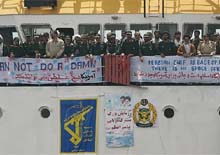
Iranian naval officers observing military exercises in the Persian Gulf earlier this month (Fars)
As the Persian Gulf war games continued and Iran demonstrated new types of equipment, Tehran sought to reassure the international community of its benign intentions. Foreign Minister Manuchehr Mottaki said on April 4 that the country's military doctrine is essentially defensive, IRNA reported.