




All the officials involved in the search for a solution to the Karabakh conflict, whether representing the conflict sides or the mediators, have remained tight-lipped in recent months over the precise issues under discussion. That atmosphere of confidentiality has been alleviated only by occasional enigmatic statements and disclosures. But the intensification of the Minsk Group's efforts in the wake of the February talks in Rambouillet also reflects a growing sense of urgency.
Upcoming Elections
Armenia is scheduled to hold parliamentary elections in 2007, and presidential elections are due in both countries in 2008. In the run-up to those elections, neither leadership dare agree to a humiliating concession that could alienate voters. For that reason, the Minsk Group co-chairs desperately want the two sides to agree on at least a preliminary draft accord before the perceived "window of opportunity" closes at the end of this year.
While the notion of a "window of opportunity" is now in question, it does reflect a very real linkage between the peace talks and the electoral cycle of all parties involved. And that linkage in turn reveals the rather troubling failure of both the Armenian and Azerbaijani governments to adequately engage and prepare their societies for any possible settlement.
A second disturbing factor is that the leadership of the unrecognized Nagorno-Karabakh Republic (NKR) remains dangerously excluded from the top-level negotiations, relying instead on Armenian "good faith" and prudence to defend their interests. It seems only natural to presuppose at least a degree of divergence in the national interests of Armenia and Nagorno-Karabakh.
But notwithstanding "windows of opportunity," the ongoing talks and meetings are important in themselves to maintaining a degree of dialogue and engagement, and in demonstrating to the population of both countries their respective leaders' commitment to resolving the conflict on the most advantageous terms possible.
Meetings
As noted above, two meetings within four months between Presidents Kocharian and Aliyev failed to yield progress on the most intractable difference between the two sides. "The issue the two presidents discussed and tried to solve is very complicated indeed," RFE/RL's Armenian Service quoted Armenian Foreign Minister Oskanian as telling journalists in Yerevan on June 6. "This was the same issue that was put before the presidents at Rambouillet. It wasn't solved then and it wasn't solved now either."
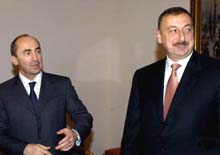
Kocharian (left) and Aliyev have met several times over the last year (Photolur)
Oskanian failed to identify the pivotal issue that is precluding progress in the peace process, but statements by other officials substantiate the hypothesis that the nexus of the problem lies in the concessions each side is, or is not, ready to make.
Most analysts assume that the variant currently under discussion is that originally proposed in late 2004 by NATO Parliamentary Assembly President Pierre Lellouche and former Spanish Foreign Minister Ana Palacio. That plan envisages a compromise settlement that would give Armenia temporary control of the unrecognized NKR in exchange for the withdrawal of Armenian forces from Azerbaijani territory, with the final status of Karabakh to be determined by its inhabitants in a referendum in five or 10 years' time. The International Crisis Group unveiled a similar plan last fall.
Solutions, Concessions
The major obstacle to either of those plans is that Azerbaijani officials have repeatedly ruled out any solution that does not preserve the country's territorial integrity. They would therefore be reluctant to permit a referendum on the future status of the NKR in which the predominantly Armenian population would doubtless opt for independence. Indeed, the current constitution of the Azerbaijan Republic expressly precludes holding a referendum on altering the country's borders. On June 6, ArmRadio.am, as cited by Groong, quoted Mammadyarov as stressing that point, and also as arguing that not only the Armenian population of Nagorno-Karabakh, but also its former Azerbaijani community, should be given autonomy under any peace settlement.
As for Armenia, the real question is whether, when, and in return for what reciprocal concession from Azerbaijan it should relinquish its sole bargaining chip by withdrawing from the seven districts of Azerbaijan contiguous to the NKR that have been occupied by Karabakh Armenian forces since 1993. Yerevan reportedly has no objection to freeing five of those districts -- Jebrayil, Fizuli, Zangelan, Agdam and Gubadla -- but has been reluctant to cede control of the strategic Lachin corridor that serves as the sole overland road link between the NKR and Armenia, or the neighboring Kelbajar district. (Retaining such a lifeline is one of the three key tenets of the Armenian negotiating position.)
U.S. Deputy Secretary of State Daniel Fried's comment in Bucharest on June 5 that "we would like to see the return of as much territory as possible to Azerbaijan as soon as possible and the return of Azerbaijanis to their native villages" implies precisely such a disagreement between the two sides over how many districts Armenia will cede and the time frame for doing so. And the Karabakh leadership may well take a harder line than Yerevan on any withdrawal from occupied territory, thereby narrowing the Armenian room for maneuver.
In that respect, progress in resolving the conflict may ultimately hinge on the ability of the OSCE -- or the international community in general -- in providing long-term guarantees (in the form of an international peacekeeping force) of the security of both the Armenian population of Nagorno-Karabakh and the Azerbaijanis who will be enabled to return to the villages in surrounding districts from which they fled in 1992-93.
The Nagorno-Karabakh Conflict
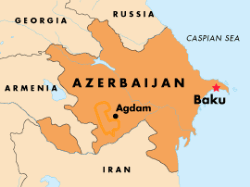 Click on the image to view an enlarged map of the Nagorno-Karabakh conflict zone
In February 1988, the local assembly in Stepanakert, the local capital of the Azerbaijani region of NAGORNO-KARABAKH, passed a resolution calling for unification of the predominantly ethnic-Armenian region with Armenia. There were reports of violence against local Azeris, followed by attacks against Armenians in the Azerbaijani city of Sumgait. In 1991-92, Azerbaijani forces launched an offensive against separatist forces in Nagorno-Karabakh, but the Armenians counterattacked and by 1993-94 had seized almost all of the region, as well as vast areas around it. About 600,000 Azeris were displaced and as many as 25,000 people were killed before a Russian-brokered cease-fire was imposed in May 1994.
CHRONOLOGY: For an annotated timeline of the fighting around Nagorno-Karabakh in 1988-94 and the long search for a permanent settlement to the conflict, click here.
 Click on the icon to view images of the Nagorno-Karabakh conflict (Flash required)
To view an archive of all of RFE/RL's coverage of Nagorno-Karabakh, click here.