



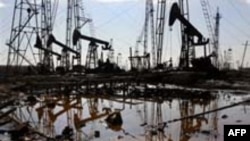
What could possibly be wrong? With oil now pouring through the multibillion-dollar Baku-Tbilisi-Ceyhan pipeline and the Baku-Tbilisi-Erzerum gas pipeline just weeks from inauguration, Azerbaijan stands on the brink of colossal wealth.
President Ilham Aliyev says he expects the pipelines to generate $140 billion over the course of the next 20 years. Even if energy prices do fall from their present dizzying heights, few would contest the figures.
Yet this week, the IMF issued a distinctly downbeat appraisal of the country's economic performance. Vitali Kramarenko, a senior economist in its Middle East and Central Asia Department, warned that the economy was in danger of overheating.
"The problem is that the government is increasing expenditure at exceptionally high rates. For the first half of 2006, expenditure increased by more than 70 percent in nominal terms compared with the first half of 2005. This causes over-heating because the supply side of the economy cannot respond to the increased demand," Kramarenko said.
And that in turn is driving inflation. "The inflation rate predictably increased from about 5.5 percent in December 2005 to about 10.2 percent in August 2006 and our forecast is that the inflation rate will continue to climb," Kramarenko said.
Complacency
Inglab Akhmadov of Azerbaijan's independent Public Finances Monitoring Center agrees. He believes the oil wealth is inducing a dangerous sense of complacency -- and providing fertile ground for the further spread of corruption. He questions whether the boom has provided any jobs outside the energy sector and warns that Azerbaijan stands on the brink of Dutch disease.
"We are at the beginning of Dutch disease's negative impact on Azerbaijan's economy because we observe trends in our national currency. We're observing a very big inflation process in Azerbaijan," Akhmadov said. "And we observe a lot of problems in the non-oil sector and business climate for all other sectors in Azerbaijan. It means we have all of the classical attributes of Dutch disease but unfortunately it is just the beginning of this process."

Azerbaijani President Ilham Aliyev at the starting point of the Baku-Tbilisi-Ceyhan pipeline (AFP)
"The Dutch disease refers to a situation when all of a sudden a country begins exporting a huge amount of natural resources relative to the size of its economy. This produces pressure on the currency. If you don't take steps to combat this, as oil exports start to boom your currency, in this case the manat, will rise against the dollar," Rusekas said. "If that happens, anything else that anyone else in your country is hoping to export becomes uncompetitive and all of your imports all of a sudden become twice as expensive in dollar terms. The only thing that the country can possibly export is the natural resource that led to the problem to begin with."
Oil Fund
The government of Azerbaijan is playing down the problem. It is hardly surprising, it says, that it is facing these problems now as the revenues from oil and gas start to boom.
But Azerbaijan is not a one-branch economy, it insists, and it is taking measures to ensure transparency in the energy sector and to ease the threat of inflation. It cites, for instance, the creation of the State Oil Fund (SOFAR) in 2001, which puts aside a share of the energy profits for long-term investment in public infrastructure and social welfare projects.
Akhmadov welcomes SOFAR, whose coffers now contain around $1.6 billion, but complains of a lack of public accountability -- a problem that he says is symptomatic of the government's handling of the entire economy.
"This is a very big challenge for the government to demonstrate transparency of its activities and transparency of vision of the situation and to insure some relevant infrastructure in society, especially to insure some control of government -- both domestic control and of course extra control from other governments' bodies and especially from civil society of these very big investment projects," Akhmadov says.
For the moment, though, Akhmadov says he sees no sign of this happening. He's not alone. The IMF is also calling for better governance and measures to improve the business climate, but Kramarenko says he is optimistic that Azerbaijan is still well-placed to benefit from its natural resources. The key, though, to future prosperity, he says, is to increase productivity now in the non-energy sector.
"To solve this problem one needs to increase the productivity of domestic producers so as to make it possible for them to withstand greater competition," Kramarenko says. "But also, one might think whether the speed of spending should be adjusted because it is the source of real exchange rate appreciation and by reducing a little bit the speed of increase in spending the government could make it easier for local producers to adjust."
Easier said than done, of course. And at a time when so many in Azerbaijan are still hell-bent on cashing in on the oil boom perhaps a bit like whistling in the wind.
RFE/RL In Azeri

Visit RFE/RL's Azeri-language website, featuring news, analysis, features, streaming audio, and more in Azeri, courtesy of RFE/RL's Azerbaijani Service.