

Tuesday, February 14, 2012


Uzbekistan

EU Expects Concrete Steps From Uzbekistan

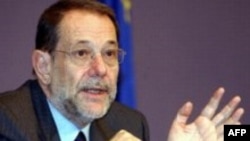
Javier Solana, the EU's foreign policy chief (file photo) (AFP)

BRUSSELS, November 14, 2006 (RFE/RL) -- Javier Solana, the European Union's foreign policy and security chief, today suggested the bloc could eventually ease its sanctions on Uzbekistan if the latter takes concrete steps to improve its human rights record.

TEXT SIZE - +

The Council of the EU on November 13 voted to extend for another 12 months the arms embargo imposed on Uzbekistan following the refusal of President Islam Karimov to let the bloc investigate last year's bloody military crackdown in Andijon. 


The bloc also decided to extend for a further six months a visa ban imposed on 12 Uzbek officials whom it holds responsible for the bloodshed. 


However, it voted to resume what it calls "technical meetings" with Karimov's government.


Solana told RFE/RL in Brussels that the decision was made possible after Uzbekistan took a number of steps toward the EU, which says it remains "profoundly concerned" by the human rights situation in that country. 


"We have to see that this acceptance in theory is really accepted in practice," Solana said, continuing that "if that is the case we will modify some of these sanctions."  


Solana did not elaborate on the "decisions" made by Uzbekistan. 


But earlier reports said Tashkent had agreed to initiate a human rights dialog with the EU and accepted to open bilateral expert-level talks on the events in Andijon last year.


Uzbek authorities say 187 people were killed in Andijon after what they describe as foreign-funded Islamists took control of the city.


Rights groups in turn say government troops killed hundreds of unarmed civilians while reasserting control over Andijon.

Aftermath Of Andijon


A dedicated webpage bringing together all of RFE/RL's coverage of the events in Andijon, Uzbekistan, in May 2005 and their continuing repercussions.



CHRONOLOGY

 An annotated timeline of the Andijon events and their repercussions.

You Might Also Like

Video Love It (Or Hate It), It's Valentine's Day

Valentine's Day, the Western holiday celebrating love, has become a global phenomenon over the past two decades. The fall of communism and the emergence of the Internet have helped February 14 become something of an unofficial international day of romance. However, not all the passions the holiday stirs are related to love. While some countries have openly embraced the holiday, others are attempting to ban it or replace it with local customs. More

Video Yo! Turkmen Rappers Flip The Script On Repression

For a growing number of Turkmen youth, rap music has become a way to express their daily struggles and inspire political change in one of the world's most oppressive countries. More

Turkmenistan's Personality Cult 2.0

Turkmen Gurbanguly Berdymukhamedov appears to be building a personality cult to match that of his eccentric predecessor. More

Most Popular


Being Discussed Now

Iranian Bomber Wounded In Bangkok

Latest Comment (1 total)

arash: As I've said before this terrorist regime must be thrown out of the ... More

Kosovo Serbs To Vote In Referendum

Latest Comment (4 total)

Eugenio: Ah, Alija, your open-hearted admission of desire to cleanse the ethnic Serbs from ... More

U.S. Hearing On Balochistan Raises Hackles, Awareness In Pakistan

Latest Comment (11 total)

Mah: Really? You wanna divide Balochistan? That's the outrageous idea I've heard so far. ... More