




The Assembly of Experts has the power to dismiss the country's highest-ranking political and religious figure, the supreme leader, and appoint a replacement. But even beyond statutory powers, victory in the Assembly of Experts race will either cement the fundamentalists' hold on Iran's elected institutions or initiate the reformists' return to political relevance.
Would-Be Candidates
The Assembly of Experts has 86 members, all of them clerics. The field of candidates for the December 15 election has fallen sharply over the past month, according to figures from the chamber that vets the hopefuls. A Guardians Council spokesman, Abbas Ali Kadkhodai, announced recently that there were 144 eligible candidates, "Iran" newspaper reported, before raising that figure by one several days later, according to state television. That represents less than 30 percent of the 492 prospective candidates Kadkhodai mentioned in mid-October.

Guardians Council spokesman Abbas Alsi Kadkhodai (Fars file photo)
Kadkhodai said that three incumbents had been rejected, although he did not identify them. According to the conservative daily "Kayhan" on November 15, they are: Majid Ansari, Ali Urumian, and Mohammad Reza Abbasi-Fard. But the daily "Aftab-i Yazd" reported on October 21 that Urumian withdrew, citing a shortage of funds.
The candidate disqualifications are likely to dominate headlines in Tehran for some time, but a prominent issue in the weeks before that announcement was the creation of election coalitions.
The final results are expected on November 28, after rejected individuals have had a chance to appeal.
The announcement by the Guardians Council has already elicited protests. A former speaker of parliament, Hojatoleslam Mehdi Karrubi, wrote to Assembly of Experts speaker Ayatollah Ali Meshkini asking him to resolve the situation. Karrubi noted the inconsistency of disqualifying a man (Abbasi-Fard) who was not only an incumbent but also a former member of the Guardians Council, "Aftab-i Yazd" reported on November 15.
Reformist Coalition
The candidate disqualifications are likely to dominate headlines in Tehran for some time. But a prominent issue in the weeks before that announcement was the creation of election coalitions. Much of the discussion centered on who would appear on the respective candidate lists backed by the reformists, the conservatives, and the fundamentalists.

Assembly of Experts head Ayatollah Ali Meshkini at an assembly session in August (epa)
The center-right Moderation and Development Party (Hezb-i Etedal va Toseh) announced that it will not participate in any coalition, the short-lived daily that aspired to succeed the former reformist newspaper "Sharq" before authorities effectively shut it down, "Ruzegar," on October 16. But it has signaled support for any group that backs the Assembly of Experts' deputy speaker, Ayatollah Ali-Akbar Hashemi-Rafsanjani, and Hojatoleslam Hassan Rohani. "Ruzegar" said that such hesitation highlights the Moderation and Development Party's indecision. It suggested that it was seeking to sustain itself by siding with the ultimate winners.
Hard-Line Splits?
Coalition efforts were also affected by long-standing disputes between older and more traditional conservatives, on the one hand, and younger and more radical fundamentalists. Reports emerged in late-October that a group called the Elite of Seminaries and Universities had been created to back Ayatollah Mesbah-Yazdi. This was described by one newspaper, "Etemad-i Melli" on October 30, as a "third movement." The paper noted reformist concerns that the new group could come to dominate the assembly.
The Elite of Seminaries and Universities allegedly rejects the list of traditional seminarian candidates, "Kargozaran" reported on November 1. The editor of Mesbah-Yazdi's "Parto Sokhan" weekly, Qassem Ravanbakhsh, explained that "some of the independent candidates are more qualified than those names that have appeared on the lists."
Ultimately, coalition formation may not have much impact when there are so few candidates. Realistically, it does not appear that the Assembly of Experts race will be very competitive.
The lack of choice could reduce voter enthusiasm.
But the fact that municipal councils are being elected the same day could boost turnout figures. The competition for those seats appears to be more intense, and there might be greater flexibility in candidate vetting on the municipal level.
If voter participation is high as a result, officials are likely to tout these elections as a sign of support for the current system.
The Iranian Revolution
 Iranians demonstrate in Tehran on February 10, 1979, shortly after the return to Iran of Ayatollah Ruhollah Khomeini (epa)
 THE ISLAMIC REPUBLIC: Iran's 1979 revolution ended 2,500 years of monarchy and established the world's first modern theocracy. In February 2004, on the 25th anniversary of that event, RFE/RL produced a special report on how the ensuing years have measured up to the expectations of those times.
"I had been freed from jail in those days, and I hoped that the [revolutionary] forces would bring democracy and progress for the country, despite the religious leadership that caused some doubts, I hoped that the press would be free, the books would be published without censorship, [political] parties, associations and civil society organizations would be formed, and I hoped that I would be able to write freely. In fact, in these 25 years, I have not seen anything but the death and silencing of those beautiful hopes and dreams," Faraj Sarkouhi, an exiled writer and journalist, told RFE/RL....(more)
ARCHIVE
RFE/RL's reporting on Iran.
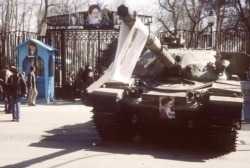 A tank bearing a portrait of Ayatollah Ruhollah Khomeini takes up a position in Tehran on February 12, 1979 (epa)