




Hadad-Adel's statement signaled further moderation in rhetoric between the two sides.
Hadad-Adel welcomed what he called a "change of tone" from Britain in the standoff.
Hadad-Adel, speaking to Iranian media as he left for Pakistan, said Britain's actions and statements over the past few days are more "inclined toward negotiations."
His comments came after Britain said it favored direct talks with Iran to resolve the dispute.
Ongoing Negotiations
British Prime Minister Tony Blair's office on April 3 issued a statement saying that "further contacts" between London and Iran have taken place, including direct talks with Ali Larijani, the head of Iran's Supreme National Security Council.
Iran's IRNA news agency today reported that the direct talks involved Larijani and Prime Minister Tony Blair's chief foreign policy adviser, Sir Nigel Sheinwald.
Iranian President Mahmud Ahmadinejad is due to hold a news conference today during which he is expected to make comments on the crisis. The conference was first scheduled for April 3, but it was subsequently postponed.
New pictures were released on April 3 of the detained British personnel, showing them in tracksuits and playing chess, a change from the previous video releases which showed them "confessing" to trespassing into Iranian waters.
The standoff has come at a perilous time for Iran's relations with the West, with the United States refusing to rule out military action over the Iranian nuclear program and the United Nations imposing new sanctions.
Bush Says 'No Quid Pro Quos'
In Washington, U.S. President George W. Bush insisted there should be no "quid pro quos" with Iran, when asked if five Iranians detained in January by U.S. forces in northern Iraq on suspicion of supporting insurgents should be freed to favor a possible release of the Britons, whom he referred to as "hostages."
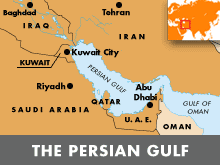
Iranian state media today reported that a Tehran envoy is to be allowed to meet the five Iranians detained by U.S. forces. It would be the first such consular visit allowed since the men were detained in January. There was no immediate confirmation of the report in Baghdad, where neither Iraqi government nor U.S. military spokesman said they knew that permission had been granted for such a meeting.
Iran Still Calling For An Admission Of Trespass
However despite the apparent thaw in the rhetoric between the two sides, British Foreign Minister Margaret Beckett urged caution.
Iran has insisted that London must "admit" that that its 15 naval personnel did intrude into Iranian waters when they were arrested.
Britain says the group was carrying out routine anti-smuggling operations in Iraqi waters, but Iran says that their global positioning system (GPS) device show they intruded on Iranian waters.
Meanwhile, Syria today said that it is mediating the dispute between Britain and Iran. Syrian Foreign Minister Walid al-Moallem was quoted by Kuwaiti newspaper "Al-Anba" as saying Syria is "undertaking quiet diplomacy between the two countries."
