



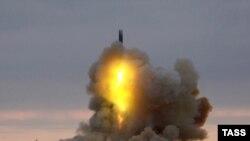
Lieutenant General Henry Obering, the director of the U.S. Missile Defense Agency, will meet high-ranking Russian officials and representatives from all NATO member states in the highest-level talks so far on Washington's controversial missile ambitions.
His task: to ease concerns about U.S. plans to deploy elements of its missile-defense system in Poland and the Czech Republic.
NATO spokesman James Appathurai said that no major breakthrough should be expected at the talks. "This shouldn't be seen as a decision-making meeting, nor is anyone seeking a breakthrough. This is an opportunity to have a discussion about missile defense, both the U.S. plans and the NATO efforts to develop missile defense," he told RFE/RL.
"So it's an open and free discussion, an opportunity to exchange views -- but also, if possible, to break down any misconceptions and mistrust that might have built up over the issue of missile defense," Appathurai added.
Seeing Different Threats
Washington insists that the shield would protect both the United States and Europe against missile attacks from "rogue" states such as Iran and North Korea.
But Moscow has angrily objected to having parts of the shield stationed on its doorstep, saying it poses a threat to Russia and disrupts global strategic balance.
Russian President Vladimir Putin has warned of a new Cold War and has threatened to retaliate if the United States goes ahead with the project.
"We don't understand why the Iranian and North Korean threats must be countered on the territory of Poland and the Czech Republic -- and not, for example, in Turkey, which is also a NATO member and whose participation in this issue would be a lot more logical," Konstantin Kosachyov, the chairman of the Russian State Duma's Foreign Affairs Committee, told RFE/RL.
Military experts say the U.S. shield would not be capable of intercepting Russian missiles. But Moscow is concerned that such capabilities might be reached after the system is in place.
Russians' Offense
Russian authorities also accuse the United States of failing to consult Moscow on its missile plans.
"We would like such dialogue to take place," Kosachyov said. "We would like Russia to be at least informed, or even better, involved in global programs to counter new challenges and threats. But this is not happening. This is precisely why we have the impression that the real target of these missile-defense systems is not some third countries, but Russia."
In Europe, Washington's missile plans have met with mixed feelings and prompted fears of a new arms race. But the vehemence of Russia's opposition to the U.S. shield has also raised some eyebrows.
NATO spokesman Appathurai describe as "unfair" Russian accusations that Washington has failed to consult Russia on the issue.
"It is certainly not true. The U.S. has consulted Russia regularly on a bilateral basis but also in the NATO-Russia Council at a high level," he said. "There have been well over a dozen briefings by the United States to the Russian Federation. So, frankly, I think that's simply an unfair accusation."
A number of Russian defense experts have suggested that Moscow's anger is less about security concerns -- and more about what it perceives as Washington's efforts to impose its will on the world.
The Proliferation Threat
 The Arak heavy-water plant in central Iran (Fars)
BENDING THE RULES. Henry Sokolski, executive director of the Nonproliferation Policy Education Center, told an RFE/RL-Radio Free Asia briefing on January 9 that the West is hamstrung in dealing with Iran and North Korea because of the way it has interpreted the international nonproliferation regime to benefit friendly countries like India and Japan.
LISTEN
Listen to the entire briefing (about 90 minutes):Real Audio Windows Media
RELATED ARTICLES
Iran, North Korea Present Proliferation Challenges
Tehran Watches As North Korea Tests Global Resolve
Rogue Nuclear Programs Threaten New Arms Race
Why Shouldn't Pyongyang Join Nuclear Club?


