

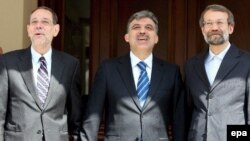
The announcement came in the wake of talks in Turkey on April 25 between EU foreign-policy chief Javier Solana and Ali Larijani, the secretary of Iran's Supreme National Security Council.
Neither Solana nor Larijani revealed details of the meeting, but both men reported some progress in their negotiations, which included a working dinner.
Solana today called it a good meeting with Larijani, Iran's top nuclear negotiator, and added that both sides tried to move the nuclear dossier forward. He spoke of a "very constructive dinner," and he said talks would continue today and "in the coming weeks."
Larijani -- who initially described the talks as "pleasant" -- said today that the two sides are moving toward a "united view" in some areas.
Backdrop Of Sanctions
The talks are aimed at breaking a deadlock over Iran's refusal to stop enriching uranium, as the UN Security Council, the United States, and the European Union have demanded.
Critics in the West fear that Iran will use its nuclear-enrichment activities for military purposes. Iran maintains all of its nuclear activities are entirely peaceful.
The meeting on April 25 was the first face-to-face exchange since the Security Council adopted a second set of sanctions against Iran, in late March, for its continuing uranium-enrichment work.
Iran could face further sanctions if it does not suspend its sensitive nuclear work by May 23. But Iranian officials remain defiant, and it is unclear how a compromise solution could be reached.
Brussels and Washington have made it clear that Iran needs to suspend its enrichment program for formal talks to begin.
Tehran Rejects 'Irrational' Preconditions
Ahead of these talks, Larijani said he expected "new ideas" from Solana on the nuclear issue. He called Western preconditions "irrational" and said they have "prevented negotiation from taking place."
Solana, for his part, expressed cautious hope that the Ankara talks would result in the resumption of formal negotiations.
"I come, like always, with a very constructive attitude," Solana said. "We have always placed on the table sensible proposals, and I hope that, this time, we will be able to move on, in the preparatory talks, that may lead, the sooner the better, to meaningful negotiations."
Negotiations between Iran and the EU broke down in 2006 when Tehran rejected an incentives package that would have included help in developing a peaceful nuclear program in exchange for a halt to the most sensitive activities.
Solana is now expected to brief EU and U.S. officials on his talks with Larijani.
Meanwhile today, U.S. Secretary of State Condoleezza Rice reiterated demands for Iran to stop its uranium-enrichment activities in order to avoid further UN sanctions.
Speaking on the sidelines of a NATO meeting in Oslo, Rice said the United States is prepared to renew contacts with Iran if it agrees to suspend enrichment work.
(compiled from agency reports)
Iran's Nuclear Program

THE COMPLETE PICTURE: RFE/RL's complete coverage of controversy surrounding Iran's nuclear program.