



Iran
Iran: Families Of Detained Students Describe Abuse In Prison
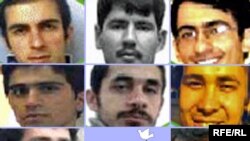
Five of the eight detained students have been freed (RFE/RL) July 25, 2007 (RFE/RL) -- Three students of the prestigious Tehran Polytechnic University, or Amir Kabir University, have spent the past 80 days in jail.
Majid Tavakoli, Ahmad Ghasaban, and Ehsan Mansuri were among eight student editors and activists arrested on accusations that they defamed Islam in student publications. The other five students have been freed.
Charges against them reportedly include inciting public opinion and insulting Iran's leaders. But rights activists and student groups say the charges are "fabricated," and that the students were jailed in retaliation for a protest against Iranian President Mahmud Ahmadinejad, who visited the university in December.
A Long List Of Abuses
The families of the three detained students have addressed an open letter to the head of the country's judiciary, Ayatollah Mahmud Hashemi-Shahrudi, in which they describe ill treatment and torture that they say is aimed at coercing false confessions.
The detainees' families say the students -- all in their early 20s -- have been subjected to physical and psychological pressure ranging from verbal abuse to beatings with cables. The long list of abuses that they claim the students have faced in prison includes sleep and food deprivation -- for up to 48 hours -- and denial of medical care.
They say the students have been interrogated for hours on end by a team of seven interrogators who have beaten and punched them into unconsciousness.
They add that the students were forced into "insupportably tiresome" positions for long periods -- including being made to stand on one leg for 18 hours -- or have been held sometimes in solitary confinement in cramped prison cells and at other times among dangerous criminals.
The letter to the judiciary chief -- published on several Iranian news websites -- also says that authorities have used threats of murder against the students and their families.
Pressure To 'Confess'
Arman Sedaghati is a Polytechnic University student and a member of Iran's largest pro-reform student group, the Office To Foster Unity (Daftare Tahkim Vahdat). Sedaghati told Radio Farda that he's been told that the detained students have been under tremendous mental pressure.
"Ghasaban's mother suffers from heart problems, and in his cell they were playing the sound of a heartbeat," Sedaghati said. "Also, once, they told him he was free but then -- when he went to the gate of Evin prison -- they took him back and put him back in solitary confinement."
Sedaghati says families learned about the plights of their loved ones after they were transferred to a public ward. "[The frequency of] their telephone calls increased after they were transferred to the public cell, and [the students] could inform their parents about the kind of torture they were subjected to, as well as its intensity," he said.
The families think the pressure is aimed at forcing the detainees to confess to the charges against them.
They say such confessions would have no value, and asked the head of the judiciary, "How much torture can a 22-year-old youngster bear?"
Rights groups and student activists are warning that about 15 students who have been in jail since July 9 are facing similar pressure to confess.
Bogus Confessions
Last week, footage of two Iranian-American scholars detained in May appeared on an Iranian television program titled "In The Name Of Democracy." The program linked Haleh Esfandiari, the director of the Middle East program at the Woodrow Wilson International Center for Scholars, and Open Society Institute urban-planning consultant Kian Tajbakhsh to what has been described by Iranian authorities as a U.S. plot to destabilize Iran's Islamic establishment.
Human rights groups, their families, and colleagues say the two were clearly forced to appear in the televised segments. They point to Iran's past record of broadcasting bogus confessions by critics and intellectuals after detentions on security charges.
Iranian officials claim the "comfortable surroundings" in which Esfandiari and Tajbakhsh appeared prove that they were not subjected to abuse. Tajbakhsh appeared in a room with a television set and bookshelves, while Esfandiari was sitting on a couch in a room with potted plants.
Two other Iranian-Americans -- Radio Farda journalist Parnaz Azima and Ali Shakeri, a founding board member at a California university's Center for Citizen Peacebuilding -- have also been detained or had their freedom curtailed on security-related charges.
Iranian government spokesman Gholamhossein Elham said on July 22 that Tehran does not employ violence against its opponents. He said that "giving the accused a hard time and pressuring them is not our policy."
Yet the letter by the families of detained students and testimony from former political prisoners suggest that critics who end up in Iranian prisons face difficult conditions, including isolation and physical abuse.
(Radio Farda broadcaster Farin Assemi contributed to this report)

More News
Iranian Rappers Detained As Government Continues To Squelch Dissent
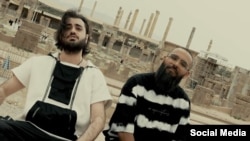
Iranian rappers Vafa Ahmadpor and Danial Maghaddam were arrested after the release of a music video titled "Standby," which is critical of the authoritarian measures in place in Iran.
Rights groups said the two men were arrested in the city of Shiraz on May 9 and that their current whereabouts are unknown. Iranian officials have not commented.
The pair’s video highlights issues such as repression by security forces, economic hardships, and the activities of the morality police while proclaiming that "we, the people of Iran, remain united and will take over this country."
On May 5 they also posted a video of them paying respects at the grave of slain street protester Arman Emadi.
In the video, Maghaddam says, “We’re one nation. Do you want to kill us all?” Maghaddam said in a post on his Instagram account on May 8 that security agents had appeared outside his residence.
He mentioned that Ahmadpor was with him at the time of the incident.
It’s not the first run-in with law enforcement for Ahmadpor, who had been previously detained in February at his home.
Maghaddam has collaborated with figures like Gholam Koveitipor, Sahar Zakaria, and Saba Kamali to address social issues such as violence against women.
In December, he disclosed that a legal case had been initiated against him, Zakaria, and Kamali in the Culture and Media Court for supposedly "inviting corruption and indecency."
Many Iranian artists and public figures have faced Iran’s judiciary for expressing their support of nationwide protests following the 2022 death of Mahsa Amini while in custody for an alleged hijab violation.
Iran's Minister of Culture and Islamic Guidance has taken a hard-line stance against protesting artists, repeatedly threatening them with a work ban.
Thousands of people, including protesters, journalists, lawyers, athletes, and artists have been arrested and at least 500 people have been killed in Iran's brutal crackdown on the protests.
Written by Ardeshir Tayebi based on an original story in Persian by RFE/RL's Radio Farda
- By Kian Sharifi
U.S. Seeks Shift In Iranian 'Decision-Making Calculus' Through Saudi-Israeli Normalization
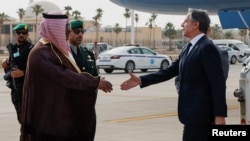
The United States wants to force a gradual shift in Iran’s “decision-making calculus” by signing a defense deal with Saudi Arabia and securing the normalization of relations between Riyadh and Israel.
“We continue to work with allies and partners to enhance their capabilities to deter and counter the threats Iran poses, impose costs on Iran for its actions, and seek to shift Iran’s decision-making calculus over time,” a U.S. State Department spokesperson told RFE/RL.
The security package has several components, including a bilateral U.S.-Saudi defense pact aimed at enhancing the Sunni kingdom’s deterrence capabilities. But Washington is adamant that regardless of how close the Americans and the Saudis are to a bilateral agreement, the security package cannot materialize without Saudi-Israeli normalization.
Saudi Arabia has conditioned the normalization of ties with Israel on the establishment of a cease-fire in Gaza and a credible pathway to Palestinian statehood.
The administration of U.S. President Joe Biden sees a three-way deal key to ensuring a sustainable peace in the Middle East, which includes isolating Iran and making it costly for the Islamic republic to maintain its current regional policies.
“Iran’s isolation in the region and in the international community is a result of its own policies,” the spokesperson said in an e-mailed statement to RFE/RL.
A calculus shift will “definitely” happen, but not in the way that the United States wants, according to Hamidreza Azizi, a fellow at the German Institute for International and Security Affairs.
“Any sort of coalition-building would result in Iran going for counter-coalitions,” he added.
But analysts maintain that for Saudi Arabia, isolating Iran is not the core objective of a security pact with the United States.
The Saudis see normalizing relations with Israel as a strategic leverage to help them extract substantial security commitments from Washington, “thereby balancing against Iranian influence without overtly antagonizing Tehran," Azizi said.
Meanwhile, securing a path toward Palestinian statehood could help Saudi Arabia assert its leadership within the Muslim world and effectively end the Arab-Israeli conflict.
Iran has long opposed Arab normalization with Israel and is a staunch critic of the Abraham Accords, which saw Bahrain and the United Arab Emirates (U.A.E.) establish diplomatic ties with Israel in 2020.
On May 1, Iranian Supreme Leader Ayatollah Ali Khamenei implicitly criticized Saudi Arabia for looking to normalize relations with Israel in the hopes of resolving the Palestinian question.
Anna Jacobs, a senior Gulf analyst at the Brussels-based International Crisis Group, argued that the U.A.E. model of balancing relations with Iran and Israel suggests that Saudi Arabia can do the same.
“Riyadh seems confident that normalization with Israel wouldn’t have a major impact on its relationship with Tehran,” she said. “The Saudi strategy with Iran right now is both containment and engagement.”
Senior Iranian Official Threatens Change In Nuclear Doctrine
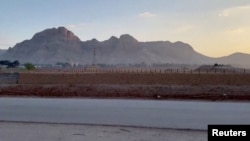
A senior Iranian official has issued a stark warning that Tehran might change its nuclear doctrine and begin to build nuclear bombs if the nation's existence is threatened.
Kamal Kharrazi, head of Iran’s Strategic Council on Foreign Relations and senior adviser to Supreme Leader Ayatollah Ali Khamenei, said in an interview aired on Al-Jazeera Arabic that Iran "has the capacity to produce a bomb," though the country has not taken the actual step of making one.
"Two years ago in an interview with Al-Jazeera, I announced that Iran has the capacity to produce a nuclear bomb. That capacity still exists today, but we have no intention of producing a nuclear bomb. However, if the existence of Iran is threatened, we will have to change our nuclear doctrine," he said.

The comments come at a time of escalating tensions between Iran and Israel, further complicated by the international community's concern over Iran's nuclear ambitions. The Islamic republic has repeatedly claimed that its nuclear program is for civilian purposes, despite possessing the technical capabilities for weaponization.
A nuclear deal in 2015 lifted U.S. sanctions against Tehran, but in 2018, then-U.S. President Donald Trump left the agreement and Washington has since ratcheted up measures against Iran that have choked the country's economy.
Efforts to revive the deal have failed, and Tehran has violated terms of the pact by producing uranium with a higher enrichment threshold.
In March, Bloomberg News quoted a senior U.S. Defense Department official as saying Iran was less than 12 days away from obtaining the fissile material necessary to produce an atomic bomb.
The threat of a shift in doctrine follows an incident last month when Israel is said to have targeted a radar system at a base near the city of Isfahan.
The attack followed an incident on April 13, when Iran retaliated against an Israeli attack on its consulate in Damascus that claimed the lives of seven senior officers from the Quds Force of Iran's Islamic Revolutionary Guards Corps. Iran launched hundreds of drones, ballistic missiles, and cruise missiles at Israel, though almost all failed to hit targets inside Israel.
After Khamenei issued a fatwa, or religious ruling, against nuclear weapons in 2005, officials were adamant that Tehran’s nuclear program was strictly for civilian purposes. But the rhetoric has shifted in recent years.
In the interview, Kharrazi also made reference to potential reactions to any attack on Iran’s nuclear facilities.
"If they want to strike at Iran's nuclear capabilities, it could naturally lead to a change in Iran's nuclear doctrine," he said.
Rafael Grossi, the head of the International Atomic Energy Agency, warned earlier this month that Iran is only weeks away from having enough enriched uranium to produce a nuclear bomb. Grossi has criticized Tehran’s cooperation with the agency as "unacceptable" and called for a significant shift in Iran's nuclear policy.
Kharrazi also hinted at the possibility of Iran withdrawing from the Nuclear Non-Proliferation Treaty (NPT) and potentially moving toward developing nuclear weapons. Iran had previously warned it would leave the NPT if its regime felt threatened.
Written by Ardeshir Tayebi based on an original story in Persian by RFE/RL's Radio Farda
Putin, Pashinian Agree On Withdrawal Of Russian Troops From Some Armenian Regions
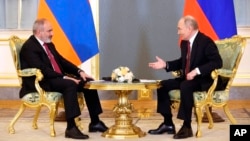
Russian border guards will withdraw from a number of regions of Armenia but will continue to be deployed on the Armenian-Turkish and Armenian-Iranian border following an agreement between Armenian Prime Minister Nikol Pashinian and Russian President Vladimir Putin.
The announcement by the Kremlin on May 9 marks a new step in Yerevan distancing itself from traditional ally Russia following accusations by Armenia that the Russian peacekeepers deployed in and around the region of Nagorno-Karabakh after a bloody war with Azerbaijan in 2020 did not do enough to stop a lightning offensive launched by Baku in September.
Spokesman Dmitry Peskov said the move was discussed and agreed upon at Pashinian's request during talks between the two leaders in Moscow on May 8.
"In the autumn 2020, at the request of the Armenian side, our troops were deployed to a number of Armenian regions. Pashinian said that currently, due to changed conditions, they are no longer needed, so President Putin agreed and the withdrawal of our military and border guards was agreed," Peskov said.
According to the agreement, the Russian border guards and military points located in Tavush, Syunik, Vayots Dzor, Gegharkunik, and Ararat will end their deployment and withdraw from those points.
Some 2,000 Russian peacekeepers have already withdrawn from the Nagorno-Karabakh area that had been for three decades under ethnic Armenian control.
Armenian authorities have accused Russian peacekeepers deployed to Nagorno-Karabakh after the 2020 war of failing to stop Azerbaijan’s new offensive in September.
Russia has rejected the accusations, arguing that its troops didn’t have a mandate to intervene and charging that Pashinian had effectively paved the way for the collapse of separatist rule in Nagorno-Karabakh by previously acknowledging Azerbaijan's sovereignty over it.
Armenia has also asked Moscow to withdraw the Russian border guards that had been deployed at Yerevan's main airport starting from August 1.
In March, Pashinian said in an interview with the France 24 television channel that his country had also frozen its membership in the Collective Security Treaty Organization (CSTO).
The CSTO has been at the heart of Armenia's turn away from Moscow, with Pashinian's government having long criticized the Russia-led security grouping for its “failure to respond to the security challenges” facing Armenia.
Pashinian declined to attend a CSTO summit in Minsk in November and said in a televised Q&A session then that any decision about Yerevan’s continued membership in the grouping -- which includes Belarus, Kazakhstan, Kyrgyzstan, and Tajikistan -- would be based on Armenia's "own state interests."
Iran Sentences Renowned Filmmaker To Flogging, Prison Sentence
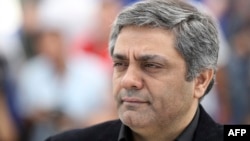
Iran’s judiciary has sentenced filmmaker Mohammad Rasoulof to flogging and eight years in prison. His lawyer, Babak Paknia, said in a social media post on May 8 that his client will only be required to serve five years in prison but was also fined and had his property confiscated. He was convicted of "collusion against national security," Paknia said. Western rights advocates and film-industry groups have condemned Iran’s actions against Rasoulof and demanded his release. Rasoulof's film titled The Seed Of The Sacred Fig is scheduled to be shown at the Cannes Film Festival this month. Rasoulof won the Berlin Film Festival’s top prize in 2020 for his film There Is No Evil, which tells four stories loosely connected to the themes of the death penalty in Iran and personal freedoms under oppression.
Nobel Laureate Slams Iranian Government For Number Of Elderly Female 'Political Prisoners'
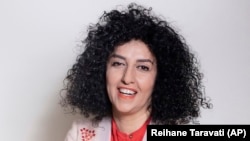
Imprisoned Iranian Nobel Peace Prize winner and human rights activist Narges Mohammadi has slammed the country’s Islamist government for holding almost two dozen women over the age of 60 incarcerated for “political” offenses.
Mohammadi, who is currently among 69 women held in Tehran's notorious Evin Prison, published a statement on Instagram highlighting the determination of older women trapped in Iran’s prison system, saying it shows their "will for liberation, as well as the cruelty and wickedness of the Islamic republic."
"The presence of these women in the ranks of those who are prepared to pay the heaviest prices indicates a widespread uprising among women for democracy, freedom, and equality, as well as the intensity of societal rebellion against discrimination, oppression, and domination," Mohammadi said, noting that "among the 69 female political prisoners in Evin, 21 are over 60 years old."
Mohammadi was sentenced in May 2016 to 16 years in prison after she established a human rights movement that campaigned for the abolition of the death penalty.
She was released in 2020 but sent back to prison in 2021. In January 2024, an Iranian court extended the 51-year-old Mohammadi's prison sentence by 15 months for “spreading propaganda” against the Islamic republic while in jail.

It was her fifth conviction since March 2021 and the third for activities from prison.
While underscoring the harsh realities faced by activists who continue to stand against authoritarian rule, Mohammadi expressed hope in her Instagram post that their resilience will eventually win out over the “tyranny” of the regime.
"It is evident that the presence of mothers and women spending their sixth and seventh decades in prison reflects the regime's brutality, misanthropy, and ferocity, which is increasingly despised as it turns a blind eye to morals, societal values, and humanity in order to maintain its fragile power," she said.
Mohammadi was awarded the 2023 Nobel Peace Prize for what the Norwegian Nobel Committee called “her fight against the oppression of women in Iran and her fight to promote human rights and freedom for all.”
Written by Ardeshir Tayebi based on an original story in Persian by RFE/RL's Radio Farda
- By AFP
Jewish Groups Protest Former Iranian President's Hungary Visit
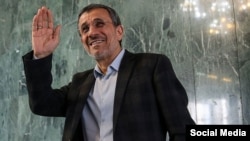
Hungarian Jewish organizations and the Israeli Embassy have condemned a public university for having invited Iran's populist former President Mahmud Ahmadinejad to an event this week. The Budapest-based Ludovika University of Public Service invited the controversial politician -- who has said Israel is doomed to be "wiped off the map" and that the Holocaust was a "myth" -- to an academic meeting. Two Hungarian Jewish congregations, together with a Jewish advocacy group, were the latest to protest the visit of "openly anti-Semitic" Ahmadinejad in a joint statement on May 8. Ludovika University of Public Service did not respond to the AFP news agency's request for comment. The government has also not yet responded. To read the original story by AFP, click here.
Iran Seeks To Tighten Crackdown On Afghan Refugees
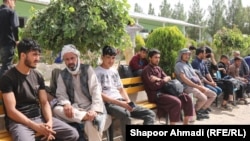
Iran says it has expelled some 1.3 million foreigners over the past year, highlighting a significant crackdown by the government on unauthorized migrants, primarily Afghan refugees.
Interior Minister Ahmad Vahidi told a press briefing that the efforts to regulate foreign nationals needs to be bolstered with legislative reforms to tighten border controls and prevent any future influx of unauthorized migrants.
"To stop unauthorized nationals from entering Iran, it is necessary to amend the relevant laws in parliament," Vahidi said in an indication the government doesn’t plan to heed calls from human rights groups to ensure a fair immigration policy.
Vahidi added that "effective” laws must be enacted to deal with expelled individuals who have managed to re-enter Iran after being deported. He did not elaborate.
Iranian officials typically use the term "unauthorized nationals" to refer to Afghan refugees and Vahidi’s statement is seen as an indication that the government plans to continue with its efforts to deport those who have fled the Taliban regime.
According to the United Nations Refugee Agency, Iran currently hosts around 3.4 million foreign refugees, with Afghans comprising the largest single group. The agency requested $114 million in aid for Iran last year to support refugee management, of which Tehran had received over $26 million by mid-2023.
This year, the refugee agency has sought $110 million in aid for Iran, with commitments from several countries, including Italy, Japan, Bulgaria, and Germany, to cover part of the sum.
Iran ranks alongside Turkey as one of the top host countries for refugees globally. The issue of Afghan migration has regained prominence following the Taliban's return to power in August 2021, leading to an increase in the number of refugees seeking safety outside their home country.
Recent government estimates suggest significant discrepancies in the number of unauthorized Afghan nationals in Iran, with figures ranging from 500,000 to 1.2 million, according to last year's assessment by the head of the National Immigration Organization.
Written by Ardeshir Tayebi based on an original story in Persian by RFE/RL's Radio Farda
- By AFP
IAEA Chief Says Cooperation From Iran 'Completely Unsatisfactory'
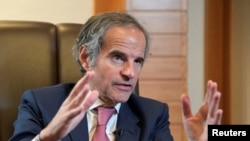
UN atomic watchdog chief Rafael Grossi said on May 7 that cooperation from Iran at present was "completely unsatisfactory" after returning from Tehran, where he urged the country to adopt "concrete" measures to address concerns on its nuclear program. "We have to be moving on.... The present state is completely unsatisfactory for me. We are almost at an impasse...and this needs to be changed," the chief of the International Atomic Energy Agency (IAEA) told reporters at the Vienna airport.
- By Kian Sharifi
No Veil, No Sale: Iran Links Pharmacies' Drug Quotas To Hijab Compliance
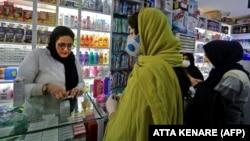
Iran has fined and shut down scores of businesses for allegedly flouting the country’s controversial hijab law in recent years.
Among them were pharmacies accused of failing to impose the Islamic head scarf on their female staff and customers.
Now, in their latest attempt to encourage compliance, the authorities have said that pharmacies could receive reduced drug quotas if they do not adhere to the hijab requirement.
A new directive issued by the Health Ministry on May 5 directly links a pharmacy’s compliance with the hijab law to its allocation of medicine. A chronic drug shortage has forced the authorities to allocate medicine among thousands of pharmacies across the country.
The move has been widely mocked in Iran, where some have criticized the clerical establishment for politicizing people's access to medicine.
'Deterrent Measures'
Heydar Mohammadi, head of Iran’s Food and Drug Administration (FDA), said on May 5 that pharmacies are obliged to ensure “proper attire” is observed on their premises.
“Compliance with [dress] norms is among the issues that play a role in pharmacies’ quotas,” said Mohammadi, a deputy health minister, during a public forum in the capital, Tehran.
The exact details of the directive are unclear. But Mohammadi said reduced quotas are among the “deterrent measures” used to ensure pharmacies followed the hijab law.
“If those measures do not work, violators will be prosecuted,” he added.
In an apparent attempt at damage control, the FDA in a May 6 statement accused the media of misrepresenting the deputy health minister’s comments. It added that the issue of attire pertained to the “professional outfits” worn by the pharmacies’ staff.
An FDA official, who spoke to RFE/RL’s Radio Farda on condition of anonymity because they were not authorized to speak to the media, said there were “too many” pharmacies in the country and the Health Ministry was struggling to distribute enough medicine to them.
'Entirely Illegal'
The FDA’s statement has done little to stem the tide of criticism.
U.S.-based legal analyst Pegah Banihashemi said the decision to link pharmacies’ drug quotas to compliance with the hijab law “is entirely illegal” and a violation of people’s rights.
“Patients who need to procure medicine will become victims of an illegal action by the Health Ministry,” she wrote on X, formerly Twitter.
Sadra Mohaqeq, a pro-reformist journalist, accused the authorities of taking people’s health “hostage.”
Hamed Bidi, head of Karzar Net, an online petition website, said the measure amounts to a “crime against humanity.”
Tehran-based activist Reza Saliani posted on X an imaginary conversation between a customer and a pharmacist, who said that he does not have a particular drug because “we don’t have enough hijabs to afford it.”

Hijab Crackdown
The authorities have intensified their enforcement of the hijab since monthslong nationwide antiestablishment protests rocked the country in 2022.
The unprecedented demonstrations were triggered by the death in custody of 22-year-old Mahsa Amini, who was accused of improperly wearing her head scarf. During the protests, women and girls removed and burned their hijabs.
As an increasing number of women flout the hijab rules, officials have threatened violators with hefty fines and imprisonment.
The authorities have also shut down scores of businesses, including retail stores, restaurants, and pharmacies, for failure to comply with the hijab law.
Last month, Iran’s Islamic Revolutionary Guards Corps (IRGC) established a new unit in Tehran to enforce Islamic dress codes amid a fresh crackdown on women not wearing the head scarf.
Kianush Farid of RFE/RL’s Radio Farda contributed to this report.
Iranian Cyberpolice To Ratchet Up Crackdown On Social Media Critics

Iran's cyberpolice are launching a plan to combat "moral and social crimes that violate Islamic, social, and cultural norms in cyberspace," in another sign of the curbing of freedoms by authorities following a renewed crackdown on the wearing of head scarves and the blocking of several social media sites.
According to the semiofficial ISNA news agency, cyberpolice chief Vahid Majid outlined the new measures targeting online activities, including "obscene live streaming, vulgar content production, and modeling."
"In a proactive strategy, we have identified and taken legal and operational actions against the operators, managers, and members of 10 active cybersites," Majid added.
The cyberpolice recently blocked several popular social media pages -- including Instagram, as well as Facebook, X (formerly Twitter), YouTube, Telegram, and WhatsApp -- while the judiciary has pursued cases involving social media commentary, summoning individuals and pressing charges for various offenses.
At the same time, the Islamic republic's authorities have resumed the deployment of the morality police on Iran's streets, aggressively targeting citizens, particularly women, in an effort to enforce strict dress codes.
This has led to the documentation by activists and victims of what they say are several incidents of violence against women challenging the compulsory hijab.
It has also led to widespread usage of the Internet by social network users and civil activists to complain about the situation.
A recent survey by ISPA, the Student Opinion Polling Center of Iran, revealed that a significant portion of the population continues to access the blocked platforms, with 46.5 percent using Instagram, 35.3 percent on WhatsApp, and 34.6 percent on Telegram as of February 2024.
The hijab became compulsory for women and girls over the age of 9 in 1981, two years after the Islamic Revolution in Iran, triggering protests that were swiftly crushed by the new authorities.
Many women have flouted the rule over the years and pushed the boundaries of what officials say is acceptable clothing.
- By AFP
IAEA Chief In Iran As Concern Grows Over Nuclear Activity
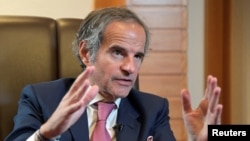
UN atomic watchdog chief Rafael Grossi arrived in Iran on May 6, where he is expected to speak at a conference and meet officials for talks on Tehran's nuclear program. The visit comes at a time of heightened regional tensions and with the International Atomic Energy Agency (IAEA) criticizing Iran for lack of cooperation on inspections and other outstanding issues. Grossi is scheduled to meet Iran's Foreign Minister Hossein Amir-Abdollahian, as well as the Islamic republic's nuclear chief, Mohammad Eslami.
Iranian Activist Sentenced To Death For Social Media Posts

A court in the central Iranian city of Isfahan has sentenced Mahmud Mehrabi to death for posting messages on social media critical of the Islamic republic.
There is scant reporting about the details of his critical posts, which led to him being convicted of “corruption on Earth” -- the most serious offense under Iran’s Islamic penal code.
Mehrabi’s lawyer, Babak Farsani, wrote on social media on May 5 that there were “serious problems” with the verdict that he hoped would help get it overturned by the Supreme Court.
Mehrabi was arrested in February 2023 and has spent the last six months in a prison ward where dangerous criminals are held, according to his sister Hajar Mehrabi, who lives in Austria.
She told RFE/RL’s Radio Farda on May 5 that her brother was among the tens of thousands of people who protested during the Women, Life, Freedom unrest in 2022. The protests were sparked by the death in police custody of Mahsa Amini, who had been detained for allegedly not properly observing Iran’s strict dress code for women.
Mehrabi put out calls for protests on his social media account and was accused of “spreading false news,” his sister said.
“The judge told him, ‘I don’t see regret in your eyes, so I have sentenced you to death’,” she added.

The “corruption on Earth” charge is usually brought against serious crimes, such as murder, drug dealing, and high-profile financial corruption cases. It remains unclear exactly what Mehrabi posted online to be hit with a charge that carries the death penalty.
Maryam Mehrabi, another sister who resides in Iran, has urged the public to gather outside the home of Ayatollah Mohammad Ali Nasseri on May 6 to protest the verdict. Nasseri is a prominent cleric in Isfahan who teaches in the city’s seminary.
She vowed to set herself on fire outside Nasseri’s residence.
This comes just over a week after another court in Isfahan sentenced popular rapper Toomaj Salehi to death for his antiestablishment songs.
Rights groups have sharply criticized Iranian authorities for their extensive use of the death penalty.
"The Iranian authorities are ruthlessly carrying out an execution spree. Prisons across the country have become sites of mass state-sanctioned killings under the guise of judicial executions," Amnesty International said recently.
Written by Kian Sharifi based on an original story in Persian by RFE/RL’s Radio Farda
Iran Files Charges Against Media Members Over BBC Report On Shakarami Death

Iran's judiciary has filed charges against several journalists and media activists who disseminated a BBC World Service report concerning the alleged "sexual abuse and murder" of protester Nika Shakarami during the 2022 protests.
The BBC report, released on April 29, cited a "highly confidential" government document that allegedly names those responsible for Shakarami's death and senior commanders involved in a subsequent cover-up.
The report, which claimed that Shakarami was abused and killed after being detained by security forces, was dismissed by the judiciary's media center as "fake, incorrect, and error-ridden." The center accused the individuals involved of publishing "false, insulting, and anti-regime propaganda" on the Internet.
"The media individuals have been summoned to the Tehran Prosecutor's Office as part of our legal duty to counter disruptors of societal psychological security," a spokesperson for the judiciary's media center said.
Activists say the report is further evidence of the repressive nature of the regime against protesters, particularly those involved in the Women, Life, Freedom movement.
In a response to the government's narrative, Fateme Heidari, the sister of Javad Heidari, another 2022 protest victim, said she spoke with Nika's mother, who told her: "'It's raining here now, Fateme, and it feels like all the sorrows of the world are raining down on me; Nika loved the rain...'"
Hamed Esmaeilion, an activist and member of a family seeking justice for the downing of a Ukrainian plane in 2020, said the BBC report “brutally revealed the murder case of Nika Shakarami,” which “has shaken all Iranians.”
"In the painful narrative of this unforgivable crime, what remains in our hearts is the unforgettable resilience of Iran's brave daughter, Nika Shakarami, facing her killers and oppressors," Esmaeilion said.
“This report has not only shone a light on the alleged abuses but also highlighted the dangers faced by journalists and activists in Iran, who risk severe repercussions for reporting on sensitive issues.
“The global response underscores the ongoing international concern regarding Iran's human rights record, particularly during times of civil unrest.”
Reza Pahlavi, the exiled former crown prince of Iran, said the perpetrators of the “crime against Nika Shakarami, and the main person responsible, [Supreme Leader Ayatollah] Ali Khamenei, will be brought to justice."
Shakarami went missing during protests in September 2022 in Tehran over the death of Mahsa Amini, who died while in police custody for allegedly wearing her head scarf improperly.
In her last communication with her friends, Shakarami said she was being chased by security forces.
Eight days later, Nika's body was returned to her family. The government said she had committed suicide.
Both deaths brought up accusations of a government cover-up.
Authorities have said she fell into a coma soon after her arrest because of health problems. But her family says she was in good health, while eyewitnesses said the 22-year-old was beaten while she was being detained.
Public anger at Amini's death has been widely seen as one of the biggest threats to Iran's clerical establishment since the foundation of the Islamic republic in 1979.
At least 500 people have been killed around the country since authorities began a crackdown on her supporters, with thousands more detained or harassed.
Written by Ardeshir Tayebi based on an original story in Persian by RFE/RL's Radio Farda
Iranian Teachers Rally Nationwide To Protest Lack Of Reforms
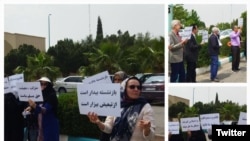
Teachers across Iran have rallied in support of reforms in the education sector and for an end to what they describe as discriminatory and oppressive treatment by authorities.
The Iranian Teachers' Union's Coordination Council reported that security forces detained four participants during the protests in Tehran, with one teacher, Mehdi Farahi Shandiz, still being held in custody. The council condemned the arrests, stating that "those detained were subjected to violence by security forces during the peaceful demonstrations."
The nationwide protests highlighted several grievances, including demands for "the immediate release of all imprisoned educators, provision of free education for all, and the abolition of gender discrimination in educational policies," according to a council resolution.
The teachers called out the Islamic republic’s government, claiming it "opts to suppress and threaten proactive teachers rather than combat embezzlers and the corrupt, subjecting them to measures such as exile, dismissal, and imprisonment."
Teachers have in recent years taken to the streets on several occasions to protest against their working conditions and to demand higher wages. They have also called on the government to speed up the implementation of reforms that would see their salaries better reflect their experience and performance.
The Human Rights Activists News Agency (HRANA) reported that just ahead of the protests, 17 teachers were summoned and interrogated by the intelligence services in Sanandaj, indicating a continued pattern of pressure and scrutiny on educational professionals in Iran.
Unrest -- including months of protests by workers -- has rattled Iran in recent years in response to declining living standards, wage arrears, and a lack of welfare support.
Labor Ministry data shows Iran's poverty rate doubled in 2021, with one-third of the population living in "extreme poverty." Since then, conditions have failed to improve.
In September 2023, Iran's Misery Index, calculated by the Iranian Statistics Center, rose to 60.4 -- its highest point ever and more than double what it was six years ago. The higher the rating, the worse off people feel.
Labor laws in Iran do not recognize the right of workers to form independent unions.
Written by Ardeshir Tayebi based on an original story in Persian by RFE/RL's Radio Farda
- By dpa
Iranian IRGC Warship Crosses Equator For First Time

An Iranian warship equipped with drones and missiles has crossed the equator into the Southern Hemisphere, Iran's IRIB state radio reported on May 4. The report did not reveal the exact location of the Shahid Mahdavi, a converted container ship operated by Iran's Islamic Revolutionary Guards Corps (IRGC) that was unveiled more than a year ago. This is reportedly the first time that the IRGC has sent a warship on a long-range mission. Iranian forces in February test-launched medium-range missiles capable of reaching targets at a distance of around 1,700 kilometers for the first time.
- By Kian Sharifi
Why Are U.S. Sanctions Against Iran's Oil Exports Ineffective?

Iran is one of the most sanctioned countries in the world. But restrictions imposed by the United States have largely failed to stymie Iran's oil exports, the backbone of its flailing economy.
U.S. sanctions have cut off Iran from most of its traditional customers, forcing Tehran to find new buyers and sell its oil at discounted prices.
But China’s willingness to buy record amounts of Iranian oil, Tehran's mastery of sanctions-evading tactics, and Washington's reluctance to strictly enforce sanctions have made U.S. measures against Iran’s energy exports ineffective, analysts say.
'Dark' Fleet Of Tankers
The lifting of U.S. sanctions as part of the 2015 nuclear deal with world powers allowed Iran to sell its oil to customers in Europe and East Asia. Oil exports reached a peak in 2018.

But exports plummeted after then-President Donald Trump reneged on the nuclear agreement later that year.
Iran has boosted its sales in recent years by circumventing sanctions, including using its "dark fleet" of tankers to illegally transport oil shipments to China.
The tactic involves ship-to-ship operations to offload the oil, middlemen, hidden money transfers, and rebranding the oil to mask its Iranian origin and make it appear to come from a third country.
"Iran is continuously developing and expanding not just the network of middlemen and trading companies involved in the sale of its oil, but also its own fleet of tankers that it predominantly uses to move its crude," said Nader Itayim, the Middle East editor at the U.K.-based Argus Media.
Chinese Appetite
Growing demand for Iranian oil in China has been key to the surge in Iran's oil sales.
Ship tracking data collected by Argus shows Iran’s oil exports currently hovering at 1.5 million barrels per day, with around 85 to 90 percent going to China.
Tehran gives China a steep discount to take its banned oil, taking up to 15 percent off the price of each barrel to make it worthwhile for Beijing to take on the liability of skirting sanctions.
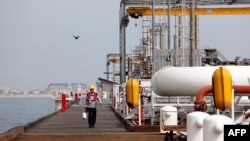
The discounts have raised questions about the long-term profitability of Iran’s business with China. But experts said that Tehran still stands to gain.
"Even at heavy discounts, selling Iranian oil is extremely profitable and sustainable," said Steve Hanke, a professor of applied economics at Johns Hopkins University. "That’s because the marginal cost of production in Iran is roughly $15 or less per barrel."
Gregory Brew, an Iran and energy analyst at the U.S.-based Eurasia Group, says U.S. sanctions were once effective at blocking oil exports to China, but that is no longer the case.
"China's rising stature as a new global power lends it greater freedom to defy U.S. sanctions," Brew said.
Reluctance To Enforce Sanctions
Some analysts said Washington has been reluctant to strictly enforce sanctions, while others maintain that sanctions in general have failed.
Resources are required to enforce restrictions while new sectors would need to be sanctioned to keep up the pressure, according to Itayim of Argus Media.
"Otherwise, the target finds ways to evade the sanctions, while at the same time the buyer becomes more complacent as it sees enforcement waning. In the case of Iran and China, I think we have seen a bit of both," Itayim said.
Analysts also argue that Washington is reluctant to strictly enforce sanctions due to the risks associated with forcing Iranian oil off the world market.
"Apart from the impact such action would have on the price of oil, which carries political and economic importance to [U.S. President Joe] Biden in an election year, aggressive enforcement would provoke both Iran and China, at a time when the United States is trying to manage escalatory risk both in the Middle East and East Asia," Brew said.
The lax enforcement of oil sanctions also extends to Venezuela and Russia, Itayim says, noting that it "has been key to keeping a lid" on oil prices.
U.S. Congress last month passed a security package that included the Iran-China Energy Sanctions Act, giving the government the authority to further restrict Iran's oil exports.
But experts are not convinced that more sanctions will have an impact.
Hanke said any new measures "will join the long list of failed Western sanctions" on the Islamic republic.
"Sanctions are always subject to workarounds that render the enforcement of sanctions futile," he added.
- By RFE/RL
Iran Hits U.S., U.K. Targets With Sanctions Over Israel Support

Tehran has imposed a round of sanctions on a group of American and British companies and individuals, including British Defense Minister Grant Shapps, over their support for Israel in its war in the Gaza Strip.
In a statement on May 2, the Iranian Foreign Ministry said British officials and entities were sanctioned because of the United Kingdom’s “deliberate support” for Israel, including “committing terrorist acts” that threatened regional peace.
The sanctions also target several military officials, including Simon Cloke, commander of Royal Air Force Akrotiri, a British air base in Cyprus used by RAF fighter jets to target the Iran-aligned Huthi rebels in Yemen.
In a separate tranche of sanctions, Iran targeted U.S.-based arms manufacturers and senior members of hawkish think tanks for their support of Israel.
Sanction targets include Lockheed Martin and General Dynamics, as well as the energy company Chevron.
Among the individuals sanctioned by Iran is Brad Cooper, who is identified as the commander of the United States Navy’s Fifth Fleet in the Middle East. Cooper turned over command of the Fifth Fleet to George Wikoff on February 1.
The targets of the sanctions will have their bank accounts in Iran frozen and will not be issued visas to enter Iranian territory.
While the impact of these measures remains unclear, they appear to be largely symbolic.
U.S. and U.K. fighter jets targeted Huthi positions several times earlier this year in response to the Yemeni rebels targeting commercial shipping in the Red Sea. The Huthis pledged to continue their attacks unless there was a ceasefire was reached in Gaza.
Israel launched its Gaza offensive in October 2023 in retaliation for a surprise attack on Israeli settlements led by Hamas, which is designated as a terrorist organization by the United States and the European Union.
Nearly 1,200 people, mostly civilians, were killed in the Hamas-led attack. The health ministry in the Hamas-run Gaza Strip says more than 34,000 people have been killed in the Israeli offensive.
Trucker Protests Over Fuel Cuts Feed Labor Unrest Sweeping Iran
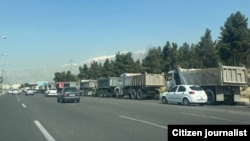
A surge of labor unrest, buffeted by widespread protests over sharp cuts to fuel quotas for truck drivers, has swept across Iran as economic hardship and poor living standards wrack the country’s workforce.
Several cities and provinces have seen large-scale protests by truck drivers in recent days ahead of the May 1 international labor day holiday, as they vent their anger of a cut in monthly fuel allocations from 3,000 liters to just 500 liters.
The reduction in fuel quotas has increased costs for operators, in turn raising the prices of goods and services for the broader population.
The protests have coincided with other protests by retired workers and in various industrial sectors across the country, which is reeling from the bite of economic sanctions on the economy over Tehran’s nuclear program.
In Arak, retired workers voiced their discontent against what they perceive as government mismanagement of the economy, while workers from Pars Paper Mill in Haft Tappeh and retirees in Shush rallied against local officials, demanding accountability and improved living conditions.
Local authorities in several regions, including Dashtyari, have reportedly ignored the protests, leading to increased frustration among the demonstrators.
According to the Free Union of Iranian Workers, the local governor in Dashtyari left his office without engaging with the protesters, exacerbating tensions.
In an attempt to quell dissent ahead of International Workers Day, several labor and social activists in Sanandaj were summoned and interrogated by local intelligence services, rights groups said.
Unrest -- including months of protests by workers -- has rattled Iran in recent years in response to declining living standards, wage arrears, and a lack of welfare support.
Labor Ministry data show Iran's poverty rate doubled in 2021, with one-third of the population living in "extreme poverty." Since then, conditions have failed to improve.
In September 2023, Iran's Misery Index, calculated by the Iranian Statistics Center, rose to 60.4 -- its highest point ever and more than double what it was six years ago. The higher the rating, the worse off people feel.
Labor laws in Iran do not recognize the right of workers to form independent unions.
Written by Ardeshir Tayebi based on an original story in Persian by RFE/RL's Radio Farda
Secret Documents Show Iranian Forces Assaulted And Molested Teen Killed In Custody, Says BBC

"Highly confidential" documents uncovered by British broadcaster BBC indicate that Nika Shakarami, a 17-year-old Iranian protester, was sexually assaulted and killed after being detained by security forces during unrest sparked by the Women, Life, Freedom protests in 2022.
According to a report published by the BBC on April 30, the documents contain detailed minutes and a report of Shakarami's case as compiled by the Islamic Revolutionary Guards Corps (IRGC). It reportedly includes the names of the individuals responsible for her death and senior commanders who allegedly tried to cover up what occurred.
RFE/RL has not been able to independently verify the BBC report.
"This document summarizes the appalling actions taken against Nika Shakarami, detailing her arrest and the subsequent cover-up attempts by senior commanders," the BBC said.
Shakarami went missing during protests in September 2022 in Tehran over the death of Mahsa Amini, who died while in police custody for allegedly wearing her head scarf improperly.
In her last communication with her friends, Shakarami said she was being chased by security forces.
Eight days later, Nika's body was returned to her family. The government said she had committed suicide.

The BBC report said documents showed Shakarami was forcibly taken into a refrigerated van, where she was handcuffed and assaulted by a male officer. As she was being assaulted, Shakarami fought back, prompting the officers to beat her with batons, they added.
Nasrin Shakarami, Nika’s mother, told RFE/RL’s Radio Farda in an exclusive video message that “the forensic medical certificate indicated that my daughter died from multiple blows from a hard object to her head.”
The BBC’s investigation revealed that a former Iranian security officer confirmed the authenticity of the documents through contacts within the IRGC’s archive, utilizing an "official code issued daily to senior intelligence officers." Questions remain about how the former agent still had access to the changing security codes.
"The document explicitly states that after being apprehended, Ms. Shakarami was placed in a van with several security agents," according to the BBC. One of the agents, as per the document, admitted to becoming “aroused” during the assault, although he later denied certain actions attributed to him.
In the document, Behruz Sadeghi, a member of the security team, is quoted as saying that it was "completely dark" inside the van and "we could only see each other with the light from our mobile phones."
When Shakarami became restive, Sadeghi says, two of his colleagues, Arash Kalhor and Sadegh Manjazi, moved to forcibly restrain her.
"She started cursing again which led to Arash Kalhor gagging her with his sock, while Sadegh laid her on the van floor and sat on her to calm her down.”
The documents quoted Kalhor as saying in a statement that, when Shakarami started yelling and struggling again, "I turned on my mobile phone and saw Sadegh Manjazi sitting on her with his hand in her trousers."
Iranian authorities and the IRGC did not respond to inquiries made by the BBC about the documents.
Following her death, the authorities were ordered by senior officials to ditch Shakarami’s body on a quiet street next to the Yadegar Imam highway in Tehran, the BBC reported, citing the documents.
During the "Women, Life, Freedom" protests, Iranian state media attempted to claim that Shakarami had committed suicide by jumping from an unfinished building near her aunt’s home, where she was living.
Her family has stated that they were not allowed to see her body, only viewing parts of her severely damaged head and face.
"Who do we complain to when no one in the government will take responsibility for killing Nika?" her mother said in despair.

The incident was similar in some ways to what Amini endured before her death.
Authorities have said she fell into a coma soon after her arrest because of health problems. But her family says she was in good health, while eyewitnesses said the 22-year-old was beaten while she was being detained.
Public anger at Amini's death has been widely seen as one of the biggest threats to Iran's clerical establishment since the foundation of the Islamic republic in 1979.
At least 500 people have been killed around the country since authorities began a crackdown on her supporters, with thousands more detained or harassed.
Written by Ardeshir Tayebi based on an original story in Persian by RFE/RL's Radio Farda
- By Reuters
Nuclear Watchdog Chief Set To Visit Iran On May 6-8
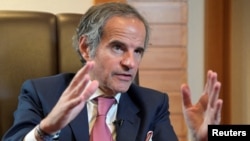
International Atomic Energy Agency (IAEA) chief Rafael Grossi is scheduled to visit Iran to take part in a nuclear conference from May 6 to May 8 and to meet Iranian officials, Iran's semiofficial Mehr news agency said on April 30. "Grossi will meet Iranian officials in Tehran before participating in the International Conference of Nuclear Sciences and Technologies held in Isfahan," the agency reported. The IAEA chief said in February that he was planning a visit to Tehran to tackle a "drifting apart" in relations between the agency and the Islamic republic.
Jailed Iranian Scholar Released From Prison Due To Health Issues

Imprisoned Islamic scholar and civil activist Sedigheh Vasmaghi has been released on bail amid concerns over her deteriorating health after she was moved to a hospital from Tehran's notorious Evin prison earlier this month.
Her release was reported on April 29 by the Emtadad Telegram channel, which said her state of health had worsened. The news was confirmed by a source speaking to RFE/RL's Radio Farda.
Vasmaghi, a vocal critic of Iran's mandatory hijab policy, was initially detained at her home on March 16, on charges of "propaganda against the system in cyberspace" and "public appearances without Shari'a-compliant hijab."
Doctors had urged for her transfer to a hospital from prison, but officials had refused several times to carry out the move. Her deteriorating health caused her to go blind.
Prior to her release, Vasmaghi penned a letter to a United Nations fact-finding committee detailing her experiences while detained by the Islamic republic, highlighting her wrongful arrest on charges of removing her hijab, or Islamic head scarf, and the subsequent brutal treatment and torture she endured at the hands of state officials.
Vasmaghi underscored in her letter that, despite her blindness, she was repeatedly taken for interrogation without legal representation and was transferred to serve her sentence without undergoing due legal process.
In November 2023, she posted a video on social media where she wasn't wearing a hijab in defiance of Iran's strict dress codes for women.
Speaking to RFE/RL’s Radio Farda at the time, Vasmaghi said she regarded her action as a protest against the religious regime's oppressive policies toward women, and advocated for the right of women to choose their own attire.

From inside Evin prison, Vasmaghi declared the mandatory hijab policy a failure. In her communication with the UN, she urged international human rights organizations to continue their efforts to hold Tehran accountable for its oppressive actions, particularly against women.
Vasmaghi has also been highly critical of Iranian Supreme Leader Ayatollah Ali Khamenei, calling him a dictator and slamming the country's "oppressive" leadership.
The death of Mahsa Amini in police custody in September 2022 after her arrest for allegedly improperly wearing her head scarf led to months of nationwide protests that thrust women's rights and public disapproval of the hijab law to the fore.
Iranian authorities responded by carrying out a violent crackdown that resulted in the deaths of over 500 protesters. They have also implemented a stricter hijab law with harsher penalties and longer prison sentences for those who disobey it.
The fact-finding committee of the UN Human Rights Council labeled these government actions against women as a "crime against humanity."
Written by Ardeshir Tayebi based on an original story in Persian by RFE/RL's Radio Farda
Former Prisoners In Iran Slam Swedish Government For Inaction In Djalali Case

A group of former prisoners who were once detained in Iran have slammed the Swedish government, saying it had failed to take enough action to secure the release of Ahmadreza Djalali, a Swedish-Iranian physician facing the death penalty in Iran.
The 15 signatories of the letter, including prominent figures such as Barry Rosen and Nazanin Zaghari-Ratcliffe, said the Swedish government’s efforts had been "insufficient" as Djalali approaches his eighth year behind bars.
"The inaction and lack of a clear strategy on Sweden's part is alarming," Siamak Namazi, one of the signatories, told RFE/RL's Radio Farda.
"It is imperative that the Swedish government upholds its responsibility towards its citizens."
Djalali, a medical professional and university professor, was detained in May 2016 by Iran's intelligence services during a visit for a scientific conference. He was subsequently sentenced to death in 2017 on charges of "espionage and selling information to Israel" and "corruption on Earth," charges he denies.
Vida Mehrannia, Djalali's wife, voiced her frustrations with the lack of progress in the case in an interview with Swedish Radio.
"The silence from the government is deafening," she said in the interview.
"We are desperate for action and engagement that can bring Ahmadreza home," she added.
The letter by the group of former prisoners underlines Iran's practice of detaining foreigners to use as bargaining chips in international negotiations.
They called on the Swedish government to collaborate internationally to combat the practice of hostage taking by establishing severe penalties as a deterrence.
Djalali’s case has also drawn attention to other Swedes detained in Iran, including Johan Floderus, and long-running tensions between Stockhokm and Tehran, particularly after the conviction of Hamid Nouri in Sweden for his role in the 1988 mass executions in Iran.
Written by Ardeshir Tayebi based on an original story in Persian by RFE/RL's Radio Farda
Toomaj Salehi, The Iranian Rapper Sentenced To Death Amid Global Outcry
There has been global outrage after Iran handed a death sentence to Toomaj Salehi, a 33-year-old rapper who was detained for supporting nationwide protests following the death in custody of Mahsa Amini in 2022. As his lawyers press ahead to appeal the decision, one prominent supporter has told RFE/RL she hopes Tehran will back down to avoid sparking a new wave of mass protests.
Iran Bans Egyptian TV Series On Life Of 11th-Century Figure Hassan Sabah
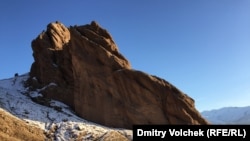
Iranian authorities have banned the controversial Egyptian television series Hashashin (Assassin) about the life of Hassan Sabah, citing historical “distortions,” state media reported on April 28. Mehdi Seifi, director of the SATRA regulatory authority, said that "the serial's narrative of Islamic history involves many distortions that seem to have been produced by a politically biased approach," IRNA reported. The 30-part series depicts Sabah and his group, which operated as a Shi'ite sect in the 11th century from mountain fortresses in northern and western Iran and were known for violent political assassinations. The series is being broadcast in Egypt and is gaining popularity throughout the Middle East. To read the original story by RFE/RL’s Radio Farda, click here.
RFE/RL has been declared an "undesirable organization" by the Russian government.
If you are in Russia or the Russia-controlled parts of Ukraine and hold a Russian passport or are a stateless person residing permanently in Russia or the Russia-controlled parts of Ukraine, please note that you could face fines or imprisonment for sharing, liking, commenting on, or saving our content, or for contacting us.
To find out more, click here.
Editors' Picks







Top Trending
Exclusive: The TikTok Trail Of The U.S. Soldier Arrested In Russia Left By His Russian 'Wife'
2Kazakh Billionaire Buys English Soccer Club
32 U.S. Citizens, Including Soldier, Join List Of Americans Being Held In Russia
4Kazakh Ex-Minister Insists In Court He Had No Intention To Kill Wife
5North Macedonia Ruling Party Concedes As Opposition Wins Dual Votes
6Chinese-Made Surveillance Cameras Are Spreading Across Eastern Europe, Despite Security Concerns
7North Macedonia's New President Prefers The Country's Old Name
8All 5 Central Asian Leaders To Attend Victory Day Parade In Moscow
9What Is Behind Serbia And China's 'Ironclad Friendship'?
10Putin Inaugurated In Ceremony Marked By Western Boycott
Subscribe

