


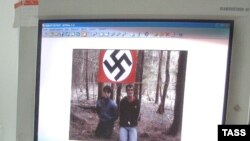
The brutal footage of the apparent slaying -- carried out by a previously unknown ultranationalist group -- has raised the question of how many such organizations operate in Russia with relative freedom.
The video was posted on the website of a group calling itself the National Socialist Party of Rus. Hints are made in the footage of a relationship with the neo-Nazi group National Socialist Society.
According to the SOVA Center, which monitors extremist groups, there are about a dozen identifiable organizations with nationalist tendencies currently operating on a nationwide scale. These include the National Socialist Society, the Movement Against Illegal Immigration, the National Power Party of Russia, the Russian All-National Union, and the Slavic Union.
Galina Kozhevnikova, the deputy director at SOVA, says similar groups are making their presence known throughout Russia.
"In actual fact, there are far more organizations like this operating on a local level, political organizations trying to play a political role, demonstrating their aspirations toward political life and activities and so on," Kozhevnikova says. "In practically every region there is an organization like this."
Inciting Violence
There is no suggestion that any of the organizations are directly involved in violent crime, but they do promote ideas that feed violence, Kozhevnikova says.
Some of the groups espouse anti-Semitism; many are overtly racist and xenophobic. There are also hundreds of so-called skinhead gangs. Police investigations have found skinheads to be behind the frequent attacks on people with dark skin on the streets of Russian cities.
They may be at the extreme end of the spectrum, but the mainstream shares some of their views. A recent survey carried out by the Levada Center, which monitors public opinion, found that 55 percent of Russians agreed with the statement "Russia should be for Russians," while 20 percent of young people did not consider the activities of skinhead or neo-Nazi groups to be dangerous.
Kozhevnikova cites a number of reasons for the growing nationalist mood among Russians. "The peak of this xenophobic mood on a domestic level was fixed by sociologists in 2005; [this] domestic xenophobia was first blamed on poor social conditions and then on conflicts," she says.
"There's no doubt that the war in Chechnya played a role -- the second Chechen war. It was taken as being a war of Russians against Chechens, Orthodox against Muslims. Of course, that played a very big role," Kozhevnikova adds.
'Social Democrats'
Part of the problem, Kozhevnikova says, is that many nationalist organizations are starting to promote themselves as civil movements, whose aim is to improve social conditions.
Aleksandr Belov, the spokesman for the Movement Against Illegal Immigration, says the group's goals are "to put a stop to the number of illegal immigrants moving to Russia and to repatriate people with Russian roots living outside the country."
"We're a democratic movement made up of people who have their own opinions and who want to live freely in their own country. They want laws to be obeyed. You could call us social democrats," Belov says.
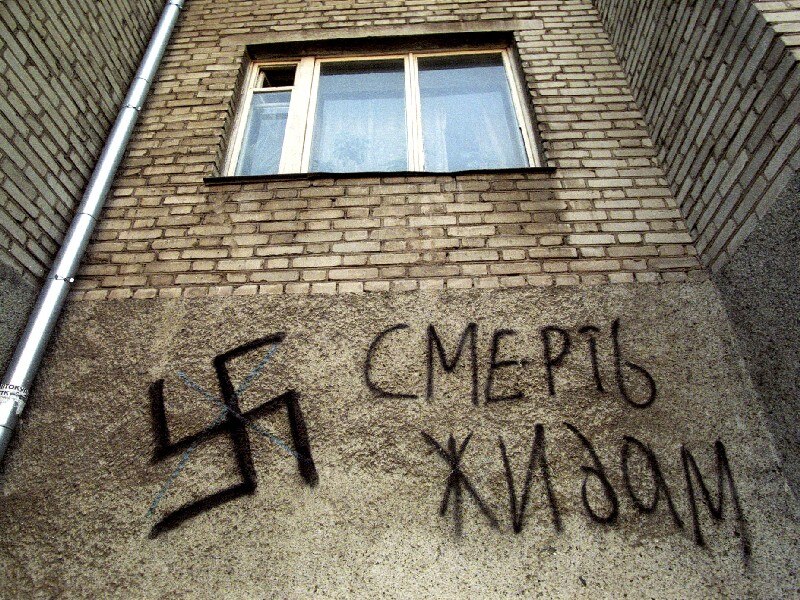
A swastika and anti-Semitic slogan on a house in Vladivostok (file photo)
Observers say there is a reason the authorities are doing little to clamp down on these groups.
"They are actively exploiting this nationalist mood," SOVA's Kozhevnikova says. "They are exploiting it from top to bottom. Because it is populism, it appeals to more than 50 percent of the population, these mass xenophobic sentiments. Once again it's [connected with] the election, where [the authorities] are showing that, of course, neo-Nazi groups are bad, but there are good nationalists, that we are nationalists -- striving for the Russian people."
In the same week that the footage of the killings was posted on the Internet, a bomb exploded on a train traveling between Moscow and St. Petersburg, Russia's busiest rail line. Investigators are looking into reports that an extremist group planted the bomb.
No proof has been put forward, but there is speculation in the media that Russia's special services may themselves have been behind the Internet video and the train explosion. Both come just weeks before the government is due to bring in tighter legislation on extremist groups.
The Federal Security Service did not respond to calls from RFE/RL.
Critics of the Kremlin say that with four months to go to a parliamentary election and a presidential vote next year, the anti-extremist measures would be used to clamp down on political opponents rather than radical groups.
Rising Russian Nationalism
 Orthodox believers and nationalists heckling a gay-rights rally in Moscow in May 2006 (RFE/RL)
A THREAT TO CIVIL, RELIGIOUS LIBERTIES: Several leading experts told a briefing hosted by RFE/RL and the U.S. Commission on International Religious Freedom that several mounting trends in Russia are posing a growing threat to human rights, especially for members of the country's ethnic and religious minorities.
LISTEN
Listen to the entire briefing (about 90 minutes):Real Audio Windows Media
RELATED ARTICLES
Why Putin Is Going To The Vatican
Bishop Assails Russian Orthodox Church

A thematic webpage devoted to issues of religious tolerance in RFE/RL's broadcast region and around the globe.