


The UN Office on Drugs and Crime (UNODC) report blames corruption and the lack of security in southern Afghanistan for the problem.
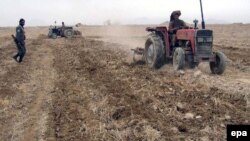
The UNODC says opium-poppy cultivation in Afghanistan increased "dramatically" in 2007.
The annual survey estimates the increase in production of opium as more than one-third, confirming Afghanistan as the major world problem in narcotics terms.
"The really bad news is that we have an increase in the number of hectares [sown with opium poppy], we have a 17 percent increase in terms of hectares in Afghanistan, and what is perhaps even more worrrying for other countries is the increase in terms of tons -- we have a 34 percent increase in opium [production] in Afghanistan," UNODC researcher Tomas Pietschmann told RFE/RL's Uzbek Service.
Huge Source Of Danger
The director of UNODC, Antonio Maria Costa, says the southern Afghan province of Helmand is becoming the world's largest drug supplier, with production bigger than that of entire countries, including Colombia.
Costa calls Helmand the most dangerous source of the most dangerous drug -- heroin -- and says blocking that source "will go a long way toward bringing stability to the region."
Speaking today in Kabul, Costa said the high growth in opium production represents a "failure" for all concerned.
"I am afraid the situation of today is a demonstration of failures by everybody," Costa said. "It is a failure on the part of the [Afghan] national administration in many respects. It is a failure on the part of foreign troops, who control the situation to increase security in the south."
Progress In Some Places
Afghanistan stands as the black spot in an otherwise encouraging report. Costa speaks of "remarkable successes" elsewhere in controlling the opium poppy, particularly in Southeast Asia. He says consumption of key narcotics has stabilised rather than increased in terms of production, trafficking, and consumption.
However, there have been some successes also in Afghanistan. Some 13, mostly northern, Afghan provinces are now declared to be opium-free, up from six provinces last year.
The hub of Afghan production is in the south, where security is much worse. NATO-led and Afghan government forces are battling the Taliban insurgency across the south, and the lawless atmosphere suits both drug dealers and the Taliban.
Costa said the presence of the Taliban creates the right conditions for the drug trade to flourish.
"We have clearly identified the link between drug trafficking -- in general, the drug processing and the drug economy in the south -- and the behavior and the presence of insurgents," Costa said.
The writ of the Afghan government in Kabul hardly extends to the south, and what authority it has is undermined by corruption among officials and police, many of whom are complicit in the poppy growing.
Donor countries have spent millions of dollars in an attempt to dissuade farmers voluntarily from growing the poppy.
The United States had sought sterner methods, namely spraying of crops to destroy them totally. But that idea was quietly shelved because of objections from the government of President Hamid Karzai, which feared the farmers would then side with the Taliban.
"The Washington Post" says Karzai and international donors are now thinking in terms of a multisided approach, involving public awareness, alternative crops, targeting traffickers, and the like.
But it quoted the head of UNODC in Afghanistan, Christina Oguz, as saying that unless the effort is pushed forward with determination "we will not see enough change for a very long time."
(RFE/RL's Uzbek Service correspondent Farruh Yusupov contributed to this report.)
Afghanistan's Opium Problem
 An antidrug billboard in Kabul shows a skeleton hanging from an opium bulb (AFP)
OPIUM FARMING ON THE RISE Despite a nationwide program by the Afghan government to eradicate opium-poppy fields and offer farmers alternative crops, international experts say that the 2006 opium crop was as much as 50 percent larger than the previous year's record crop. Afghanistan also accounted for practically all of the world's illegal opium production.(more)
RELATED ARTICLES
NATO Struggles With Security, Rebuilding In Southern Province
UN Antidrug Chief Wants NATO To Destroy Opium
Saffron Could Help Wean Farmers Off Opium Poppies
Poppy-Eradication Drive Launched In Western Province
Insurgency Gains Ground As Poppy-Eradication Efforts Struggle