



As methods of transportation go, a military helicopter is superior to everything else in Afghanistan. It is fast, reliable, relatively safe, and offers unrivalled views.
Again, as on the way to Zabul, my trip this day to Uruzgan from Kandahar takes me gradually out of the gray-brown dustbowl of the desert into mountains which first resemble immense crumbling boulders and are later replaced with younger-looking volcanic ridges, sporting unexpected pink and purple streaks. Again, there are the clay-walled domestic compounds, evidence of agriculture (largely neglected), checkerboard herds of white and black goats routinely scattered by the helicopters, and the imperturbable camels.
The countryside seems to be made for heat, in a Switzerland-meets-the-Sahara fashion. Signs of temporary respite exist in the shape of seasonal riverbeds and wadis. Most human habitation clings to verdant slivers of vegetation following rivers, but there are plenty of settlements in the arid highlands and the seemingly uninhabitable deserts.
MORE Afghan Diary: Part One, Part Two, Part Three, Part Five
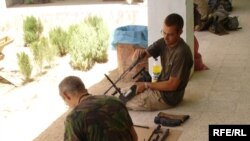
My first stopover is at FOB Ripley, or more precisely in its Dutch part called Kamp Holland (the camp is shared with the Australians). We observe ANA soldiers performing a mock vehicle check under the tutelage of Australian instructors. The ANA men are engineers by trade, but their Australian trainer says all skills come in handy "behind the wire." I chat with the Afghan soldiers, one of whom speaks English. A Pashtun hailing from Peshawar in Pakistan, he says loyalty to his country was what brought him into the army. He says "Americans" (read ISAF) are friends of the Afghan people, whereas those who do not like them are "enemies of the people." The soldier says he feels at ease wearing his uniform in the provincial capital, Tarin Kowt, but adds that he would not do so in Chora.
Which is precisely where I am headed next.
Frequent Attacks
Chora is a small Dutch base situated amidst a patchwork of areas that ISAF describes as being mostly "nonpermissive." In a "nonpermissive" environment, attacks on ISAF troops are regular. Boundaries here are fluid, the Dutch like to stress. "Going around a corner, you can go from being smiled at to being shot at," says one soldier.
We are initially scheduled to go on a patrol with the Dutch troops in a "permissive" area adjacent to their camp, but an early morning rocket attack (which does not hit either the Dutch or the nearby ANA camp) puts an end to that -- though the experience ought to be routine, as the Dutch say they suffer one attack a day.
After landing in a helicopter-generated sandstorm, I walk past an assembly of morose, tense-looking locals and enter the camp -- to emerge one-and-a-half hours later as the Black Hawks return. The compound is surrounded on three sides by towering mountains, but the Dutch soldiers do not appear cowed. To the contrary, they proudly recount the breaking of a three-day Taliban siege in late June. That, an ISAF official later says, had been the Taliban's only serious attempt this year to take the fight to NATO.
Again, I chat to ANA soldiers who say the Taliban are "strong" in the area. They say they are eager to fight, but complain they remain dependent on ISAF for air cover.

Practicing vehicle checks (RFE/RL)
They also tell me many Taliban are local. "They come from Kala-Kala," says one, referring to a notorious regional Taliban stronghold. A Dutch officer concurs, saying "more than half" of the Taliban are locals with mostly petty grudges that drive them to armed violence. He says the mood of a given locality could depend on a plethora of circumstances, among them views of the local mullahs and elders, and considerations linked to criminal enterprises. The latter is a euphemism for poppy growing, a popular pastime in Uruzgan, with two yearly crops.
The ANA soldiers also tell me that most foreign Taliban are Pakistanis, Arabs, Uzbeks, and Chechens. Like ISAF officials, they say they've learned this information from intercepted radio chatter.
The Dutch appear to take a more "caring" approach to their ISAF tasks than is the rule in the south. One senior officer says that while the security of the troops remains paramount, they always "try not to physically hurt anyone." He also says there is "no one solution" in Uruzgan, adding that the Dutch take the time to find individual solutions to each situation -- ranging from repulsing Taliban advances by force to talking to community leaders to ease local tensions.
On the way back, we fly over a green rural neighborhood emitting heady wafts of what reminds many in my party of the smell of cannabis.
Part Five: Leaving, The Afghan Way
RFE/RL Afghanistan Report

SUBSCRIBE For regular news and analysis on Afghanistan by e-mail, subscribe to "RFE/RL Afghanistan Report."