

But perhaps until now, he hasn't been known internationally as an anti-Semite.
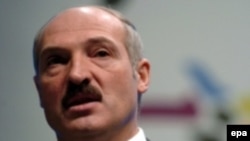
Talking to a group of Russian journalists on October 12 about the past living conditions of the southeastern town of Babruysk, Lukashenka said, "It was scary to enter, it was a pigsty. That was mainly a Jewish town -- and you know how Jews treat the place where they are living."
"Look at Israel, I've been [there]. I really don't want to offend anyone -- but they don't care much about, say, grass being cut, like in Moscow," Lukashenka said, in comments broadcast live on national radio.
Lukashenka also called on Jews "with money" to return to Babruysk, once a thriving Jewish center. Last year, the town, as the host of a harvest festival, received a large injection of state cash.
Derogatory Myths
Despite his professed intentions, Lukashenka did cause offense. Israeli officials and Jewish organizations within Belarus have condemned his comments, which have raised questions about the rise of anti-Semitism in Belarus.
Israeli Ambassador to Belarus Zeev Ben-Ari told RFE/RL's Belarus Service that Lukashenka was drawing on an old, derogatory anti-Semitic stereotype. Lukashenka's speech "alluded to the myth that I thought had died, at least among the progressive part of humanity," Ben-Ari said. "This myth sees the Jews as untidy and dirty people who smell bad -- and is undoubtedly anti-Semitic."
Israeli Foreign Minister Tzipi Livni said in a statement that "the role of leadership is to fight anti-Semitism wherever it raises its ugly head, all over the world, not to encourage it."
As a sign of protest, the Israeli Foreign Ministry considered recalling the country's ambassador to Belarus. The ministry decided against the recall, but summoned Belarusian Ambassador to Israel Ihar Lyashchenya to register "strong condemnation."
Rene van der Linden, the president of the Parliamentary Assembly of the Council of Europe, has also criticized the comments, calling on Lukashenka to apologize.
With up to 28,000 people, Belarus's Jewish community is small. According to government statistics, the two predominant religions are Belarusian Orthodoxy (80 percent) and Catholicism (14 percent).
A Growing Trend?
The point -- if there was one -- of Lukashenka's comments remains unclear. Was this just a crude lapse or was it representative of a new anti-Semitic trend in Belarusian society?
Ambassador Lyashchenya refused to recognize the anti-Semitic character of Lukashenka's statement, saying that the president had "respect and a good feeling for the Jewish people." "Belarus and anti-Semitism are mutually exclusive things," he said.
But Valeri Karbalevitch, a political commentator at RFE/RL's Belarusian Service, said Lukashenka has made anti-Semitic statements in the past, for instance comparing dishonest oligarchs with Jews, or likening his critics to people with "hooked noses."
Lukashenka has "openly made such remarks to attract support, for both in Belarusian and Russian societies anti-Semitism is evident every day. Lukashenka wanted to demonstrate that he was one of them, a representative of this segment of the population," Karbalevitch said.
But this time, Karbalevitch said he believes that Lukashenka's comments were "simply a slip of the tongue." RFE/RL's Belarus Service reports that the president's comments have not since been rebroadcast or reprinted in state-controlled media.
It is unlikely that Lukashenka's comments represent a sizable increase in anti-Semitism in Belarus.

A Belarusian man cleans a vandalized Holocaust memorial in the town of Lida (AFP)
The report noted that, during the reporting period, several Jewish religious sites had been vandalized. Last week, vandals reportedly desecrated graves in a Jewish cemetery in Babruysk and daubed the gates with a swastika.
But Franklin J. Swartz, an American historian who has lived in Belarus for 10 years collecting oral histories of Belarusian Jews and working to restore Jewish cemeteries, said the level of anti-Semitism is remarkably low in Belarus.
"Compared to other countries in the immediate vicinity of Belarus -- such as Lithuania, Latvia, Estonia, Ukraine, Russia, [and] Poland, especially -- there is very, very little, and I would say virtually no societal anti-Semitism in daily life in Belarus," said Swartz, who directs the East European Jewish Heritage Project. "During the Soviet period there was a certain amount of institutionalized anti-Semitism. But now I find no examples of that."
Little Reflection On The Past
Belarus's recent history is pockmarked with the tragedies of anti-Semitism.
Before World War II, Jews made up about 1 million out of Belarus's entire population of 10 million.
During the Nazi occupation, some 800,000 Jews were killed. Cities and towns -- including Babruysk -- turned into ghettos, labor camps, or mass graves.
Historian Swartz says that in postcommunist Belarus, the authorities have attempted to commemorate the Holocaust. "Every single town where there were Jews who were killed has an execution site that was put up by the government," Swartz said. "The wording during the Soviet period was that a peaceful Soviet citizen was killed by a fascist. Now, as they put up new ones, it is much more straightforward, and just says that Jews were killed by Germans and their collaborators."
Perhaps a deeper problem for Belarus, aside from the sporadic attacks on Jewish religious sites, is coming to terms with the past.
According to Karbalevitch, Belarusian society has not reflected deeply enough on the Holocaust.
"In Soviet times, talk of the Holocaust was hushed up," he said. "The Holocaust did not liquidate the anti-Semitic tendencies that have been present since even before the [October] Revolution."
Latest:
U.S. Calls On Lukashenka To Retract Anti-Semitic Remarks
Council Of Europe Condemns Lukashenka Remarks On Jews
RFE/RL Belarus, Ukraine, And Moldova Report

SUBSCRIBE For weekly news and analysis on Belarus, Ukraine, and Moldova by e-mail, subscribe to "RFE/RL Belarus, Ukraine, And Moldova Report."

