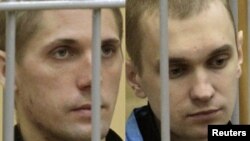
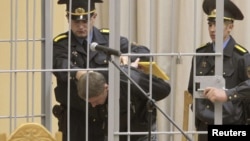
The trial of Dzmitry Kanavalau and Uladzislau Kavalyou in Minsk was held in the Palace of Justice -- "a place clearly suited for performances and concerts, not for a trial."
MINSK -- Aleh Hruzdzilovich, a correspondent with RFE/RL's Belarus Service, attended every session of the 2 1/2-month trial of accused subway bombers Dzmitry Kanavalau and Uladzislau Kavalyou, who were executed last week despite pleas for clemency and complaints that the court process was flawed.
Hruzdzilovich has written about the trial in a new book, currently being excerpted by RFE/RL's Belarus Service. In an interview with Syarhey Ablameika of RFE/RL's Belarus Service, Hruzdzilovich talks about the reasons why so many doubts remain about both the trial and the men's execution.
RFE/RL: Your book is going to be called "Who Blew Up the Minsk Metro?" But why are you posing that question? Hasn't the court already answered that question? The terrorists have been identified and put to death.
Aleh Hruzdzilovich: The court named the terrorists. But I think -- and this is according to my own impressions, as well as those of a majority of my contacts -- that everyone still has questions. I also have questions.
We're all unsure that the terrorists were Dzmitry Kanavalau and Uladzislau Kavalyou, and we're especially unsure that the degree of punishment that Kavalyou, for example, received, can be considered deserved. So it raises this important question of who did it -- a question I think that still needs to be resolved.
A combo photo of Uladzislau Kavalyou (left) and Dzmitry Kanavalau during a court hearing in Minsk in September 2011.
It's also true that this took place at a politically dangerous moment. Even now things remain complicated. There's an obvious political factor running through this entire story. So it's hard to believe that there were simply two guys who blew up a bomb like a New Year's firecracker, and that there's nothing political about it.
At the trial, I had the impression that the authorities were already taking this political factor into account; you could hear it coming through in the case materials. The judge tried to hide it, but it still got out. It's a fact that has to be considered. And if politics are involved, then it's not at all surprising that the question of who did it has yet to be fully resolved.
RFE/RL: Do you answer the question you pose, or do you leave the reader the possibility of drawing their own conclusions?
Hruzdzilovich: Of course I try to lay out my own opinion. But naturally there are still a lot of questions to which neither I nor the court can offer clear answers. The most important thing is that people -- judging from messages on the Internet, various articles, and interviews -- understand this situation pretty well or at least are trying to, and they have come up with certain theories of their own that are worthy of attention and analysis. I'm trying to analyze these theories as well. They're interesting for me, as a journalist.
'Some Kind Of Phantasmagoria'
RFE/RL: You attended the entire trial, which ran from September 15 through November 30 of last year. All in all, you were present for more than 40 court sessions. What was your lasting impression of what you saw? Was there any way in which this trial was different from others?
Hruzdzilovich: It's possible [that] the biggest difference was the atmosphere of obvious theatricality. Everything took place in the assembly hall of the Palace of Justice, a place that is clearly suited for performances and concerts, not for a trial.
Uladzislau Kavalyou is led into a holding cage before hearings in Minsk on September 15.
Up on the stage, there was an iron cage. Down below, there were people sitting in plush chairs, lounging and watching things up on the stage unfold. Occasionally the judge would step down and demonstrate some things, like a magician.
Very often this trial seemed like some kind of phantasmagoria. And then, suddenly there would be these flashes of reality -- a dog would bark in the hallway, and a masked OMON officer would squeeze through the door carrying an automatic rifle and escort the accused into the cage, their hands behind their back like some kind of bird. It was terrible -- like a shower that runs hot and cold.
RFE/RL: I was shocked by one of your stories about the fact that there were hidden balconies in the hall for correspondents from state television and the official news agency, Belta. Was it really the case that members of the state-run mass media were working under considerably better conditions than independent journalists?
Hruzdzilovich: I know for a fact it was true for Belta, because I spoke to one of their correspondents and he confirmed it. He sat up there, with his own dedicated Internet connection. All of us down in the hall had no Internet connection -- we couldn't even send text messages. During breaks we would jump out and send things from the corridor. Even in the foyer just outside the courtroom you couldn't do anything -- the connection didn't work. And that guy from Belta sat up above, and everything worked for him.
As for Belarus-TV, I didn't see exactly, because from the hall it was impossible to observe that balcony. But we could see how the judge, the lawyers, the defendants -- who were all up on the stage -- would sometimes raise their eyes and look up at someone. So we got the impression that there was someone there.
But when I saw the station's coverage of the first day of the trial, showing how one of the defendants responded to the essential question of whether he was guilty or not -- I knew that this moment couldn't have been filmed, because the judge had already raised the issue of permits and said no cameras were allowed. But it was clear that they did, and the angle of the shot suggested it was filmed from the balcony. By the way, there was also television footage of the sentencing, taken from that same balcony -- despite the judge's ban.