



The next tweets of revolution may be heard in Sochi.
At least, that’s what local police there would have you believe. Police chief Aleksandr Birillo became the latest Russian official to justify a crackdown by waving the Orange flag when he told a press conference that “one of the candidates” in the city’s April 26 mayoral election is planning mass disorders involving people trucked in from other cities. Birillo told RIA Novosti that among the evil-doers will be people “with experience participating in the March of Dissent protests” and “the Orange Revolution in Ukraine.”
As a result, the police are trucking in their own out-of-towners -- back-up troops from nearby Krasnodar. A staffer for mayoral candidate Boris Nemtsov told gazeta.ru that Nemtsov believes the point of the troops is to disrupt the process of monitoring the voting in order to cover up irregularities. Nemtsov’s campaign acknowledged that it plans to bring volunteers to Sochi to serve as election monitors.
“The Moscow Times” reports today that teachers and others have begun “early voting” in Sochi, filling out ballots en masse while sitting at tables under the watchful eye of local administration officials instead of bothering with the privacy of a voting booth. Why are the teachers voting early on a Monday (while their school remains empty)? Because, according to officials interviewed by the daily, their “work schedule” doesn’t allow them to participate in the normal vote, which is scheduled for a Sunday precisely in order to enable working people to participate.
The early-voting scam is one the Russian powers-that-be have used for ages in order to get the results they want, but it has been aggressively perfected since the 2007 Duma elections. In November 2007, gazeta.ru reported that four times more absentee ballots had been printed up for those elections than were produced for the 2003 legislative polls.
The field of candidates in Sochi has been whittled down from 25 contenders to six, as the local election commission has found pretexts and technicalities to eliminate one candidate after another. The highest-profile casualty was billionaire Aleksandr Lebedev, who has vowed to appeal his elimination and to ask that the election be nullified. Also among the rejects was Viktor Kurpitko, head of the local branch of the left-leaning, pro-Kremlin A Just Russia party.
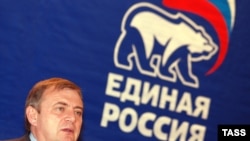
But Nemtsov remains in the race, despite being denied access to all local media and facing constant petty harassment. The Unified Russia candidate is acting Sochi Mayor Anatoly Pakhomov, who has met in recent days with both President Dmitry Medvedev and Prime Minister Vladimir Putin.
Kurpitko told RFE/RL’s Russian Service the Kremlin’s tactic is to reduce the field in order to ensure that Pakhomov wins in the first round, rightly calculating that a head-to-head second round with Nemtsov would give the articulate oppositionist too big a platform and too much exposure.
In his much-ballyhooed interview with “Novaya gazeta” last week, Medvedev praised the Sochi election, saying that it was a “genuine political battle” in which “various political forces” were participating. He added that the more such elections there are, the better it is for democracy in the country. Considering how he himself was elected president, it is hard not to read these remarks with cynicism.
For the record, though, it should be noted that some analysts see the recent developments – including Medvedev’s “Novaya gazeta” interview and the Sochi elections – as evidence that Putinism is over and Putin is on his way out the door. Analyst Aleksandr Ryklin wrote on “Yezhednevny zhurnal” last week that while such an election (if it were as competitive as Medvedev painted it) might be good for democracy, “for Putin, it is completely bad.”
For him, Olympic Sochi is not just an image project. It is a crucial, fateful project. And [opposition politician Garry] Kasparov is absolutely correct – in this case, Nemtsov is not tangling with the foul and unknown former mayor of Anapa, Pakhomov, and he isn’t even battling all of Unified Russia. All of them are mannequins, puppets. He has one opponent in Sochi, and his name is Vladimir Putin. And the more Nemtsov there is in Sochi, the less Putin will remain. If Nemtsov suddenly wins, nothing will be left of Putin. A puddle on the asphalt.
Putin, of course, understands that he is on his way out. That fortune has turned away from him. Only there is nothing he can do about it. The point of no return has been passed. And even if it has not been passed, he simply has nowhere to return to.
Clearly, if Nemtsov won and were allowed to become mayor of Sochi, it would almost certainly force us to take another look at our assessment of the state of Putinism. But if, instead, the media are hamstrung, state-sector workers are roped into massive voter fraud, police are trucked in to prevent monitoring and create an atmosphere of intimidation, and the ruling party’s faceless candidate achieves a resounding, first-round win, then we’ll have a pretty good idea that “managed democracy” is alive and well.
And if Medvedev continues to act as if this brand of political theater is good for Russian democracy, we’ll have a pretty good idea about him too.