



Wednesday, February 15, 2012


The Power Vertical

A Decade With Putin

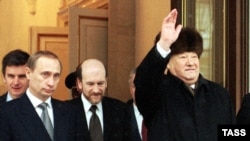
Yeltsin leaving the Kremlin on December 31, 1999.

Multimedia

TEXT SIZE - +

We are fast coming up on the 10th anniversary of Putinism. On August 9, 1999, Putin was named first deputy prime minister after the government of Sergei Stepashin was dismissed. The same day, President Boris Yeltsin named Putin acting prime minister and anointed him the presidential successor. On August 16, the Duma approved Putin as premier, making him Russia’s fifth prime minister in 18 months. And the rest is history: Yeltsin resigned on New Year’s Eve, and Putin was elected president on March 26, 2000.


So I suppose we can expect a lot of anniversary reflections over the next few weeks. The Levada Center got things rolling with a new poll on opinions about Putin. The interesting thing about the Levada poll is the stability of the views expressed over the span of the last five years. Twenty-two percent of respondents now say that Putin’s greatest achievement has been raising living standards (including wages and pensions), while 24 percent held that view in March 2004. In the latest poll, 17 percent responded that his main achievement was “the economic development of the country,” while 9 percent lauded his role in “raising optimism and hope for short-term improvements.” Only 8 percent said Putin had no significant achievements, a figure that was down from 12 percent in 2004, but up from the 5 percent registered in March 2008.


On the other hand, 35 percent of respondents said Putin had been least effective in combating corruption (President Dmitry Medvedev’s signature issue!), while 23 percent said he’d done worst at “subduing the oligarchs.”


Asked about changes in the gap between rich and poor since the Yeltsin years, 48 percent said the gap had increased, while another 31 percent said it remained the same. Only 15 percent believe the gap has been narrowed.


And why is Putin so popular? Thirty-five percent said it is because people believe Putin is capable of coping with the problems the country faces. However, 31 percent said Putin is supported because “people don’t see anyone else they can count on,” a reflection of the Kremlin’s iron-fisted control of the central media. Nonetheless, 63 percent of respondents said the fact that “practically all power in the country” is concentrated in Putin’s hands is “good for the country.” Just 16 percent disagreed with that view.


Gazeta.ru today published a really interesting commentary by veteran journalist Boris Tumanov that starts to lay some of the theoretical groundwork for looking at a decade of Putinism. It also, by the way, sheds interesting light on the ongoing debate about interpretations (falsifications) of history generally. Tumanov writes that “Russia is the only country in the world here history revels in the subjunctive mood,” and marvels that the country “still can’t decide whether the hecatomb of Stalinism was a monstrous crime or a great boon for the country.”


Anyway, Tumanov challenges the notion that if Russia had carried out a sweeping lustration (a process of exposing and barring from public life people who had worked in high Soviet posts, in the security organs, or the military leadership), then Putinism might not have happened. By the way, he calls what we have seen over the last decade “the revanche of the sovok” (sovok being a colloquial word for Soviet-minded people). I am one of those who feels the lack of lustration in Russia was and is a major obstacle to the country’s democratic development, so I read Tumanov’s take with great interest.


Tumanov basically argues that the urge to restore elements of the Soviet system began not in 1999, but in 1993 or even earlier. He argues that the results would have been largely the same if Yeltsin and Boris Berezovsky “had chosen not an ex-chekist from Petersburg, but a Petersburg lawyer or the head of a furniture store. Or even someone from Vladivostok or Novocherkassk.” No choice would have “altered the intractable clan nature of power in Russia.” Essentially, he says, anyone Yeltsin had chosen would have divided the spoils among his “own people” – people from his hometown, or people he’d studied with or people from the government agencies where he’d made his career.


The return of the sovok is inevitable in a society “where people silently endure any humiliation on the part of their own government but are outraged at the very thought that the United States might not ‘respect’ Russia or, worse ‘isn’t afraid’ of Russia.”


--Robert Coalson

Tags: Vladimir Putin , Russia

This forum has been closed.
Comment Sorting
Comments
     
by: Michael Averko
July 28, 2009 09:35
Russian or otherwise, not everyone who has been impressed with Putin is in the "sovok" category. Moreover, when it comes to former Communist bloc issues, one need not be a "sovok" to be critical of some American government policies and the at times atrocious English language mass media coverage.

In this sense, there's something resembling a kind of nouveau McCarthyism in this piece.

All this is said while agreeing that a "sovok" attitude exists among a good number of Russians. Keep in mind, that the most "European" of former Yugoslavs, the Slovenians are known to have Tito era Yugoslav nostalgic elements. This type of a mindset exists in other former Communist countries. It's therefore bogus to suggest that Russia stands alone on this matter.

A number of Americans periodically get offended when they feel a non-American source has been disrespectful of the US. Should Russians at large be different in relation to some of the sleaze dished out at them and their country?

BTW, polls in Moldova and Ukraine show that Putin would win the presidency in these two former Soviet republics against any other world leader, including the respective natives. This is the kind of politically incorrect information being regularly downplayed in English language mass media.

In an unchallenged citation, the above piece suggestively over-generalizes on the issue of how Stalin is viewed in contemporary Russia.

by: Gus from: Portland, OR
July 31, 2009 02:33
The article states:

---------------
Tumanov basically argues that the urge to restore elements of the Soviet system began not in 1999...
---------------

Which "elements" of the Soviet system are we discussing, and why is it necessarily an abomination to attempt to restore them? I'm tired of demagogical statements like that, which are based on the axiom that everything that the USSR stood for must be evil to the core. Your readers aren't so gullible that you have to shovel-feed them propaganda. Thank you for demonstrating academic dishonesty at its purest.

Like the previous poster, it puzzles me also that many Americans feel it is their duty to criticize other nations, at the same time refusing foreigners the right to criticize the state of America.

by: olga from: Los Angeles
July 31, 2009 21:30
What I love about strident Russian apologists (previous 2 comments) is their need to say things that are completely untrue while acting like they're indisputable facts. Foreigners criticize Americans and the American government all the time. This website is funded by Americans and it allows you to criticize Americans all you want. Do you not understand that?

Russian media and government officials says things that are "disrespectful" of America all the time, and most Americans could care less.

And, this piece isn't about how Stalin is viewed in contemporary Russia. DUH! Can you read? It's titled, "A Decade with Putin." And how the hell is that quote you're referring to an "unchallenged citation"?

by: Michael Averko
August 04, 2009 05:55
The above piece brings up the sovok term and its sentiment in Russia. This point leads to how some have flippantly misrepresented how Stalin is generally viewed in contemporary Russia.

I grant that the end of my comments in the previous post could've been better explained.

As fow being critical, let's not pretend it's so one way. I've heard Michael McFaul note how many Russians seem to like to tweak the US. Well, among his fellow American based wonks and mass media folks, the same is true in reverse. Yet, I don't see him highlighting that as he righteously (in a suggestive tone) passes that attitude on his Russian peers at large. He's not alone in that respect.

FYI, my criticims are with some American government policies and not against America and Americans at large.

About This Blog

The Power Vertical is a blog written especially for Russia wonks and obsessive Kremlin watchers by Brian Whitmore. It covers emerging and developing trends in Russian politics, shining a spotlight on the high-stakes power struggles, machinations, and clashing interests that shape Kremlin policy today. Check out The Power Vertical Facebook page or