



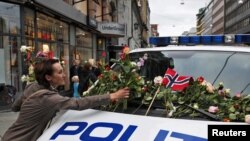
The terrorist bombing in the Minsk subway in April and the terrorist bombing and shooting in Oslo on July 22 have at least one thing in common: according to official accounts, both attacks were the work either of lone terrorists or a small group of acquaintances.
But only about one-third of Belarusians, according to opinion polls, believe one man carried out the Minsk attack, in which 15 people were killed. In Norway, the official reports have also been greeted skeptically. Many analysts have expressed the opinion that some sort of force or organization would have to be behind the bombing outside the prime minister's residence and the mass shooting at the summer camp.
In part, this is a reflection of ordinary human psychology -- every serious, important event must have such foundations. Conspiracy theories, many of which either directly or indirectly place blame on the authorities, have swirled in every country where a major terrorist attack takes place. In this way, the mind shields itself from the terrible truth of the fundamental vulnerability of modern society -- and in particular from the fact that it is vulnerable first of all to attacks from lone terrorists.
Terrorism experts acknowledge that preventing such an attack is virtually impossible. And, as we can see, neither the repressive, all-controlling nature of Belarusian society nor the open, democratic character of Norwegian society offered any immunity. Incidentally, by nearly all measures, Norway ranks among the freest and most prosperous societies in the world. But this did not prevent mass slaughter.
Such a thing wouldn't be possible in a premodern society. A person doesn't blow up his own village. Without modern technology, one person cannot sweep away dozens of people in just a few moments. And both Norway and Belarus are modern societies -- mass cultures with a high level of technology, where harmless things that are legally purchased can be turned into bombs.
The fact that Norwegian Anders Behring Breivik, unlike the Belarusian terrorists, has presented a political rationale for his crimes does not really matter much. Every society has its problems and conflicts, but only in a particular type of mind can they be transformed into a desire to commit the mass murder of one's own countrymen.
What Can Be Done?
In fact, the Belarus experience shows the senselessness of trying to find some sort of explanation for what happened in the endless ramblings of Breivik's manifesto. The real motivation might be something completely different, something completely nonpolitical. The Muslim community in Norway, incidentally, is not nearly as large as the ones in France or Germany, where we have not seen such incidents. In considering these events, rational explanations lead to a dead end since the response simply does not match the purported stimulus and was not essentially determined by it.
The reaction to a terrorist attack is sort of a mirror of society. The reason why the public in Belarus is so strongly inclined toward conspiracy theories lies not only in the nature of the attack, but also in the closed nature of a society in which people endlessly hear official pronouncements about the evil plottings of the country's enemies. Now how can we live without them?
What's more, the attitude toward the authorities is somewhat ambivalent -- many look to the state for benefits and protection, but at the same time, we see it as capable of almost anything. Capable of lies, most of all. And a lot of people hold both these views at the same time.
The portrait of a society can also be found in the answer to the question: What now? The idea that Norway should respond to the terrorist attack with increased openness is now very popular and, at first glance, seems rather strange. After all, Norway is already a global leader in this respect. What is the point of more openness if the openness the country already has didn't prevent such a tragedy in Norway? There is no point. The reasoning, rather, is that if Norway responds by, say, reducing immigration, then Breivik will have achieved his goal. And that would be a bad precedent for achieving one's political ends.
The reaction in Belarus -- at least the reaction of the authorities -- seems more logical: bolster state control. The methods that should have prevented a terrorist attack failed to do so and so, logically, they must be given the opportunity to work better. But in reality this reaction is also senseless. There were, after all, terrorist incidents in the Soviet Union and in Nazi Germany (we need only think of the assassination attempts against Leonid Brezhnev and Adolf Hitler), and today's Belarus, thankfully, is far from achieving those levels of total control.
Some observers see the expansion of the role of the secret services following the April Minsk explosion as proof that the state was involved. But that isn't necessarily the case. It is just that both societies -- Belarus and Norway -- are responding to an existential challenge to their essential foundations.
But the really rational answer might be that there is nothing to be done. That this is the price of modern society, the price of technology, the price of the constant stress of an information society. But people aren't computers. They can't think this way. Society does not seek merely to prevent the repetition of such horrors in the future, but also is looking to find some sense in life after such an event. Solidarity. Mutual aid. This is really the main response to such threats, the only one that provides the opportunity to go on.
Yuri Drakakhrust is a broadcaster with RFE/RL's Belarus Service. The views expressed in this commentary are the author's own and do not necessarily reflect those of RFE/RL
But only about one-third of Belarusians, according to opinion polls, believe one man carried out the Minsk attack, in which 15 people were killed. In Norway, the official reports have also been greeted skeptically. Many analysts have expressed the opinion that some sort of force or organization would have to be behind the bombing outside the prime minister's residence and the mass shooting at the summer camp.
In part, this is a reflection of ordinary human psychology -- every serious, important event must have such foundations. Conspiracy theories, many of which either directly or indirectly place blame on the authorities, have swirled in every country where a major terrorist attack takes place. In this way, the mind shields itself from the terrible truth of the fundamental vulnerability of modern society -- and in particular from the fact that it is vulnerable first of all to attacks from lone terrorists.
Terrorism experts acknowledge that preventing such an attack is virtually impossible. And, as we can see, neither the repressive, all-controlling nature of Belarusian society nor the open, democratic character of Norwegian society offered any immunity. Incidentally, by nearly all measures, Norway ranks among the freest and most prosperous societies in the world. But this did not prevent mass slaughter.
Such a thing wouldn't be possible in a premodern society. A person doesn't blow up his own village. Without modern technology, one person cannot sweep away dozens of people in just a few moments. And both Norway and Belarus are modern societies -- mass cultures with a high level of technology, where harmless things that are legally purchased can be turned into bombs.
The fact that Norwegian Anders Behring Breivik, unlike the Belarusian terrorists, has presented a political rationale for his crimes does not really matter much. Every society has its problems and conflicts, but only in a particular type of mind can they be transformed into a desire to commit the mass murder of one's own countrymen.
What Can Be Done?
In fact, the Belarus experience shows the senselessness of trying to find some sort of explanation for what happened in the endless ramblings of Breivik's manifesto. The real motivation might be something completely different, something completely nonpolitical. The Muslim community in Norway, incidentally, is not nearly as large as the ones in France or Germany, where we have not seen such incidents. In considering these events, rational explanations lead to a dead end since the response simply does not match the purported stimulus and was not essentially determined by it.
The reaction to a terrorist attack is sort of a mirror of society. The reason why the public in Belarus is so strongly inclined toward conspiracy theories lies not only in the nature of the attack, but also in the closed nature of a society in which people endlessly hear official pronouncements about the evil plottings of the country's enemies. Now how can we live without them?
What's more, the attitude toward the authorities is somewhat ambivalent -- many look to the state for benefits and protection, but at the same time, we see it as capable of almost anything. Capable of lies, most of all. And a lot of people hold both these views at the same time.
The portrait of a society can also be found in the answer to the question: What now? The idea that Norway should respond to the terrorist attack with increased openness is now very popular and, at first glance, seems rather strange. After all, Norway is already a global leader in this respect. What is the point of more openness if the openness the country already has didn't prevent such a tragedy in Norway? There is no point. The reasoning, rather, is that if Norway responds by, say, reducing immigration, then Breivik will have achieved his goal. And that would be a bad precedent for achieving one's political ends.
The reaction in Belarus -- at least the reaction of the authorities -- seems more logical: bolster state control. The methods that should have prevented a terrorist attack failed to do so and so, logically, they must be given the opportunity to work better. But in reality this reaction is also senseless. There were, after all, terrorist incidents in the Soviet Union and in Nazi Germany (we need only think of the assassination attempts against Leonid Brezhnev and Adolf Hitler), and today's Belarus, thankfully, is far from achieving those levels of total control.
Some observers see the expansion of the role of the secret services following the April Minsk explosion as proof that the state was involved. But that isn't necessarily the case. It is just that both societies -- Belarus and Norway -- are responding to an existential challenge to their essential foundations.
But the really rational answer might be that there is nothing to be done. That this is the price of modern society, the price of technology, the price of the constant stress of an information society. But people aren't computers. They can't think this way. Society does not seek merely to prevent the repetition of such horrors in the future, but also is looking to find some sense in life after such an event. Solidarity. Mutual aid. This is really the main response to such threats, the only one that provides the opportunity to go on.
Yuri Drakakhrust is a broadcaster with RFE/RL's Belarus Service. The views expressed in this commentary are the author's own and do not necessarily reflect those of RFE/RL

