




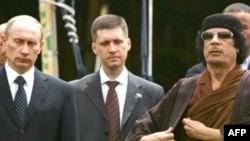
Russian policy toward Libya over the past few months has been a study in ambivalence. Earlier this month, Kremlin emissary Mikhail Margelov met with the Libyan opposition and declared them "serious and responsible people." He also held talks with Qaddafi government officials about the dictator's possible exit. Meanwhile, with striking inconsistency, Moscow dispatched chess champion Kirsan Ilyumzhinov to Tripoli to cultivate good relations with the Libyan strongman.
The reasons why the Russian government can't quite make up its mind about Libya say volumes about Moscow's complicated feelings toward the Arab Spring. In Libya, the Russians face a tangle of commercial and strategic interests that entails both risks and opportunities. The possible collapse of Qaddafi's regime could doom arms contacts worth some $4 billion -- not to mention the huge stake held by Russian state energy champion Gazprom (along with Italy's ENI) in Libya's Elephant oil field. Losing the Elephant investment would be especially painful, since Moscow and Gazprom have spent years trying to gain decisive influence over the European energy market by obtaining leverage over North African gas supplies to Europe. Russia is also worried by what it sees as a growing tendency toward armed intervention by the West. In March, Russian Defense Minister Anatoly Serdyukov told visiting U.S. Defense Secretary Robert Gates that the surest way to protect civilians in Libya was an immediate cease-fire. That was the day after Prime Minister Vladimir Putin denounced the intervention in Libya as a "medieval call for a crusade, when someone would call on someone to go to a specific place and liberate something."
And yet, shortly after Putin's criticisms, Medvedev openly contradicted his mentor. He defended Russia's decision to abstain on the UN Security Council resolution authorizing the NATO effort in Libya and warned that the word "crusade" could lead to a "clash of civilizations." The reluctance to oppose intervention probably owed much to the understanding that there was little Moscow could do to stop the NATO operation. But there's also the point that Russia has benefited from the spike in oil prices caused, at least in part, by the Libyan chaos. Not only does the corresponding increase in Russian government revenues obviate the need to undertake modernizing the political and economic system, but it also allows Putin to advertise Russia's reliability as an energy supplier -- one not roiled by domestic upheavals.
Russia's responses to the Arab Spring have tended, like our own, to differ from country to country. In Tunisia and Egypt, Russia underscored its interest in local solutions -- perhaps because its own commercial and strategic interests in both of those countries are relatively minimal. Syria, by contrast, is an entirely different matter. This is one case where Russia's tacit cooperation with the West on Libya is not likely to be replicated. Indeed, Moscow, along with Beijing, has threatened to veto any Security Council action on Syria and announced that it would not even consider such a resolution. Foreign Minister Sergei Lavrov has declared Russia's firm opposition to bringing Syria before the Security Council. The unrest there, he said, is purely a Syrian internal affair, and went on to emphasize that, in Russia's view, "all this must stop so that the reforms announced by President al-Assad can be implemented." Moscow's intransigence is relatively easy to explain. Russia's close relations with the Ba'ath regime in Damascus go all the way back to Soviet days; Syria still buys virtually all of its weaponry from Moscow. The Kremlin is also wary of jeopardizing its ties with Iran, Assad's backer. Meanwhile, as Russia sees it, the NATO operation in Libya has far exceeded the original UN mandate, and Moscow does not want to see anyone try a repeat performance with Syria.
Closer to home, Russian reactions to the wave of revolutionary change in the Middle East also betray a mix of motivations. First, from Medvedev down, Russian officials fear that Islamist forces, most notably the Muslim Brotherhood in Egypt, will be the eventual winners of any democratic election -- and that this could have a direct impact on rising Islamist movements within Russia itself, which is still plagued by a lingering insurgency in the North Caucasus. The elite also believes that revolutions that come close to Russia are invariably instigated by outside forces. At a meeting to discuss the instability in Russian's North Caucasus, where militants are seeking to overthrow local governments and have staged numerous terrorist attacks, President Medvedev said about the Middle East: "These states are very complex. It is quite possible that difficult events will occur, including the rise of fanatics to power... It is necessary to look truth in the eye. They earlier prepared such a scenario for us."
Meanwhile, at a session of the Russian parliament in April, the government revealed that it had counseled the Central Asian states to implement modest reforms, much like those undertaken in Russia since 2005. In the name of preserving stability, Russia recommended that these states develop their education systems and improve the living standards of their populations. Further advice included creation of civil society and the establishment of inter-religious peace.
Yet this well-meaning advice only goes so far. Even as the Kremlin urges its friends in Central Asia to become more responsive to the needs of their own populations, it continues to use every means at its disposal to make sure that rising domestic discontent cannot spill into the streets. Most notably, perhaps, the Russian government has recently proposed that the owners of online social media should be held responsible for all content posted on their websites -- an apparent effort to forestall a "Facebook Revolution" at home. Prime Minister Putin recently vowed to create 25,000,000 new jobs over the next decade, and both he and Medvedev are promising wage hikes. While some of this largesse can be explained by the approach of the next round of national elections in 2012, their sheer scale suggests that the powers-that-be are seriously concerned about a possible recurrence of the sorts of anti-government demonstrations that took place in 2005.
Could Middle East events be replicated in Russia? A recent public opinion poll indicates that 49 percent of respondents (up from 38 percent a month earlier) were ready to participate in protests, while another 24 percent said they would join a rally or other local protest action (up from 18 percent a month earlier). These are not overwhelming numbers, and yet the authorities are clearly rattled. Even a Kremlin loyalist such as Konstantin Kosachev, the chairman of the Duma's International Affairs Committee, recently urged the government and society to heed the lessons of the Arab Awakening. Without a return to democratization in Russia, neither Putin nor Medvedev can afford to support the wave of people power sweeping the Middle East. For the time being, though, all signs point not to democratization, but to increased corruption, authoritarianism, and state chauvinism.
The Arab spring has turned into the Arab summer, and the situation in the Middle East remains unsettled. For the moment, at least, Kremlin policies toward the region follow suit. In the short run, Russian foreign policy will likely continue to focus on the same priorities: preventing further western military interventions, looking to take advantage of any openings, and protecting long-standing economic interests. Over the longer term, however, it remains to be seen how long Moscow can manage to muddle through -- both domestically and internationally.
Stephen Blank is a professor of Russian National Security Studies at the U.S. Army War College. Carol Saivetz is a Research Affiliate in the Security Studies Program of the Massachusetts Institute of Technology. The views expressed in this commentary are the author's own and do not necessarily reflect those of RFE/RL
The reasons why the Russian government can't quite make up its mind about Libya say volumes about Moscow's complicated feelings toward the Arab Spring. In Libya, the Russians face a tangle of commercial and strategic interests that entails both risks and opportunities. The possible collapse of Qaddafi's regime could doom arms contacts worth some $4 billion -- not to mention the huge stake held by Russian state energy champion Gazprom (along with Italy's ENI) in Libya's Elephant oil field. Losing the Elephant investment would be especially painful, since Moscow and Gazprom have spent years trying to gain decisive influence over the European energy market by obtaining leverage over North African gas supplies to Europe. Russia is also worried by what it sees as a growing tendency toward armed intervention by the West. In March, Russian Defense Minister Anatoly Serdyukov told visiting U.S. Defense Secretary Robert Gates that the surest way to protect civilians in Libya was an immediate cease-fire. That was the day after Prime Minister Vladimir Putin denounced the intervention in Libya as a "medieval call for a crusade, when someone would call on someone to go to a specific place and liberate something."
And yet, shortly after Putin's criticisms, Medvedev openly contradicted his mentor. He defended Russia's decision to abstain on the UN Security Council resolution authorizing the NATO effort in Libya and warned that the word "crusade" could lead to a "clash of civilizations." The reluctance to oppose intervention probably owed much to the understanding that there was little Moscow could do to stop the NATO operation. But there's also the point that Russia has benefited from the spike in oil prices caused, at least in part, by the Libyan chaos. Not only does the corresponding increase in Russian government revenues obviate the need to undertake modernizing the political and economic system, but it also allows Putin to advertise Russia's reliability as an energy supplier -- one not roiled by domestic upheavals.
Russia's responses to the Arab Spring have tended, like our own, to differ from country to country.
Russia's responses to the Arab Spring have tended, like our own, to differ from country to country. In Tunisia and Egypt, Russia underscored its interest in local solutions -- perhaps because its own commercial and strategic interests in both of those countries are relatively minimal. Syria, by contrast, is an entirely different matter. This is one case where Russia's tacit cooperation with the West on Libya is not likely to be replicated. Indeed, Moscow, along with Beijing, has threatened to veto any Security Council action on Syria and announced that it would not even consider such a resolution. Foreign Minister Sergei Lavrov has declared Russia's firm opposition to bringing Syria before the Security Council. The unrest there, he said, is purely a Syrian internal affair, and went on to emphasize that, in Russia's view, "all this must stop so that the reforms announced by President al-Assad can be implemented." Moscow's intransigence is relatively easy to explain. Russia's close relations with the Ba'ath regime in Damascus go all the way back to Soviet days; Syria still buys virtually all of its weaponry from Moscow. The Kremlin is also wary of jeopardizing its ties with Iran, Assad's backer. Meanwhile, as Russia sees it, the NATO operation in Libya has far exceeded the original UN mandate, and Moscow does not want to see anyone try a repeat performance with Syria.
Closer to home, Russian reactions to the wave of revolutionary change in the Middle East also betray a mix of motivations. First, from Medvedev down, Russian officials fear that Islamist forces, most notably the Muslim Brotherhood in Egypt, will be the eventual winners of any democratic election -- and that this could have a direct impact on rising Islamist movements within Russia itself, which is still plagued by a lingering insurgency in the North Caucasus. The elite also believes that revolutions that come close to Russia are invariably instigated by outside forces. At a meeting to discuss the instability in Russian's North Caucasus, where militants are seeking to overthrow local governments and have staged numerous terrorist attacks, President Medvedev said about the Middle East: "These states are very complex. It is quite possible that difficult events will occur, including the rise of fanatics to power... It is necessary to look truth in the eye. They earlier prepared such a scenario for us."
Meanwhile, at a session of the Russian parliament in April, the government revealed that it had counseled the Central Asian states to implement modest reforms, much like those undertaken in Russia since 2005. In the name of preserving stability, Russia recommended that these states develop their education systems and improve the living standards of their populations. Further advice included creation of civil society and the establishment of inter-religious peace.
Yet this well-meaning advice only goes so far. Even as the Kremlin urges its friends in Central Asia to become more responsive to the needs of their own populations, it continues to use every means at its disposal to make sure that rising domestic discontent cannot spill into the streets. Most notably, perhaps, the Russian government has recently proposed that the owners of online social media should be held responsible for all content posted on their websites -- an apparent effort to forestall a "Facebook Revolution" at home. Prime Minister Putin recently vowed to create 25,000,000 new jobs over the next decade, and both he and Medvedev are promising wage hikes. While some of this largesse can be explained by the approach of the next round of national elections in 2012, their sheer scale suggests that the powers-that-be are seriously concerned about a possible recurrence of the sorts of anti-government demonstrations that took place in 2005.
Even a Kremlin loyalist such as Konstantin Kosachev, the chairman of the Duma's International Affairs Committee, recently urged the government and society to heed the lessons of the Arab Awakening.
Could Middle East events be replicated in Russia? A recent public opinion poll indicates that 49 percent of respondents (up from 38 percent a month earlier) were ready to participate in protests, while another 24 percent said they would join a rally or other local protest action (up from 18 percent a month earlier). These are not overwhelming numbers, and yet the authorities are clearly rattled. Even a Kremlin loyalist such as Konstantin Kosachev, the chairman of the Duma's International Affairs Committee, recently urged the government and society to heed the lessons of the Arab Awakening. Without a return to democratization in Russia, neither Putin nor Medvedev can afford to support the wave of people power sweeping the Middle East. For the time being, though, all signs point not to democratization, but to increased corruption, authoritarianism, and state chauvinism.
The Arab spring has turned into the Arab summer, and the situation in the Middle East remains unsettled. For the moment, at least, Kremlin policies toward the region follow suit. In the short run, Russian foreign policy will likely continue to focus on the same priorities: preventing further western military interventions, looking to take advantage of any openings, and protecting long-standing economic interests. Over the longer term, however, it remains to be seen how long Moscow can manage to muddle through -- both domestically and internationally.
Stephen Blank is a professor of Russian National Security Studies at the U.S. Army War College. Carol Saivetz is a Research Affiliate in the Security Studies Program of the Massachusetts Institute of Technology. The views expressed in this commentary are the author's own and do not necessarily reflect those of RFE/RL