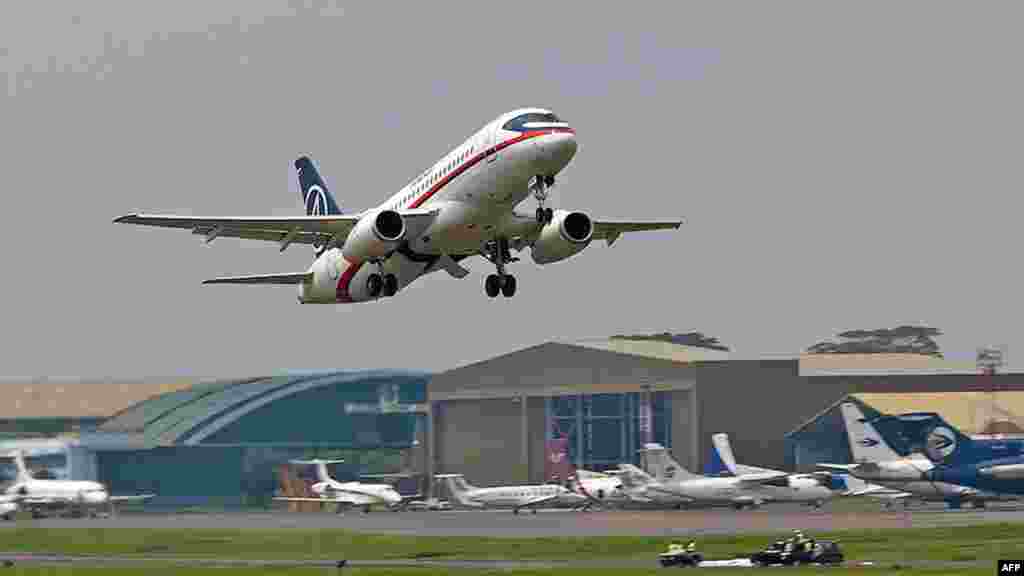
A Russian Sukhoi Superjet 100 takes off for a demonstration flight at Jakarta's Halim Perdanakusuma airport on May 9. It crashed shortly afterwards.
The Sukhoi Superjet-100 was designed to restore pride in Russia's aviation industry.
By creating its first new passenger aircraft since the collapse of the Soviet Union, Russia hopes to gradually replace its creaking Soviet-era fleet of passenger planes and regain a foothold on the international civil aviation market.
These hopes suffered a painful blow on May 9 when the Superjet crashed into an Indonesian mountain with some 50 people on board. There were no survivors.
Ironically, the plane was performing a promotional flight as part of a six-nation tour of Asia aimed at drumming up more orders.
Potential buyers will be closely watching the results of the investigation to determine whether the plane crashed due to mechanical or pilot error.
Nonetheless, Russian aviation experts remain upbeat about the Superjet's commercial prospects.
'An Isolated Incident'
"Although some buyers may react emotionally, an isolated incident cannot threaten any plans," says Aleksei Sinitsky, the editor of Russia's "Aviatransport Review" magazine.
"After all, we are talking about a plane that obtained a European certificate of airworthiness. It's no miracle of technology, but it's a perfectly good, modern aircraft that is capable of finding its niche on the market."
Russian Airliner Crashes In Indonesia
1/7The Sukhoi Superjet 100 passenger plane at Jakarta-Halim Perdana Kusuma Airport in a May 9 photo.
A Russian-made Sukhoi Superjet 100 with around 50 people aboard went missing from radar screens during a promotional flight just south of the Indonesian capital, Jakarta, on May 9. Wreckage suggested it had slammed into the side of a dormant volcano, with no initial signs of survivors from among the diplomats, businessmen, journalists, and crew.
2/7A handout photo of the Sukhoi Superjet 100 that crashed as it took off for a demonstration flight on May 9 from Jakarta's Halim Perdanakusuma Airport.
A Russian-made Sukhoi Superjet 100 with around 50 people aboard went missing from radar screens during a promotional flight just south of the Indonesian capital, Jakarta, on May 9. Wreckage suggested it had slammed into the side of a dormant volcano, with no initial signs of survivors from among the diplomats, businessmen, journalists, and crew.
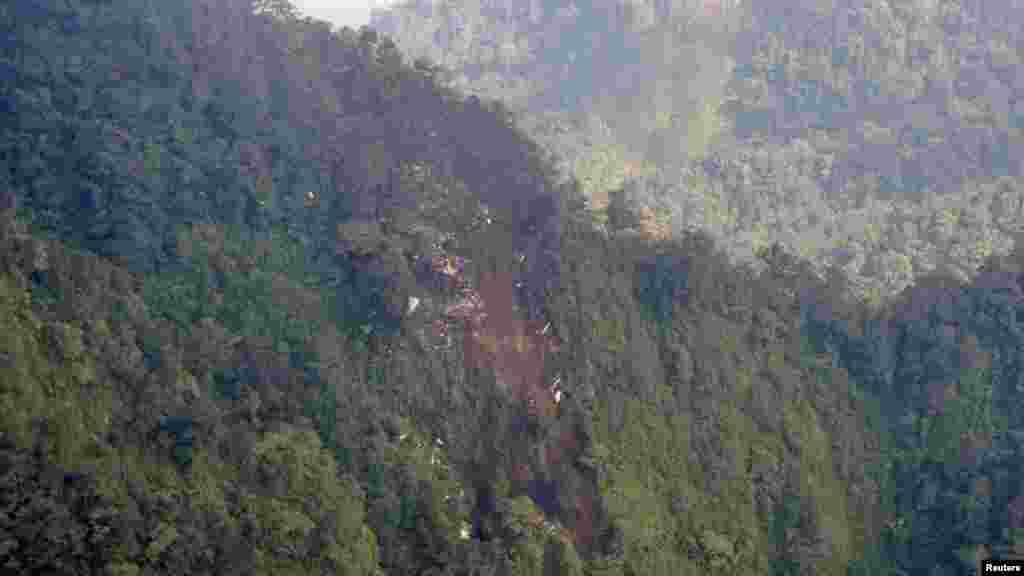
3/7A view of the Sukhoi aircraft's wreckage on Mount Salak, in the West Java province of Indonesia, on May 10.
A Russian-made Sukhoi Superjet 100 with around 50 people aboard went missing from radar screens during a promotional flight just south of the Indonesian capital, Jakarta, on May 9. Wreckage suggested it had slammed into the side of a dormant volcano, with no initial signs of survivors from among the diplomats, businessmen, journalists, and crew.
4/7Relatives of a passenger of the missing Sukhoi aircraft grieve as the ill-fated plane's passenger list is checked at Halim Perdana Kusuma Airport in Jakarta.
A Russian-made Sukhoi Superjet 100 with around 50 people aboard went missing from radar screens during a promotional flight just south of the Indonesian capital, Jakarta, on May 9. Wreckage suggested it had slammed into the side of a dormant volcano, with no initial signs of survivors from among the diplomats, businessmen, journalists, and crew.
5/7The plane's manufacturer, Sukhoi, is trying to enter the commercial aircraft market after years making military jets like the Su-35 and T-50 in this shot from a 2011 test flight.
A Russian-made Sukhoi Superjet 100 with around 50 people aboard went missing from radar screens during a promotional flight just south of the Indonesian capital, Jakarta, on May 9. Wreckage suggested it had slammed into the side of a dormant volcano, with no initial signs of survivors from among the diplomats, businessmen, journalists, and crew.
6/7An Aeroflot Sukhoi Superjet 100 like the one that crashed is seen landing at Moscow's Sheremetyevo Airport on March 28.
A Russian-made Sukhoi Superjet 100 with around 50 people aboard went missing from radar screens during a promotional flight just south of the Indonesian capital, Jakarta, on May 9. Wreckage suggested it had slammed into the side of a dormant volcano, with no initial signs of survivors from among the diplomats, businessmen, journalists, and crew.
7/7Soldiers and members of a search-and-rescue team rushed to the crash site in hopes that some of the 50 or so passengers and crew survived.
A Russian-made Sukhoi Superjet 100 with around 50 people aboard went missing from radar screens during a promotional flight just south of the Indonesian capital, Jakarta, on May 9. Wreckage suggested it had slammed into the side of a dormant volcano, with no initial signs of survivors from among the diplomats, businessmen, journalists, and crew.
Previous slide
Next slide
The Superjet, which can carry up to 103 passengers, has been touted as Russia's answer to similar planes by other manufacturers, such as Canada's Bombardier and Brazil's Embraer.
It was developed in cooperation with Western partners, including Italy's Finmeccanica and French aerospace firms Thales and Safran.
So far, Sukhoi has orders for 170 Superjets worldwide.
Until the crash, Indonesia, with its fast-growing middle class, was poised to become one of the biggest potential clients. Two Indonesian airlines have already placed orders for at least 42 jets.
The Russian presidential administration, too, recently voiced interest in purchasing several Superjets.
Sukhoi plans to produce up to 1,000 of the planes by 2029, primarily for foreign buyers.
While the crash is unlikely to significantly hurt the plane's commercialization, it remains a deeply embarrassing incident for Sukhoi that comes just one year after its inaugural passenger flight.
The tragedy also revives concerns about Russia's aviation safety fuelled by a spate of deadly plane crashes in recent years.
Delays And Mishaps
Magomed Tolboyev, a renowned Russian test pilot, has described the incident as a "slap in the face" for the country's aviation industry.
"I don't know what happened there, but the aircraft is not to blame, it's a fine plane," he says. "But what was the crew doing? There were representatives of potential buyers on board. How could they do that?
"As I have warned many times, we are ruining Russian aviation! It was a brand new jet, and they destroyed it."
Despite being largely viewed as a reliable aircraft, the Superjet itself has suffered a series of development delays and minor mishaps.
Just days ago, a Superjet overran the runway during a landing in the Russian city of Kazan. No one was injured.
A technical glitch forced the cancellation of a scheduled flight in March. And the first Superjet to be used by Russia's flagship carrier, Aeroflot, was grounded for weeks due to an air-conditioning problem.
Another setback to hit the Superjet was a report by the Russian television station NTV revealing that dozens of employees at the manufacturing plant had purchased fake engineering diplomas from a local technical college.
Sukhoi said the employees were not directly involved in assembling the planes.