



Saturday, May 26, 2012


The Power Vertical

The Kremlin's Divide And Conquer Strategy

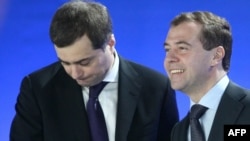
President Dmitry Medvedev (right) and the deputy Kremlin chief of staff Vladislav Surkov.
TEXT SIZE - +
Praise the rank-and-file protestors. Deride the 'professional opposition.' Offer some concessions on the margins. Divide, rule, and hope everything goes back to 'normal.'
 
This appears to be the Kremlin's strategy for dealing with Russia's new post-December 4 political milieu.
 
There were hints of this in Prime Minister Vladimir Putin's December 15 live call-in program where he proposed some tepid political reforms and claimed to be "pleased" to see "young, active people formulating their opinion clearly" in anti-government protests -- while darkly suggesting that some of their leaders were in the pay of foreign powers. 
 
And there were more hints in President Dmitry Medvedev's state-of-the-nation speech on Thursday when he proposed "a comprehensive reform of the political system" that would give "all active citizens the legal chance to participate in political life" -- but vowed that the authorities would "not let provocateurs and extremists involve society in their adventures."
 
But the clearest indication of how Team Putin plans to proceed came -- fittingly -- in comments by Deputy Kremlin Chief of Staff Vladislav Surkov, the regime's unofficial ideologist.
 
In an interview that appeared today in "Izvestiya," Surkov suggested that the reforms Putin and Medvedev were offering -- restoring the election of governors, easing the rules for registering candidates and parties for elections -- would be sufficient to assuage the protest movement: 
 
Change is not just coming, it has already taken place. The system has already changed. This is a fait accompli.  Look at the results of the Duma elections. Look at the protests on Bolotnaya Square.  Look at the discussions on the web. Look at the prime minister's call-in program on December 15.  Look at the president's address to the nation. All that remains is to formalize these changes legally.
 
I think some influential people may try to slow down these changes, but they will not stop the process. The tectonic structure of the society has been set in motion. The social fabric has acquired a new quality. We are already in the future. And the future is troubled. But there is no reason to be afraid. Turbulence, even strong turbulence, is not a disaster, but rather a kind of stability. Everything will be fine.
 
And he made a distinction between the majority of the protesters, whose opinions deserve respect, and a minority of rabble rousers seeking to foster a colored revolution:
 
There are those who wish to convert the protests into an Orange Revolution, that's for sure. They are acting according to the methods of [non-violent revolutionary theorist Gene] Sharp and using the latest revolutionary techniques to such an extent that it has even become boring. I would advise these gentlemen to abandon that dream.
 
But the point is not these swindlers. The point is the absolute reality and naturalness of the protests. This is the best part of our society, or rather, the most productive part of society -- and it is demanding self-respect.
 
They are saying 'we are here, we are meaningful, we are people.' We cannot arrogantly dismiss their opinions. The right thing for the authorities to do is to take their opinions into account and respond benevolently. We have proposed the direct election of governors and the practically free registration of parties. We are yielding to the reasonable requirements of the active part of society -- we were not forced to do this, it is our constitutional duty and obligation.
 
Of course, one could argue that those going to the streets are a minority. This is true, but what a minority! And if you look, after all, at the ruling majority, it is also, in fact, a minority. It is just a bigger minority. Modern democracy in a complex and fractured society is generally a democracy of minorities. If you think strategically and listen to the minority, then among them you will find tomorrow's leaders.
 
Of course, the crowd may make unreasonable demands, and at times and kowtow to provocateurs. But for provocateurs we have the law. We have a duty to protect the state's foundations and the constitutional order.
 
So Team Putin has started to negotiate with a newly energized civil society. They appear to be gambling that the concessions they offered will be enough to take the steam out of the protests and split the previously apolitical (or previously pro-Putin) middle class -- which accounts for the mass of the demonstrators -- from leading opposition figures like Boris Nemtsov, Ilya Yashin, Aleksei Navalny, and Yevgenia Chirikova. They aim to appease the former while isolating and discrediting the latter.
 
Here is political analyst Nikolai Troitsky speaking to "Kommersant FM"
 
Surkov is a clever man and he can certainly see and understand that it wasn't a handful of outsiders who came to the streets and squares in December. There was a new force -- people who had basically been apolitical. According to the principle of 'divide and conquer,'  Surkov is seeking to divide this force -- which still doesn't have a leader or a structure -- from the non-systemic opposition, which has long pushed for changes.
 
Whether it will work is still an open question. And there is an important detail that Surkov (as well as Putin and Medvedev) left out: none of the proposed reforms will be enacted until at least 2013, when the current election cycle is over and Putin is safely embedded in the Kremlin.
 
Political analyst Paul Svyatenko makes this case in an interview with Kommersant FM:
 
Surkov's interview  was an attempt to argue that the demonstration on Saturday makes no sense because the authorities have already solved the issues that were driving people to the streets. But in reality this is not the case. The measures proposed by Medvedev in his December 22 speech only mapped out ways to democratize Russia's political system. But they will not be implemented until the next electoral cycle, which means for the Duma in 2016 and for president in 2018.
 
There has been some chatter among journalists and analysts suggesting that Surkov, who was passed over for Kremlin chief of staff in favor of Sergei Ivanov, is on the outs. "Kommersant," for example, cited unidentified sources as saying Putin wouldn't work with him.
 
Likewise, political analyst Igor Bunin suggested in an interview on Dozhd TV that Surkov's comments to "Izvestiya" were out of step with the elite's thinking because he praised the protesters.
 
 
The claim in "Kommersant" could be true. But I think that a more likely explanation for Surkov being passed over (if that is indeed what happened) that he is more suited to working in the shadows, as a deputy chief of staff and informal ideologist, than as the Kremlin's chief administrsor. 
 
But his "Izvestiya" interview is, in my opinion, completely on message and consistent with the narrative being pushed by both Putin and Medvedev.
 
-- Brian Whitmore
 

Tags: Vladimir Putin , Russian protests , Vladislav Surkov , Dmitry Medvedev

This forum has been closed.
Comment Sorting
Comments
     
by: La Russophobe from: USA
December 23, 2011 18:26
"Whether it will work is still an open question." It's fine to ask that question, but it is not close to being complete analysis. You must also ask whether it needs to work, whether there any real movement that the Kremlin needs to contend with. The fact that 0.5% of the population demonstrates in an unfocused way with no real leadership in Moscow every other month does not mean the Kremlin has any kind of serious problem that it needs to address.
In Response

by: WorldTraveler from: NY/USA
December 25, 2011 10:16
Your comment sounds like another attempt to belittle, or marginalize the opposition. The truth is the protesters speak for a vast number of Russians who are fed up with the pathetic state of their country, and who see through Putin's rhetoric, and staged photo-ops. Most in Russia know their country is among the most corrupt in the World, and rightly blame of the government for this. It's time for a change and Putin should step down; this trading of posts with Medvedev is silly and counter to any semblance of democracy.
In Response

by: Anonymous
December 28, 2011 10:18
that Russia is not able to evolve in the sense that many hoped
is certainly true .

But ... speak about a "pathetic state of their country" this is
the result of an assessment dense of prejudice .

What you and others don't understand Is that protestors

are not expression of a will of more Democratic

are not expression of a will of more open-mindedness to the world

what they realy want is something of worse than the "Putin power " that everyday you criticize .

More or less

is how to be happy

for the protests of the Taliban in Afghanistan .
In Response

by: EB from: USA
December 25, 2011 13:22
Whether you take the 30K or 100K figure for the number of protesters, it is by far the biggest problem the Kremlin has had to face in Putin's time in terms of public opinion. I don't see how this could be seen as anything less than a new and threatening situation to power. Yes, the main effort is limited to Moscow, but Moscow matters most. As for unfocused - their primary message has been quite clear - new parliament elections. That is a lot more focus than we've seen in all of the Occupy protests all over the US.
In Response

by: rick from: Milan
December 28, 2011 10:33
you cannot impose new election
only because you do not like the results !

THIS IS NOT DEMOCRTIC

you cannot impose new election
only with the power of the square

THIS IS NOT DEMOCRTIC

you cannot impose new election
without concrete evidence

THIS IS NOT DEMOCRTIC

you cannot impose new election
without been expression of a definite portion of population

THIS IS NOT DEMOCRTIC .

VERY SOON
they will have their chance
for impose their political will

If they will be able to present fot the next presidential elections
a single candidate for the position of president
a single candidate who is also credible
and not the usual opportunistic oligarch

them, the protesters will have their chance for change

We have just to see
if it will be change for the better
or for worse
In Response

by: World Traveler from: NY/USA
December 28, 2011 21:26
To rick from Milan - It isn't a question of not liking the results of the election; the issue is the elections themselves are un-democratic. There is no transparency, and all institutions in Russia including the Judiciary and media are no longer independent. Corruption is endemic and Putin has consolidated power in a way that bears no semblance to true democracy. Putin, and his party, are the problem. Period. The only solution, which seems unlikley in the short term, is to abolish most of what Putin has put in place and start a fresh. Of course, a revolution would work just as well. Let's hope the protests continue to grow, and those in power continue to feel the heat. And perhaps the biggest problem has been Putin's reaction, which by-in large has been to demean and belittle the protesters.

by: Tomac from: San Francisco, USA
December 27, 2011 10:39
Sir,

The nature of the protests in Moscow at this point, and in the foreign capitols is impressive as many Russians are seen to be apolitical, and however reluctantly, followers of the leaders of the current regime. The reasons for this are that Russia itself does appear to still be dealing with breaking from its leftist orientation during the 1900's, and the current regime does promise better economic and business development for the country as a way of dealing with this. These are just two simple reasons (promises) that allow for the populace to usher in the Putin regime in 2012. That even small protests have taken place, and in cities abroad, indicates the overall scepticism of Russians about 'Team Putin,' as well as the renewed emphasis in government apparently on the military and security services. The reaction of the crowds in Moscow and abroad are classic with respect to the apparent resented and reviled alchemy of the state to exercise dominion over its populace at home and abroad and its political promises among other things.

That there is question as to the legitimacy of results of recent elections gives rise to ordinary curiosity about related details and the methods of the various parties who benefited from the outcome of the elections. Usually, even in political regimes that are quite large, there is some acquiescence as to official looking into the election problems, and then some certification of results either way. The protests do not appear thus to have enough of an impact to warrant this, even to test the proposition of improprieties, and this is probably the result of the spontaneity of the gatherings and some lack of organisation and influence over the regime that ignores them apart from security issues. It is unfortunate the crowds are pointing out the unfulfilled promises of the post - Soviet era, and it is as well unfortunate there appears to be no direction in Russia today along the lines of more liberal reforms: The regime continues to favour a public emphasis on heavily profitable commercial activities, business influences as beholden to the state, and public policy, even confiscatory and intrusive as it can be, probably just as arbitrary as it was before the Yeltsin era. All these points bring up more politics and some of these are points of contention that will never be resolved, and because, and again anew, the regime has found fertile and profitable ground in fixed ideas and a preoccupation with constitutional decisiveness and a strict rule of law, centrism, the regional power and even arbitrary edicts of Moscow and its workings over all of the country.

One is far from the dictature of the proletariat here, it does seem, and there is nonetheless a 'United Russia' party line that dispenses with the efforts at forming a government of consensus or some coalition of parties and interests without regard to efforts to further centralise rule and pre - determine regional politics as secondary to those in Moscow. This is a kind of tradition in politics and administration in Russia and is important insofar as constitutional and other powers and rights of the people are concerned - especially insofar as it is allowed through public debate and resolution through the coming elections.

by: Myron from: USA
December 28, 2011 01:18
As a student of Russian history, this struck me as having some of the same lines as the 1905 Revolution, the regime seeing the popular will to make some changes, but in the end, really are meaningless. What did they do in 1905? Nicholas derided the opposition, offered some concessions, and went back to ruling as he always had since 1894. Nicholas derided opposition as being in control of foreign powers, namely communists and anarchists from aboard (Lenin, Trotsky, et al). Nicholas graciously "allowed" political parties he could manipulate and only would sign off on reforms he wanted, and it took several Dumas to get the one he wanted. In 1905, they neutralized a lot of people as they took the wait and see approach. We all know how it ended 12 years later.
In Response

by: rick from: Milan
December 28, 2011 10:02
how can you do in comparison

between Tsarist regime and a system that has all the tools for be called democratic?

The truth is that who express an anti-democratic are these protesters
expression of a political conception of intransigence and authoritarianism
even greater than the so-called "vertical of power"
nostalgic for the Soviet Union and Nazi-inspired convinced ipernationalists

This People is claiming for the USSR 2 and crying with a loud voice that does not want a 2° perestroika !

I don't think that people in poverty in 1905 asked the same things ....
In Response

by: Frank
December 30, 2011 12:38
The stated events of 1905 were part of a gradual process that inaccurately get dismissed as meaningless.

Changes were occurring albeit imperfect and gradual. On that particular, there's a similarity with the present situation. Some are of the belief that the Bolshevik coup essentially stunted (to a good degree) political development and that post-Soviet Russia is somewhat indicative of a continuation of the situation just prior to 1917.

WW I was a blessing for the Bolsheviks.

About This Blog

The Power Vertical is a blog written especially for Russia wonks and obsessive Kremlin watchers by Brian Whitmore. It covers emerging and developing trends in Russian politics, shining a spotlight on the high-stakes power struggles, machinations, and clashing interests that shape Kremlin policy today. Check out The Power Vertical Facebook page or

Listen

​​