Salman Rushdie went into hiding after Iran's Islamic authorities issued a fatwa against him in 1989 for "The Satanic Verses." Rushdie recently found himself facing an all-new adversary: Facebook.
Fingers pounding on the keyboard, author Salman Rushdie is, as always, engrossed in writing, but this time it's not fiction. It's not even literature. It's pure online activism.
When Facebook abruptly changed his name from "Salman Rushdie" to the legally correct "Ahmed Rushdie" without warning on November 14, an outraged Rushdie launched an intense online campaign in protest.
Rushdie's account name has since been changed back to "Salman." Facebook explained the reversal by saying the site does allow people to use their middle name as their first name -- Rushdie's middle name is Salman -- so "this was just a mistake."
Rushdie's case is part of an increasingly aggressive effort by Facebook to implement a policy of authentication among users -- a requirement also being pushed by platforms like Google+.
The controversy illustrates an ongoing debate about the direction of the Internet: Will it be a medium where users' online identities must be the same as their legal names? Or will the culture of anonymity that has been prevalent until now continue to dominate?
It also raises disturbing issues for online activists in repressive societies like Iran, Azerbaijan, and Belarus, where people rely on the cloak of anonymity to ensure their safety.
Twitter, where Rushdie launched his online campaign (@SalmanRushdie), does not require its users to have real names on their accounts.
Facebook, on the other hand, requires users to register under their legal names in order to serve as an authentication go-between for clients and as many as 7 million other sites and applications.
Real Names, Greater Profits
"Facebook has always been based on a real name culture," the company wrote in an e-mail to RFE/RL. "We fundamentally believe this leads to greater accountability and a safer and more trusted environment for people who use the service."
It also leads to greater profits.
The Rushdie affair reveals a growing conflict facing social-networking giants like Facebook, in which financial payoff can conflict with the personal freedom of the site's 800 million active users.
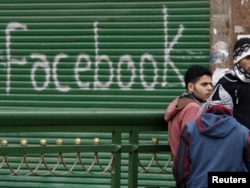
Opposition supporters talk near graffiti referring to the social networking site Facebook on Tahrir Square during the midst of the uprising in Cairo on February 5, 2011.
Facebook was successful because it launched as a new platform for personal liberty, allowing anyone with Internet access to join a community. These communities continue to revolutionize the way we understand online interaction. But they also have unexpected consequences as personal liberties like privacy increasingly contravene the profit margins of big companies such as Google and Facebook.
Security technology expert and author Bruce Scheier says money dictates the behavior of big business online.
"Both Facebook and Google+ are pushing the real-names policy. They're doing it for purely selfish reasons. They want to be vehicles for commerce. ... You're not Facebook's customer. You're Facebook's product that it sells to its customers," Scheier says. "And yes, some people will leave, but they know most people will stay, and they will make more money because they'll sell real names to advertisers, not aliases."
Unwanted Attention
Companies spend $2 billion a year gathering personal data, according to a recent report cited in "The New York Times." Facebook itself is reportedly working toward integrating airline ticket sales directly into its own platform -- a move greatly helped, no doubt, by a real-names policy.
While Rushdie is just one of many Facebook and Google+ users affected by Facebook's identity screening, Scheier notes that the policy is being implemented relatively slowly, possibly in an effort to avoid unwanted attention.
Cue Rushdie, whose fame allowed him to take the move public.
Mark Zuckerberg, the CEO of Facebook
"Imagine if you're not Salman Rushdie," says Mahmood Enayat, the director of the Iran Media Program at the Annenberg School for Communication at the University of Pennsylvania. "I mean, you're not going to get your account back. And that's happened a lot. I mean, they deactivate a lot of accounts. And it's really hard for someone who is in Iran -- maybe your English is not good, maybe you don't want to provide your real identity -- to get the account activated again."
Enayat believes this will have activists turning to more "flexible" websites for their online activities.
"The main thing is, that really means that you can't use these platforms any more for activism purposes. Because if you're an activist, the chances are that you don't want to use your real name," Enayat says. "And I think this really goes against how these platforms have been used in Arab Spring [and] in the case of Iran."
Online Activists Alarmed
Facebook is often credited with helping mobilize people to take to the streets for the mass street protests in Iran in 2009 and the recent popular uprisings throughout the Arab world.
The Rushdie affair has alarmed online activists, who need the anonymity provided by Facebook accounts to protect their own safety. These activists often use blanket names like "Working For Freedom" to prevent them from being tracked by the government as they engage in the web-based opposition activities that proved instrumental during the Arab Spring unrest.
A Facebook user operating under the name of "Working For Freedom," for example, now risks having the account name automatically changed to hisor her legal name overnight -- a potentially life-threatening development.
Amnesty International released a report on November 15 listing five countries in which online activity can lead to arrest: China, Azerbaijan, Syria, Vietnam, and Egypt.
Egyptian activist Mohamed Ibrahim is an administrator for the 158,000-member "We Are All Khaled Said" Facebook page, which was at the forefront of the anti-Mubarak uprising.
"Many activists were working with hidden identities (including me) until the Egyptian revolution succeeded and some even after the revolution in fear of regime arrest and torture," Ibrahim writes in an e-mail interview, adding that Facebook's authentication policy "could very well cause someone’s life to be lost if an activist's real identity was revealed."
Facebook disabled access to the "We Are All Khaled Said" page for a brief period in November on the grounds that its administrators were operating under false names.
"I can imagine a similar mistake in other dictatorships could also easily lead to imprisonment or death," he says.