



Saturday, February 04, 2012


Features

Bosnia's Serb Republic Challenges OHR

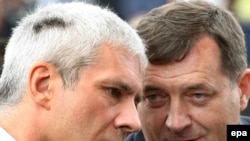
Serbian President Boris Tadic (left) talks with Milorad Dodik, prime minister of the Bosnian entity of Republika Srpska, in Pale last month
TEXT SIZE - +

The parliament of Bosnia's Republika Srpska has approved a plan to end that republic's participation in all state institutions unless the country's EU-backed International Office of the High Representative (OHR) reverses a decision concerning the state electricity company.


The October 1 vote sets the stage for a potentially ugly showdown between the Republika Srpska -- which has long wanted the international community to withdraw its presence in the country -- and the OHR, which is currently held by Austrian diplomat Valentin Inzko.


The OHR was established in 1995 after the war to oversee the peace agreement that ended hostilities. Since the end of the war, Bosnia has been divided into a Serbian region (Republika Srpska) and the Muslim-Croat Federation -- with power apportioned accordingly.


The high representative presides over both entities and has the power to impose and enforce laws and fire officials who obstruct the peace.


The trouble began last year, when Bosnian Serb minority shareholders of the national electricity distributor, Elektroprenos, began obstructing its operations and boycotting board meetings in an attempt to show that a joint Serbian-Muslim-Croatian entity cannot succeed.


Inzko has just taken a series of decisions to keep the Serbs in line and the power grid operational.


The October 1 vote in the Bosnian Serb parliament was a direct repudiation of Inzko's actions.


Threats From Banja Luka

Republika Srpska President Rajko Kuzmanovic has called for Inzko to "withdraw or freeze" his decisions and leave the solution to the electricity grid problems in the hands of locally run entities.
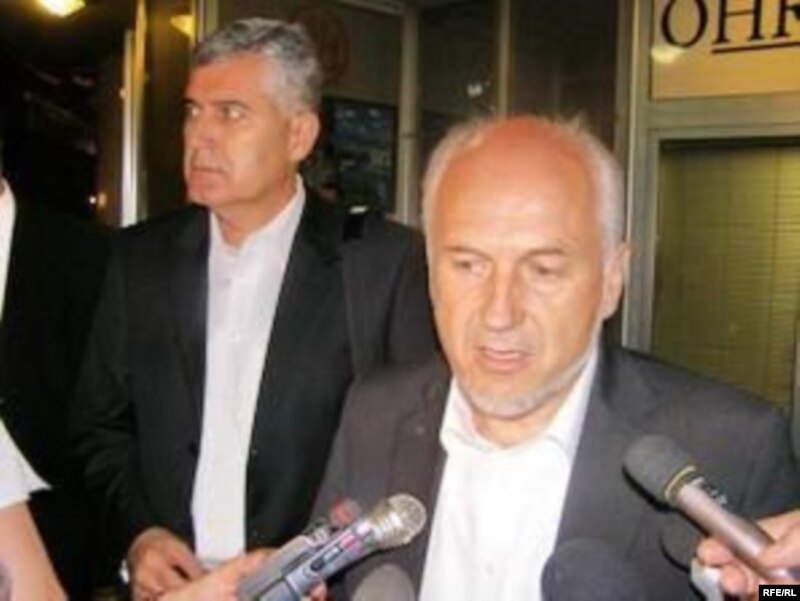
 

Banja Luka wants the High Representative, Valentin Inzko, out.

Before the vote in parliament, he said Republika Srpska would "not hesitate to withdraw [its] representatives from Bosnia's joint institutions and to call on the Republika Srpska citizens to declare [their views] in a direct and democratic way."


But a much wider call has already gone out.

Prime Minister Milorad Dodik wants to see the 14-year-old, EU-run OHR shut down. He recently told parliament: "The times have changed. It is high time that Bosnia gets out of the OHR protectorate."


Muslims and Croats, meanwhile, aspire to a more centralized state and are generally welcoming of EU-style reforms. In the Elektroprenos dispute, the Muslim-Croat federation, which is a majority share-holder in the grid, supports Inzko.


EU Response

RFE/RL's Balkan Service director, Gordana Knezevic, says the vote suggests that members of the Bosnian Serb parliament share Dodik's contempt for the international community. She doesn't think Dodik will back down now.


"He's kind of challenging the international community," Knezevic says. "He's become used to the idea that, no matter what kind of disrespect he showed for the decisions of the international community, he's never had to withdraw, or apologize, or take a step back, because he's never faced a tough response. And the reason why he didn't face any tough response was the fact that the countries which are supposed to agree upon policy on Bosnia don't have the same opinions."

She adds: "It's the problem of nonexistent European policy toward Bosnia -- there's always someone who disagrees with whatever tough measures should be taken."
 

Knezevic adds that in Sarajevo, the capital of the federation, there is little expectation that the OHR or EU will have a decisive response to the vote.


"Nobody expects that the international community will now react differently compared to the last few months or last few years. [Dodik] has never actually faced any efficient or clear or tough decision on the part of the European Union," Knezevic says. 


So far, Inzko's office has had no response to the vote.

A Breach Of Dayton?
 
Sulejman Tihic, a former member of Bosnia's tripartite presidency and the current head of SDA, the Party of Democratic Action, told RFE/RL's Balkan Service that the Serb parliament's decision to withdraw from governing institutions represents a grave breach of the peace deal that ended the war.


"This decision is the most serious violation of the Dayton peace agreement we've seen. The creation of the Office of the High Representative is mandated by both the constitution [of Bosnia-Herzegovina] and the Dayton agreement. And Republika Srpska is also a product of Dayton, as is the [Muslim-Croat] Federation," Tihic said.

"It's not possible to accept one aspect of Dayton and reject another. You can't approve of Republika Srpska but reject Annex 10 [of Dayton], which established the Office of the High  Representative. It's not possible to approve of Republika Srpska but reject Annex 9, which guarantees the function of public corporations [like the Elektroprenos power grid operator]," he added. 

In April, former High Representative Paddy Ashdown told a U.S. Congressional committee that he has seen a dramatic reversal of progress in Bosnia over the last few years, largely because of the Republika Srpska's scorn for the European Union.


Ashdown told the U.S. Helsinki Commission that "the progress of forward movement of Bosnia and Herzegovina towards a position not just of stability, but also functionality, as a state has now moved substantially into reverse. There are elements -- largely in the Republika Srpska -- who would wish to even undo the reforms toward statehood that have already been established. And indeed, [they] have been allowed to do so."


Belgrade In The Background

Just as it has never hidden its disdain for Brussels, Banja Luka has never hidden its loyalty to Belgrade.


The question of whether Serbia is offering either implicit or overt support in decisions made by Republika Srpska looms over the growing tensions.


On September 30, Serbian Foreign Minister Vuk Jeremic traveled to Banja Luka for talks with Dodik. In a breach of diplomatic ettiquette, he did not inform Sarajevo of his visit.


A similar oversight occurred on September 8, when Serbian President Boris Tadic showed up at the opening of a new school -- named "Serbia" -- in the town of Pale without first notifying Sarajevo.


In his remarks at the ribbon-cutting, Tadic said Serbia "has a responsibility to Serbs wherever they are. Serbia is not responsible for the citizens of Serbia alone; Serbia is responsible for all the people who belong to our nation."


Milenko Dereta, an analyst based in the Serbian capital, said the episode was part of an ongoing Serbian campaign to shatter Bosnian sovereignty and build a unified Serbian nation.


She said it would be "an achievement [in tolerance]" if a school named "Serbia" opened in Muslim-Croat half of Bosnia.


"But when it's in Republika Srpska," she said, "it's like a...flag being raised to mark territorial gains."

written by Heather Maher with reporting from RFE/RL's Balkan Service

This forum has been closed.
Comment Sorting
Comments page of 3
    Next 
by: Sergey
October 02, 2009 00:54
"Milenko Dereta, an analyst based in the Serbian capital, said the episode was part of an ongoing Serbian campaign to shatter Bosnian sovereignty and build a unified Serbian nation."

If Bosnian sovereigny means having Christian Orthodox Serbs and Catholic Croats living under Islamic barbaric Sharia law in Islamic Republic of Bosnia, then I have no problem with "shattering" Bosnian sovereignty.

As I said in one of the previous forums, if the world great Western powers decided in 1990's that Yugoslavia should be divisible, it looks ridiculous to try to keep Yugoslavia's former constituent republics together.

My concern is the survival of the Christian civilization in the Balkans (and the entire Europe in general) in light of growing Islamist threat and the suicidal political correctness of the European (and American) political, social and cultural establishment who simply refuse to see what is going on.

Also I think that RFE/RL should stop playing a PR manager for promoting the unity of the Islamic Republic of Bosnia and look more objectively at the situation.

by: trollbuster from: chicago
October 02, 2009 01:42
more heavy-handed anti-serb propaganda from radio free europe-radio liberty, which is on par with soviet like journalism.

glory to republika srpska standing up to muslim nazinalist attempts to centralize bosnia against the dayton accords.

by: Franc
October 02, 2009 02:30
It is untrue that Muslims and Croats want more centralized state - to the contrary, only Muslims want a more central power to Sarajevo. Croats and Serbs want DE-centralized state of affairs to avoid domination by Muslims. I hope the mistake was result of superficial knowledge or ignorance of the author and not intentional misinformation. But it can't be discounted either . . .

by: Ron
October 02, 2009 03:00
Well, Bosnia was and is an artificial state. I will be the last person to say that Bosnia must be split. But if these three peoples reallly do not want to live together I don't think the EU should force them.

If Kosovo can go... why not RS (from Bosnia)?

I wish Yugoslavia had never fallen apart.

And about Serbia feeling responsible for Serbs around the world. Well, isn't that exactly what Israel is doing? And the US? And Croatia by the way.... almost all Croations in Bosnia also have Croation passport.

by: Alain from: Paris
October 02, 2009 06:11
RFERL quotes Milenko Dereta who says: "But when it's in Republika Srpska," she said, "it's like a... flag being raised to mark territorial gains."

“Territorial gains” implies that the territory has been taken away from somebody else's posession. This is a very cynical and smart way to portray the Serbs as "land grabbers" when in fact, before the war, 65% of Bosnian land was owned by Serbian farmers (the Muslims were more concentrated in urban areas). Serbs have been living on that land since the 7th century.

Here's a map of the Balkans in 1000 AD from Wikimedia:
http://upload.wikimedia.org/wikipedia/commons/c/cc/Europe_1000.jpg

Here's another one of Medieval Europe:
http://web.ku.edu/~eceurope/hist557/lect1-2_files/EuropeByzantineEmpireabout1000ad.jpg

And another one:
http://www.culturalresources.com/images/maps/Eur1100Big.jpg

During the 11th century and for many hundreds of years afterwards, all of the North American continent belonged to the native Indians. Bosnia was inhabited by Serbs.

So what "territorial gains" is the author of this article talking about?

by: iko from: antwerp
October 02, 2009 08:20
It seems history is repeating itself; Milosevic played the arrogant, defiant and duplicitous card in his dealing with the Europeans in the 1990's and got away with it until the death toll of those victimized by his policies was so great that the Europeans had to allow the Americans to do something. Now it is Dodik using the same tactics of his mentor to complete the destructive vision of Milosevic. Bosnia is prepared and has shown repeatedly its preparedness to meet European demands, many of which have been not in their best interests of its citizens, to enter the EU but RS uses its numbers in the executive and its bullying power on the ground to stymie any attempt to ensure Bosnia and Herzegovina becomes a functional state. Does the core principle of a unity in Europe not demand a response to the disunity Dodik et al is promoting. Sacre le bleu. Why ?

by: Wim Roffel
October 02, 2009 13:08
Obviously the journalist has disdain for Dodik. However, she should remember that the Bonn powers were not part of Dayton. And to define a party that comes up for its own interest as having contempt for another party just because that other party doesn't agree sounds silly to me. The OHR is supposed to have a mediating role, not an imperial one.

BTW annex 10 od Dayton foresees joint public cooperations "for mutual benefit". One has to wonder whether that is any longer the case with Elektroprenos.

by: Miki
October 02, 2009 13:12
For how long international community is going to live in denial, refusing to admit that Bosnia as a single country is not viable? You cannot put cats and dogs in the same sack. It is time for the entire world to face reality: Serbs do not want to live in Bosnia. Kosovo Albanians were given the right to secede from Serbia, why shouldnt Serbs in Bosnia have the same right? Is it just because they are Serbs?

by: iko from: antwerp
October 03, 2009 11:26
The borders of Bosnia historically defined by the same geography that marks most borders, the natural landforms, has been documented since Roman times. The artificial adminstrative borders hat the serbs keep on referrring to iin order to justify their aggression, in all its forms, is so transparnet that it is a wonder that anyoine takes them seriously.
The use of terms such as Bosnian Serb or Croat is a relatively recent phenomenon, prior to that they were Bosnian Orthodox or Bosnian Catholics or Bosnian Muslims. The conversion from religion to nationality is a political exercise and exposed to all the political manipulations. One wonders if the same complacency as to the rights of a country to exist was applied to Spain, Italy, Switzerland, Belgium, whether we would still have these countries named as such or whether some of them would even exist. It is ironic that a Bosnina Croat declares himself a Croat in Bosnia but when he goes on holidays to the coast the locals laugh at him and correct him, Bosnian they call him. Ask a Bosnian Serb refugee in Serbia how the locals refer to them. It's a sad way to learn who you are.
Finally why is it that the bogyman of the Islamic fanatic is always waved to justify another fanatic's viewpoint but the reality of what nationalists did and are doing under the Christian icons is rarely mentioned. Having seen the results of 'Christian' endorsed terror and the tolerance of Muslims we should be praising them not condemning them.

by: trollbuster from: chicago
October 03, 2009 20:48
franc, your point about the article's mistake on what croats want in bosnia is in line with the propaganda put out by vile organizations like the anti-serb crusading bosnian institute.

people like stephen schwartz, marko attila hoare and hoare's parents have disingenuously suggested what the above propaganda piece peddles.

the news organization carrying the above article lacks integrity in its former yugoslav coverage.
Comments page of 3
    Next 

Most Popular


Being Discussed Now

Saakashvili Regrets 'Compromises'

Latest Comment (6 total)

Alex: Mariam jan, what church did Georgians belong to when they became Christians? More

The Truth-Teller: Natasa Kandic, Urging Serbs To Face The Past

Latest Comment (15 total)

Abdulmajid: Yeah, yeah... of course, Natasa Kandic, like me, does not subscribe to the ... More

Umarov Calls End To Attacks On Civilians

Latest Comment (3 total)

anonymous: whoever you are, you aren't an american, and you don't know anything about ... More