




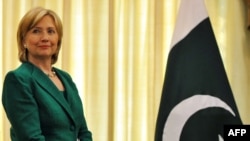
U.S. Secretary of State Hillary Clinton is in Pakistan to meet with government officials, civic leaders, businesspeople, and even leaders of the country's political opposition.
For security reasons, the State Department isn't giving details of Clinton's visit -- not even a timetable, let alone the topics she's expected to discuss with Pakistan's civilian and military leaders.
The security concerns proved correct, as Clinton's arrival in the country coincided with a car bomb that tore through a market in the northwest Pakistani city of Peshawar early on October 28. At least 90 people were killed and more than 200 wounded.
Clinton was three hours' drive away in the capital, Islamabad, when the blast took place.
In remarks carried live on Pakistani news channels, she said, "I want you to know that this fight is not Pakistan's alone. This is our struggle as well."
Clinton's first trip to the country as secretary of state comes as the Pakistan army is mounting a major offensive against Al-Qaeda and Taliban militants from the country's mountainous northwestern region -- a move that has been welcomed in Washington.
At the same time, however, anti-American sentiment is running high in Pakistan, and has been worsened by a new $7.5 billion U.S. aid package, the Kerry-Lugar bill, that includes conditions that many Pakistanis believe intrude on their nation's sovereignty.
The country is torn between a dislike of the United States and a need for U.S. assistance, according to Stephen Cohen, who studies South Asia at the Brookings Institution, a private policy research center in Washington.
"A lot of [Pakistanis] deeply resent the relationship with the United States, and resent what they regard as undue conditionality of the Kerry-Lugar” U.S. aid bill, Cohen said. “But many of the same people understand that Pakistan is in a desperate position and absolutely needs that Kerry-Lugar and military support we're providing.”
He continued: “Nobody likes to be the recipient of aid from somebody else, but they don't have much of a choice. So I think that we may be making some dent in the pervasive anti-Americanism in Pakistan, but it's still going to take a long time before that begins to dissipate."
Uncoordinated Policy?
Cohen says the problems Clinton will face are complicated by the fact that the special U.S. envoy to Afghanistan and Pakistan, Richard Holbrooke, has yet to make significant progress on the ground in either country.
Some blame Holbrooke's strong personality, Cohen says, but he dismisses that conclusion because Holbrooke is merely trying to put forward a policy made by others. He says the real question is whether the United States has too many centers of policy involved with Afghanistan and Pakistan.
Those include "Holbrooke himself. The secretary of state and the Department of State -- I don't think they're the same thing. National Security Council staff, whatever it's doing,” Cohen said. “The Senate and the House have different views. The Department of Defense. You have many clusters of policy-making, [but] I'm not sure if there's much policy coordination in the system. And I don't know, actually, who performs that function on behalf of the president."
But Cohen stresses that it's still early in U.S. President Barack Obama's administration, and he still has time to learn how to become what Cohen calls a "foreign policy president" who will make his own decisions, rather than hire intelligent people to make the decisions on his behalf.
Pakistani President Asif Ali Zardari has been doing better than anyone expected, according to Simon Serfaty, who studies global security at the Center for Strategic and International Studies, another Washington think tank.
Serfaty acknowledges that Zardari is "president by accident." He ran for the presidency only after his wife, Benazir Bhutto, who twice served as prime minister, was assassinated in December 2007. He also concedes that Zardari is greatly dependent on U.S. support.
But Zardari also has taken action to drive Muslim militants from the country's tribal regions.
"The Pakistani president, in my view, is doing better than had been anticipated," Serfaty says. "He's still in control, he has succeeded in launching his army on a path of regaining the real estate that had been lost to the Taliban, which [former President Pervez] Musharraf, his predecessor, did not seem to be able to keep going."
Tall Order For Clinton
So can Clinton work with Zardari to win the hearts and minds of the Pakistani people? Serfaty says no. He concedes she is much admired around the world, and can capitalize on this to a great extent. But he insists that hearts and minds cannot be won during this brief visit.
Instead, Clinton's primary job during her visit to Pakistan seems to be to reassure both its civilian and military leadership of the wisdom of joining the United States in fighting the extremists as part of the war in Afghanistan.
To Serfaty, that could be a very difficult job. "The people we are asking to fight with us in Afghanistan, to fight with the U.S., to assume a bit of the burden of the war, are people who are also watching a major debate unfolding here in Washington as to whether this war is winnable," he says.
General Stanley McChrystal, the general appointed to run the Afghan war, "just said that if we do not do more than we're doing now, we'll lose the war, and if we're doing more than we're doing now, maybe we will not lose it. Maybe," Serfaty adds.
If Clinton succeeds in reassuring Pakistan's leaders, Serfaty says, they may in turn be able to win the support of their people for a strong fight against the militants.
For security reasons, the State Department isn't giving details of Clinton's visit -- not even a timetable, let alone the topics she's expected to discuss with Pakistan's civilian and military leaders.
The security concerns proved correct, as Clinton's arrival in the country coincided with a car bomb that tore through a market in the northwest Pakistani city of Peshawar early on October 28. At least 90 people were killed and more than 200 wounded.
Clinton was three hours' drive away in the capital, Islamabad, when the blast took place.
In remarks carried live on Pakistani news channels, she said, "I want you to know that this fight is not Pakistan's alone. This is our struggle as well."
Clinton's first trip to the country as secretary of state comes as the Pakistan army is mounting a major offensive against Al-Qaeda and Taliban militants from the country's mountainous northwestern region -- a move that has been welcomed in Washington.
At the same time, however, anti-American sentiment is running high in Pakistan, and has been worsened by a new $7.5 billion U.S. aid package, the Kerry-Lugar bill, that includes conditions that many Pakistanis believe intrude on their nation's sovereignty.
The country is torn between a dislike of the United States and a need for U.S. assistance, according to Stephen Cohen, who studies South Asia at the Brookings Institution, a private policy research center in Washington.
"A lot of [Pakistanis] deeply resent the relationship with the United States, and resent what they regard as undue conditionality of the Kerry-Lugar” U.S. aid bill, Cohen said. “But many of the same people understand that Pakistan is in a desperate position and absolutely needs that Kerry-Lugar and military support we're providing.”
He continued: “Nobody likes to be the recipient of aid from somebody else, but they don't have much of a choice. So I think that we may be making some dent in the pervasive anti-Americanism in Pakistan, but it's still going to take a long time before that begins to dissipate."
Uncoordinated Policy?
Cohen says the problems Clinton will face are complicated by the fact that the special U.S. envoy to Afghanistan and Pakistan, Richard Holbrooke, has yet to make significant progress on the ground in either country.
Some blame Holbrooke's strong personality, Cohen says, but he dismisses that conclusion because Holbrooke is merely trying to put forward a policy made by others. He says the real question is whether the United States has too many centers of policy involved with Afghanistan and Pakistan.
Those include "Holbrooke himself. The secretary of state and the Department of State -- I don't think they're the same thing. National Security Council staff, whatever it's doing,” Cohen said. “The Senate and the House have different views. The Department of Defense. You have many clusters of policy-making, [but] I'm not sure if there's much policy coordination in the system. And I don't know, actually, who performs that function on behalf of the president."
But Cohen stresses that it's still early in U.S. President Barack Obama's administration, and he still has time to learn how to become what Cohen calls a "foreign policy president" who will make his own decisions, rather than hire intelligent people to make the decisions on his behalf.
Pakistani President Asif Ali Zardari has been doing better than anyone expected, according to Simon Serfaty, who studies global security at the Center for Strategic and International Studies, another Washington think tank.
Serfaty acknowledges that Zardari is "president by accident." He ran for the presidency only after his wife, Benazir Bhutto, who twice served as prime minister, was assassinated in December 2007. He also concedes that Zardari is greatly dependent on U.S. support.
But Zardari also has taken action to drive Muslim militants from the country's tribal regions.
"The Pakistani president, in my view, is doing better than had been anticipated," Serfaty says. "He's still in control, he has succeeded in launching his army on a path of regaining the real estate that had been lost to the Taliban, which [former President Pervez] Musharraf, his predecessor, did not seem to be able to keep going."
Tall Order For Clinton
So can Clinton work with Zardari to win the hearts and minds of the Pakistani people? Serfaty says no. He concedes she is much admired around the world, and can capitalize on this to a great extent. But he insists that hearts and minds cannot be won during this brief visit.
Instead, Clinton's primary job during her visit to Pakistan seems to be to reassure both its civilian and military leadership of the wisdom of joining the United States in fighting the extremists as part of the war in Afghanistan.
To Serfaty, that could be a very difficult job. "The people we are asking to fight with us in Afghanistan, to fight with the U.S., to assume a bit of the burden of the war, are people who are also watching a major debate unfolding here in Washington as to whether this war is winnable," he says.
General Stanley McChrystal, the general appointed to run the Afghan war, "just said that if we do not do more than we're doing now, we'll lose the war, and if we're doing more than we're doing now, maybe we will not lose it. Maybe," Serfaty adds.
If Clinton succeeds in reassuring Pakistan's leaders, Serfaty says, they may in turn be able to win the support of their people for a strong fight against the militants.