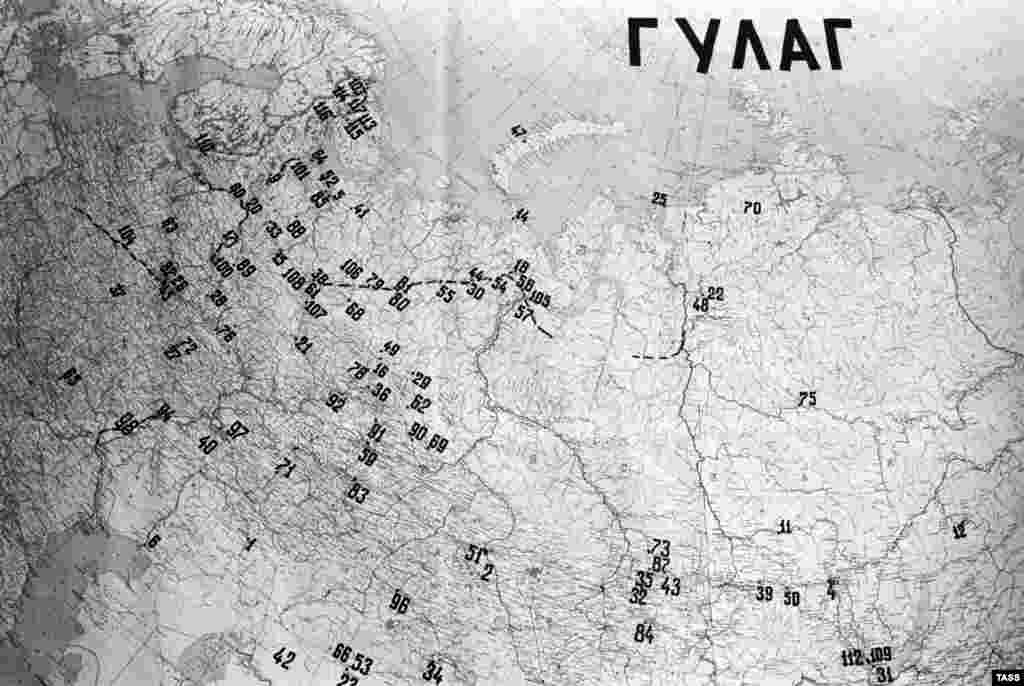
1/15A map of the U.S.S.R. with Gulag camp locations marked
It's been 50 years since the publication in 1962 of Aleksandr Solzhenitsyn's "One Day In The Life Of Ivan Denisovich," a grim tale of imprisonment that laid bare for the first time the extent of Stalinist repression in the Soviet Gulag. A sprawling and lethal network of labor camps, the Gulag served as the Soviet regime's main tool of political repression and source of free labor, devastating millions of lives from 1917 to 1960. The author drew on his own eight years in prison for anti-Soviet propaganda, including as prisoner #282 at a special camp for political prisoners at Ekibastuz. But conditions throughout the network were brutal by design. (18 PHOTOS)
Show moreShow less
2/15A subdivision of Ozerny Labor Camp No. 7 in 1951
It's been 50 years since the publication in 1962 of Aleksandr Solzhenitsyn's "One Day In The Life Of Ivan Denisovich," a grim tale of imprisonment that laid bare for the first time the extent of Stalinist repression in the Soviet Gulag. A sprawling and lethal network of labor camps, the Gulag served as the Soviet regime's main tool of political repression and source of free labor, devastating millions of lives from 1917 to 1960. The author drew on his own eight years in prison for anti-Soviet propaganda, including as prisoner #282 at a special camp for political prisoners at Ekibastuz. But conditions throughout the network were brutal by design. (18 PHOTOS)
Show moreShow less
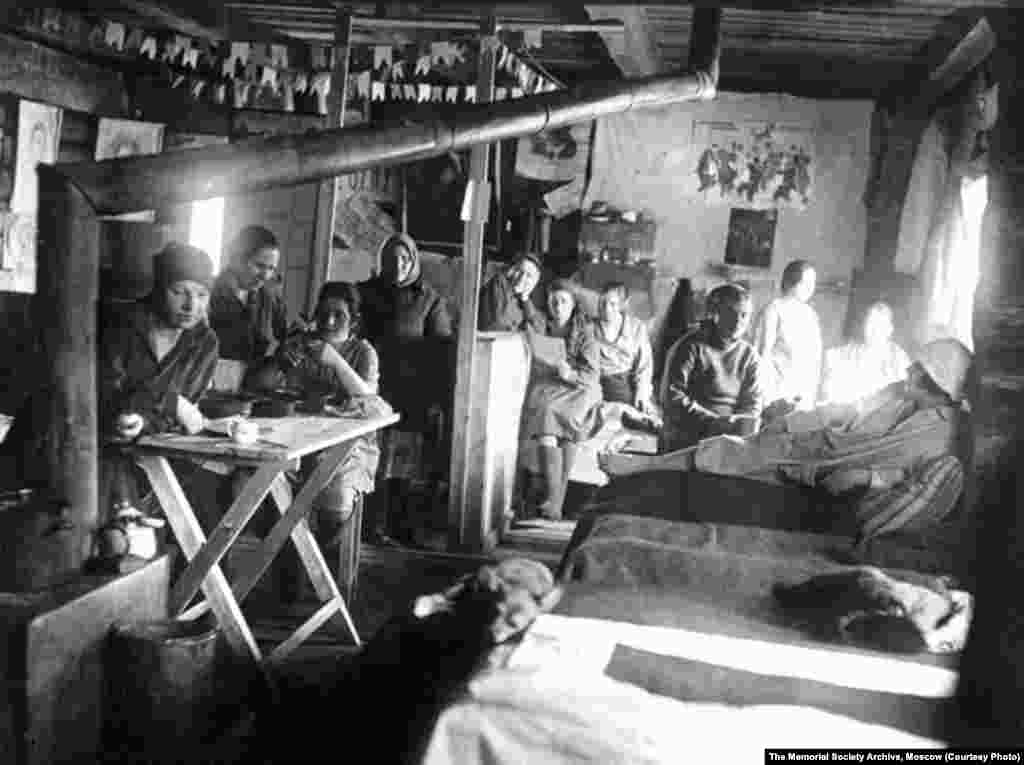
3/15Female prisoners in overcrowded, poorly heated barracks (undated)
It's been 50 years since the publication in 1962 of Aleksandr Solzhenitsyn's "One Day In The Life Of Ivan Denisovich," a grim tale of imprisonment that laid bare for the first time the extent of Stalinist repression in the Soviet Gulag. A sprawling and lethal network of labor camps, the Gulag served as the Soviet regime's main tool of political repression and source of free labor, devastating millions of lives from 1917 to 1960. The author drew on his own eight years in prison for anti-Soviet propaganda, including as prisoner #282 at a special camp for political prisoners at Ekibastuz. But conditions throughout the network were brutal by design. (18 PHOTOS)
Show moreShow less
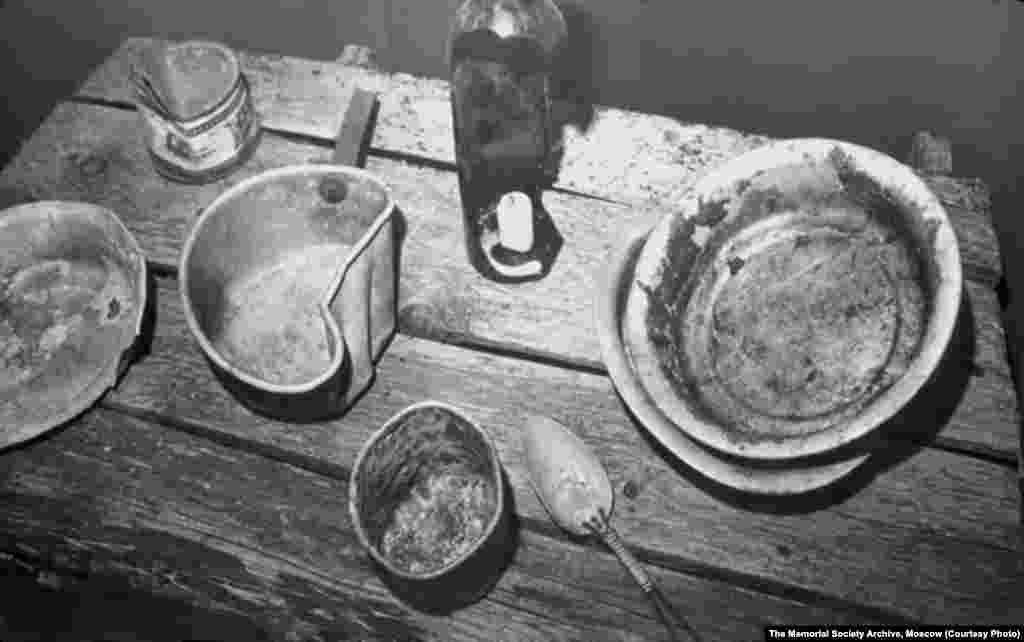
4/15Eating utensils recovered on an expedition to former Gulag sites (undated)
It's been 50 years since the publication in 1962 of Aleksandr Solzhenitsyn's "One Day In The Life Of Ivan Denisovich," a grim tale of imprisonment that laid bare for the first time the extent of Stalinist repression in the Soviet Gulag. A sprawling and lethal network of labor camps, the Gulag served as the Soviet regime's main tool of political repression and source of free labor, devastating millions of lives from 1917 to 1960. The author drew on his own eight years in prison for anti-Soviet propaganda, including as prisoner #282 at a special camp for political prisoners at Ekibastuz. But conditions throughout the network were brutal by design. (18 PHOTOS)
Show moreShow less
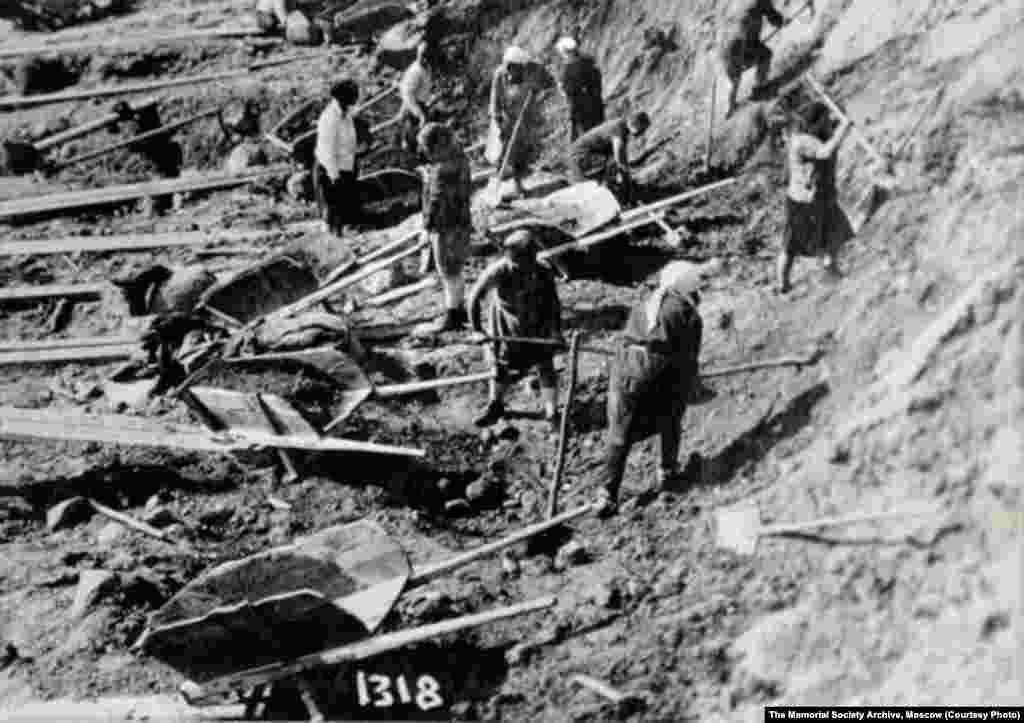
5/15Female prisoners work with shovels and wheelbarrows at an excavation site at Belomorkanal in 1932.
It's been 50 years since the publication in 1962 of Aleksandr Solzhenitsyn's "One Day In The Life Of Ivan Denisovich," a grim tale of imprisonment that laid bare for the first time the extent of Stalinist repression in the Soviet Gulag. A sprawling and lethal network of labor camps, the Gulag served as the Soviet regime's main tool of political repression and source of free labor, devastating millions of lives from 1917 to 1960. The author drew on his own eight years in prison for anti-Soviet propaganda, including as prisoner #282 at a special camp for political prisoners at Ekibastuz. But conditions throughout the network were brutal by design. (18 PHOTOS)
Show moreShow less
6/15Shock workers and officials from the Belomorkanal camp visiting a forest in Vaidai in 1932, posing in front of a banner that read: "Labor in the U.S.S.R. is a matter of Honor, Glory, Valor, and Heroism."
It's been 50 years since the publication in 1962 of Aleksandr Solzhenitsyn's "One Day In The Life Of Ivan Denisovich," a grim tale of imprisonment that laid bare for the first time the extent of Stalinist repression in the Soviet Gulag. A sprawling and lethal network of labor camps, the Gulag served as the Soviet regime's main tool of political repression and source of free labor, devastating millions of lives from 1917 to 1960. The author drew on his own eight years in prison for anti-Soviet propaganda, including as prisoner #282 at a special camp for political prisoners at Ekibastuz. But conditions throughout the network were brutal by design. (18 PHOTOS)
Show moreShow less
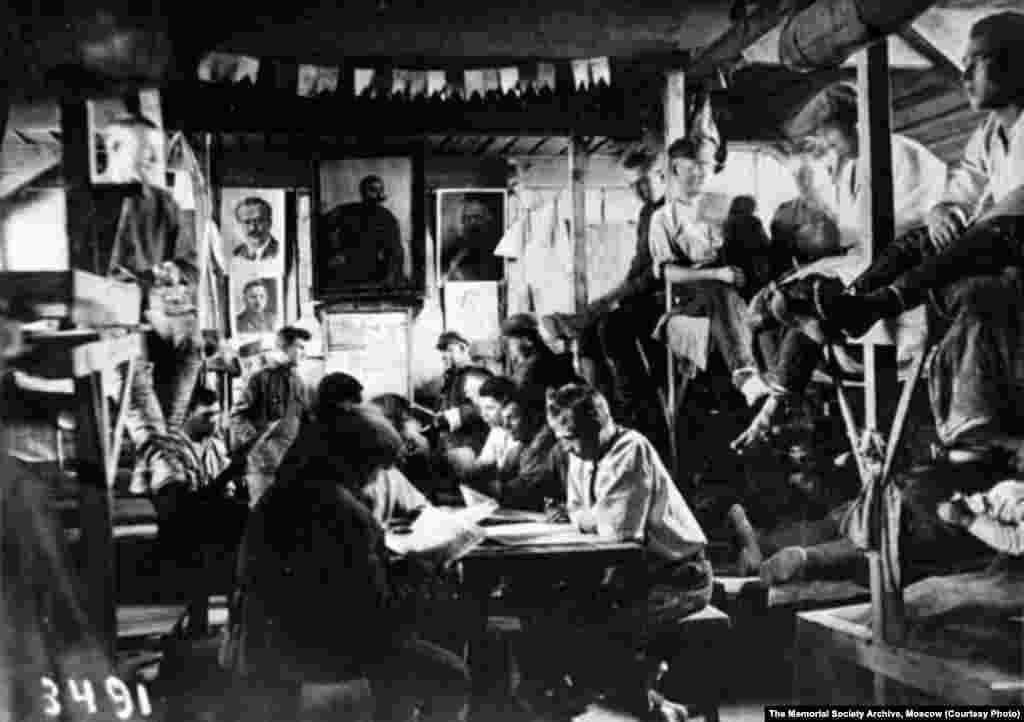
7/15Prisoners gathered after a speech by the head of the Belomorkanal camp in 1932
It's been 50 years since the publication in 1962 of Aleksandr Solzhenitsyn's "One Day In The Life Of Ivan Denisovich," a grim tale of imprisonment that laid bare for the first time the extent of Stalinist repression in the Soviet Gulag. A sprawling and lethal network of labor camps, the Gulag served as the Soviet regime's main tool of political repression and source of free labor, devastating millions of lives from 1917 to 1960. The author drew on his own eight years in prison for anti-Soviet propaganda, including as prisoner #282 at a special camp for political prisoners at Ekibastuz. But conditions throughout the network were brutal by design. (18 PHOTOS)
Show moreShow less
8/15Prisoners in the sewing workshop at Belomorkanal camp in 1932
It's been 50 years since the publication in 1962 of Aleksandr Solzhenitsyn's "One Day In The Life Of Ivan Denisovich," a grim tale of imprisonment that laid bare for the first time the extent of Stalinist repression in the Soviet Gulag. A sprawling and lethal network of labor camps, the Gulag served as the Soviet regime's main tool of political repression and source of free labor, devastating millions of lives from 1917 to 1960. The author drew on his own eight years in prison for anti-Soviet propaganda, including as prisoner #282 at a special camp for political prisoners at Ekibastuz. But conditions throughout the network were brutal by design. (18 PHOTOS)
Show moreShow less
9/15A Gulag prisoner's padded jacket, with identification numbers visible on the back
It's been 50 years since the publication in 1962 of Aleksandr Solzhenitsyn's "One Day In The Life Of Ivan Denisovich," a grim tale of imprisonment that laid bare for the first time the extent of Stalinist repression in the Soviet Gulag. A sprawling and lethal network of labor camps, the Gulag served as the Soviet regime's main tool of political repression and source of free labor, devastating millions of lives from 1917 to 1960. The author drew on his own eight years in prison for anti-Soviet propaganda, including as prisoner #282 at a special camp for political prisoners at Ekibastuz. But conditions throughout the network were brutal by design. (18 PHOTOS)
Show moreShow less
10/15Two men exit a paddy wagon designed to look like a delivery truck. (undated)
It's been 50 years since the publication in 1962 of Aleksandr Solzhenitsyn's "One Day In The Life Of Ivan Denisovich," a grim tale of imprisonment that laid bare for the first time the extent of Stalinist repression in the Soviet Gulag. A sprawling and lethal network of labor camps, the Gulag served as the Soviet regime's main tool of political repression and source of free labor, devastating millions of lives from 1917 to 1960. The author drew on his own eight years in prison for anti-Soviet propaganda, including as prisoner #282 at a special camp for political prisoners at Ekibastuz. But conditions throughout the network were brutal by design. (18 PHOTOS)
Show moreShow less
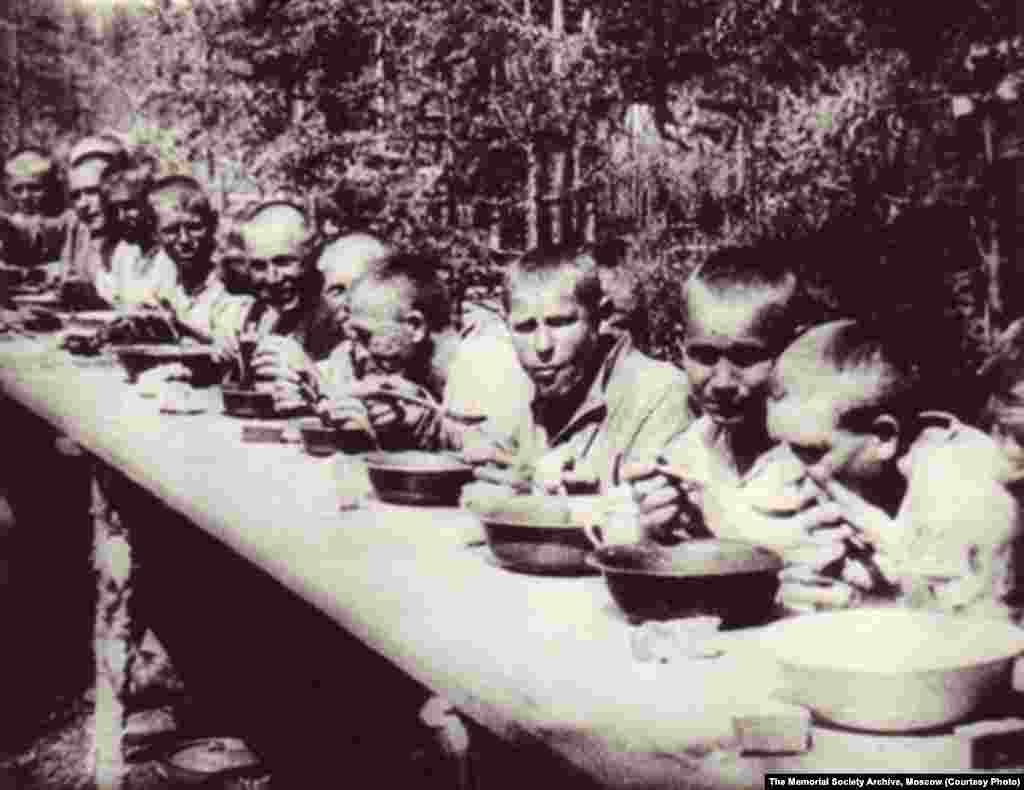
11/15Prisoners eat lunch at the Bamlag camp in 1933.
It's been 50 years since the publication in 1962 of Aleksandr Solzhenitsyn's "One Day In The Life Of Ivan Denisovich," a grim tale of imprisonment that laid bare for the first time the extent of Stalinist repression in the Soviet Gulag. A sprawling and lethal network of labor camps, the Gulag served as the Soviet regime's main tool of political repression and source of free labor, devastating millions of lives from 1917 to 1960. The author drew on his own eight years in prison for anti-Soviet propaganda, including as prisoner #282 at a special camp for political prisoners at Ekibastuz. But conditions throughout the network were brutal by design. (18 PHOTOS)
Show moreShow less
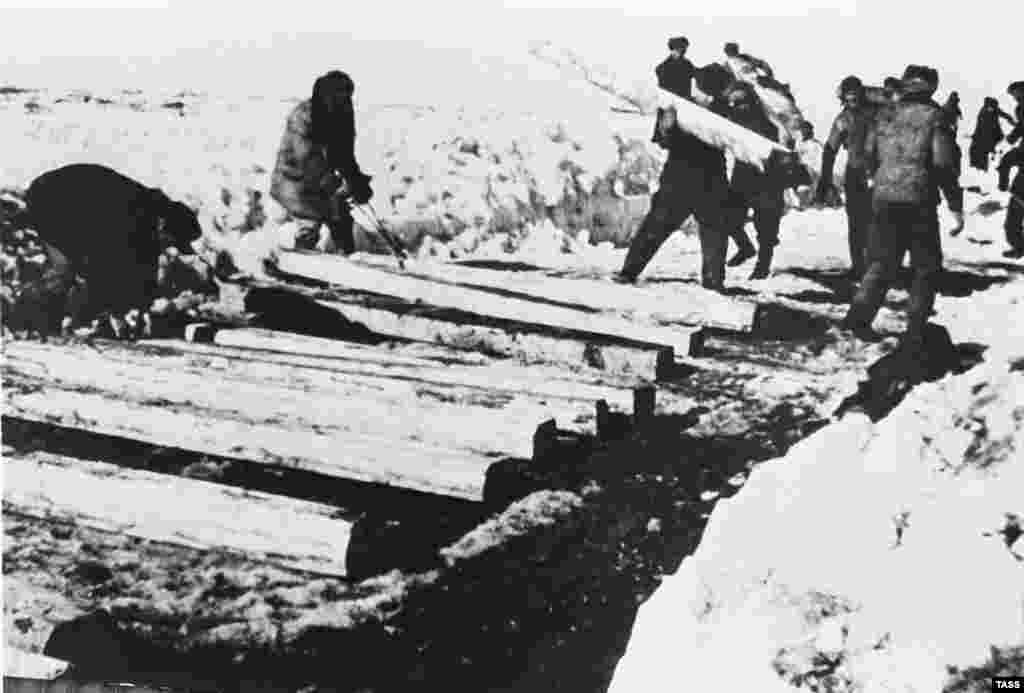
12/15Prisoners work on construction of the North Pechora Railway. (undated)
It's been 50 years since the publication in 1962 of Aleksandr Solzhenitsyn's "One Day In The Life Of Ivan Denisovich," a grim tale of imprisonment that laid bare for the first time the extent of Stalinist repression in the Soviet Gulag. A sprawling and lethal network of labor camps, the Gulag served as the Soviet regime's main tool of political repression and source of free labor, devastating millions of lives from 1917 to 1960. The author drew on his own eight years in prison for anti-Soviet propaganda, including as prisoner #282 at a special camp for political prisoners at Ekibastuz. But conditions throughout the network were brutal by design. (18 PHOTOS)
Show moreShow less
13/15Patient-inmates in the infirmary at the Belomorkanal camp in 1932
It's been 50 years since the publication in 1962 of Aleksandr Solzhenitsyn's "One Day In The Life Of Ivan Denisovich," a grim tale of imprisonment that laid bare for the first time the extent of Stalinist repression in the Soviet Gulag. A sprawling and lethal network of labor camps, the Gulag served as the Soviet regime's main tool of political repression and source of free labor, devastating millions of lives from 1917 to 1960. The author drew on his own eight years in prison for anti-Soviet propaganda, including as prisoner #282 at a special camp for political prisoners at Ekibastuz. But conditions throughout the network were brutal by design. (18 PHOTOS)
Show moreShow less
14/15Convicts work on timber at Ozerlag, one of the largest Stalin-era concentration camps, in the Irkutsk region of Siberia. (undated)
It's been 50 years since the publication in 1962 of Aleksandr Solzhenitsyn's "One Day In The Life Of Ivan Denisovich," a grim tale of imprisonment that laid bare for the first time the extent of Stalinist repression in the Soviet Gulag. A sprawling and lethal network of labor camps, the Gulag served as the Soviet regime's main tool of political repression and source of free labor, devastating millions of lives from 1917 to 1960. The author drew on his own eight years in prison for anti-Soviet propaganda, including as prisoner #282 at a special camp for political prisoners at Ekibastuz. But conditions throughout the network were brutal by design. (18 PHOTOS)
Show moreShow less
15/15The Karaganda Corrective Labor Camp, known as Karlag, was among the largest of the Gulag camps. Seen in 1955, it was operated like a state farm and housed some 800,000 prisoners throughout its existence.
It's been 50 years since the publication in 1962 of Aleksandr Solzhenitsyn's "One Day In The Life Of Ivan Denisovich," a grim tale of imprisonment that laid bare for the first time the extent of Stalinist repression in the Soviet Gulag. A sprawling and lethal network of labor camps, the Gulag served as the Soviet regime's main tool of political repression and source of free labor, devastating millions of lives from 1917 to 1960. The author drew on his own eight years in prison for anti-Soviet propaganda, including as prisoner #282 at a special camp for political prisoners at Ekibastuz. But conditions throughout the network were brutal by design. (18 PHOTOS)
Show moreShow less
Previous slide
Next slide
EKIBASTUZ, Kazakhstan -- November is not a good time to find yourself on the streets of this flat, windswept city.
The temperatures have dipped to minus-20 degrees Celsius, whipped to a bone-freezing chill by strong winds that blow in across the steppe, unimpeded by hills or forests.
This city in northeastern Kazakhstan is where Soviet planners chose to build one of their most notorious labor camps, a special facility for political prisoners that was part of the massive network of prisons known collectively as the Gulag.
The camp has long since vanished, replaced by the city's Shakhtyor Stadium. But Dariga Tokayeva, a guide at the Ekibastuz city museum, says the prison remains infamous for its miserable conditions.
"What was it like?" Tokayeva repeats as she considers the question. "There were barracks with no heating. It was very cold. People were brought there in the clothes they were wearing when they were detained. It was so cold here that the people were dying like flies."
Tens of thousands of Soviet-era prisoners passed through Ekibastuz, including Russian and Kazakh intellectuals, Chechens, Belarusians, Ukrainians, and Balts, and German and Japanese prisoners of war.
'They Destroyed Them There'
The camp's most famous prisoner, Russian writer Aleksandr Solzhenitsyn, was held at the camp from 1950-53, serving out the end of an eight-year sentence for anti-Soviet propaganda.
Aleksandr Solzhenitsyn, prisoner No. 282
Solzhenitsyn's legendary rendering of life at Ekibastuz, "One Day In The Life Of Ivan Denisovich," was published 50 years ago this month in the Soviet literary magazine "Novy Mir" (New World).
In some parts of the world, the anniversary has revived interest in the grim history of the Soviet Gulag and the Ekibastuz camp, where prisoners were enlisted in bricklaying and heavy labor, forced outside as long as the temperature hovered above minus-40 degrees Celsius.
But a half-century later, most Ekibastuz residents have little to say about their city's past as a Soviet prison site. Today, the town is better known for its rich coal deposits and a phalanx of coal-fired and thermal plants that power large swaths of Central Asia.
One local resident, Yerkanat Sultan, can barely be heard above the gusts of howling winter air. But asked about the prison, he repeats a sentiment heard frequently among local Kazakhs.
"Sure, we know," Sultan says. "They oppressed Kazakhs there; they destroyed them there."
Bitter Topic
Even Solzhenitsyn, the camp's most famous inmate, remains a deeply divisive figure for many Kazakhs.
They say he lost his standing as a dissident icon when, in 1990, he published a now-infamous article arguing that Kazakhstan's northern territories should be part of Russia.
The article, "Rebuilding Russia," infuriated native Kazakhs and nearly led the country's northern territories into interethnic violence.
Zhumakeldi Kasenov, an elderly Ekibastuz resident bundled against the cold in a fur hat and a fur-trimmed coat, remains angry to this day about what he views as Solzhenitsyn's betrayal.
"I know about him," Kasenov says. "He was a Russian writer who served his prison term in Ekibastuz. His last articles were against Kazakhs and we have rejected them."
In With The New
Still, "Denisovich" and Solzhenitsyn remain permanent parts of the city's history.
The local museum contains photographs and quotes from the writer, and guide Nadezhda Storozhuk says she has corresponded with the writer's widow, Natalia, who has sent numerous books to add to the museum's archives.
There was even the hope that Solzhenitsyn himself would return to Ekibastuz and the site of one of his most famous literary works.
But Storozhuk says he never managed to make the trip before his death in 2008.
"In 2004, a Rossiya [TV] film crew came to visit the Ekibastuz camp," Storozhuk says. "They came with a man who had been Solzhenitsyn's friend, a prisoner at the Ekibastuz camp who was mentioned in 'One Day In The Life Of Ivan Denisovich.' They filmed the former camp site. Solzhenitsyn was ill at the time and couldn't come himself, so his friend came."
The former prisoner, says Storozhuk, came back to Ekibastuz expecting to see barbed wire and other grim remnants of the camp. What he found instead, she says proudly, was a "young and prospering town."
Correspondents Merhat Sharipzhan and Daisy Sindelar contributed to this report