


The murk of war often becomes the murk of history. Take the case of Ejup Ganic, who was arrested in London last year as Serbia sought his extradition for allegedly ordering a series of atrocities in Sarajevo in May 1992, at the beginning of the Bosnian war. The Serbs accuse Ganic, who was then acting president, of ordering an attack on Yugoslav People’s Army soldiers as they withdrew from a barracks in Sarajevo. The accounts of what happened, of course, widely differ -- memories faded by time, attempts at rewriting history, or, more generously, the fog of war clouding perceptions. Some archive footage survives, but not enough to create a clear picture.
What is remarkable about the recent wave of uprisings in the Middle East and North Africa is less the organizing role of social media, but more the power of the video camera (usually housed inside a humble mobile phone). This hasn’t just affected news gathering, but also the process of testimony and the possibilities of posterity.
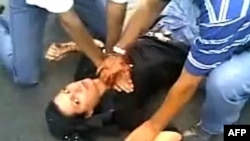
The video of the murder of Neda will live on; as will the Egyptian man getting gunned down by security forces; or the Bahraini man getting shot in the head repeatedly with rubber bullets at close range. Never before is there so much opportunity to preserve and recreate a living history for future generations.
Except there is a problem here: the information gatekeepers. After protesters broke into the headquarters of the Egyptian security agency, they removed a slew of digital evidence, some of which ended up on Flickr. But Flickr removed the images, citing a violation of its Community Guidelines (more on that here).
During ethnic violence in Kyrgyzstan last year, videos posted by ethnic Uzbeks were regularly taken down for terms of service (TOS) violations, presumably because they were flagged by angry ethnic Kyrgyz. There are many examples of activists in the Middle East having their Facebook pages taken down after they were flagged for "abusive" content by a critical mass of users.
While corporations of course, should behave ethically in cases where human rights are impacted, it doesn’t always help to take a holier-than-thou approach. Ebele Okobi-Harris from Yahoo (which owns Flickr) makes some good arguments defending their policy, going some way to answer the question of why Flickr can't make exceptions for activists.
Sometimes the choices companies like Flickr or YouTube make are equally complex. For instance, if a video showing a vicious beating of a ethnic Tajik by a skinhead on the Moscow Metro is uploaded by a human rights group crusading against racism, it would seem harder to take down than if it were uploaded by neo-Nazis.
Sensitive information -- uploaded in the heat of the moment -- is often taken down, or pages are disabled, because enough people (government lackeys, extremists, whatever) are flagging the content for abuse. As sites like Facebook, or YouTube can’t personally deal with every flag, automation kicks in. (In a commercial world where Flickr is set up for people to share their family’s baby photos, rather than be a repository for sensitive documents from the Egyptian secret services, those terms of service and community guidelines make sense.)
They make sense, but aren't that helpful to activists or just people with a story to tell. Throughout last year’s ethnic violence in Kyrgyzstan, I kept thinking to myself about the mass archive of material that would never find its way out of people's pockets or purses. That's why perhaps what's needed is some kind of website or portal, WikiWitness say, where data could be uploaded for posterity.
Alexis Madigral had an interesting post a few weeks ago on attempts to archive for posterity the Egypt developments:
One of those trying to do that is 18 Days In Egypt:
Jeff Jarvis has an interesting suggestion on BuzzMachine about utilizing a witness tag on Twitter: i.e. something to discern tweets from eyewitnesses on the ground from the masses of retweeters out there. So, as Jarvis suggests, instead of #jpquake (for discussion) you would have !jpquake (for witnesses). (The Middle East protests have shown Twitter to be an excellent way to get eyewitness accounts out from the ground, but often they get lost in the mass of retweets. Too much noise, not enough signals.)
Whatever you think about WikiLeaks as an organization, websites offering people a secure channel to leak information are now a reality. By setting up something like WikiWitness -- a secure, safe platform that guarantees anonymity and ideally connected to something as ubiquitous as YouTube and linked to something with the credentials of, say, the UN -- the terabytes of video, photos, or other raw data could be archived for use in an investigation, or simply to preserve history, without the risk of a corporation deleting it. (It isn't just about archiving the Internet, but archiving what's in people's pockets.)
The content might not even need to be visible in real time -- that would help get around the fact that such evidence can often take months to verify, can actually serve to be inflammatory in times of crisis, and crucially would prevent parties from flagging them for abuse and thus deleting them. To gain trust, it would need to be a channel that would be seen (as much as possible) as neutral and impervious to the demands of governments seeking to censor the information.
Such a thing might exist already, I don't know. In many ways, the human rights organization Witness does a lot of this type of thing.
Does anyone know any organizations out there who are doing things like this?
What is remarkable about the recent wave of uprisings in the Middle East and North Africa is less the organizing role of social media, but more the power of the video camera (usually housed inside a humble mobile phone). This hasn’t just affected news gathering, but also the process of testimony and the possibilities of posterity.
The video of the murder of Neda will live on; as will the Egyptian man getting gunned down by security forces; or the Bahraini man getting shot in the head repeatedly with rubber bullets at close range. Never before is there so much opportunity to preserve and recreate a living history for future generations.
Except there is a problem here: the information gatekeepers. After protesters broke into the headquarters of the Egyptian security agency, they removed a slew of digital evidence, some of which ended up on Flickr. But Flickr removed the images, citing a violation of its Community Guidelines (more on that here).
During ethnic violence in Kyrgyzstan last year, videos posted by ethnic Uzbeks were regularly taken down for terms of service (TOS) violations, presumably because they were flagged by angry ethnic Kyrgyz. There are many examples of activists in the Middle East having their Facebook pages taken down after they were flagged for "abusive" content by a critical mass of users.
While corporations of course, should behave ethically in cases where human rights are impacted, it doesn’t always help to take a holier-than-thou approach. Ebele Okobi-Harris from Yahoo (which owns Flickr) makes some good arguments defending their policy, going some way to answer the question of why Flickr can't make exceptions for activists.
Who is an activist? Who gets to decide? Are activists, for example, only people who hold views and advocate for the kinds of issues with which I agree? Should the designation be limited to registered human rights organizations? What about organizations in countries where registration as a human rights organization is illegal or dangerous?
Sometimes the choices companies like Flickr or YouTube make are equally complex. For instance, if a video showing a vicious beating of a ethnic Tajik by a skinhead on the Moscow Metro is uploaded by a human rights group crusading against racism, it would seem harder to take down than if it were uploaded by neo-Nazis.
Sensitive information -- uploaded in the heat of the moment -- is often taken down, or pages are disabled, because enough people (government lackeys, extremists, whatever) are flagging the content for abuse. As sites like Facebook, or YouTube can’t personally deal with every flag, automation kicks in. (In a commercial world where Flickr is set up for people to share their family’s baby photos, rather than be a repository for sensitive documents from the Egyptian secret services, those terms of service and community guidelines make sense.)
They make sense, but aren't that helpful to activists or just people with a story to tell. Throughout last year’s ethnic violence in Kyrgyzstan, I kept thinking to myself about the mass archive of material that would never find its way out of people's pockets or purses. That's why perhaps what's needed is some kind of website or portal, WikiWitness say, where data could be uploaded for posterity.
Alexis Madigral had an interesting post a few weeks ago on attempts to archive for posterity the Egypt developments:
Somewhere in all that real-time information sharing, there are deep and important stories about how the revolution played out in the streets and hearts of Egypt.
But the problem is, there's no single place where one could find all of that information, particularly with any kind of metadata attached about where it came from and who made it. Worse, Twitter's search function only works for a limited amount of time, which means that searches for #Jan25 or other popular hashtags will soon come up empty. Facebook shares will melt down timelines.
The online life of the revolution is in danger of slipping away from easy retrieval. It's being buried under the avalanche of always-new events. But a few people are trying to preserve what happened
But the problem is, there's no single place where one could find all of that information, particularly with any kind of metadata attached about where it came from and who made it. Worse, Twitter's search function only works for a limited amount of time, which means that searches for #Jan25 or other popular hashtags will soon come up empty. Facebook shares will melt down timelines.
The online life of the revolution is in danger of slipping away from easy retrieval. It's being buried under the avalanche of always-new events. But a few people are trying to preserve what happened
One of those trying to do that is 18 Days In Egypt:
18 Days in Egypt aims to be a crowd-sourced documentary about what happened there. Launched just a week ago by former New York Times video journalist and current Knight fellow at Stanford University, Jigar Mehta, the site wants to tackle the difficult task of providing the right context for the raw videos and news that others have posted and collected.
Jeff Jarvis has an interesting suggestion on BuzzMachine about utilizing a witness tag on Twitter: i.e. something to discern tweets from eyewitnesses on the ground from the masses of retweeters out there. So, as Jarvis suggests, instead of #jpquake (for discussion) you would have !jpquake (for witnesses). (The Middle East protests have shown Twitter to be an excellent way to get eyewitness accounts out from the ground, but often they get lost in the mass of retweets. Too much noise, not enough signals.)
Whatever you think about WikiLeaks as an organization, websites offering people a secure channel to leak information are now a reality. By setting up something like WikiWitness -- a secure, safe platform that guarantees anonymity and ideally connected to something as ubiquitous as YouTube and linked to something with the credentials of, say, the UN -- the terabytes of video, photos, or other raw data could be archived for use in an investigation, or simply to preserve history, without the risk of a corporation deleting it. (It isn't just about archiving the Internet, but archiving what's in people's pockets.)
The content might not even need to be visible in real time -- that would help get around the fact that such evidence can often take months to verify, can actually serve to be inflammatory in times of crisis, and crucially would prevent parties from flagging them for abuse and thus deleting them. To gain trust, it would need to be a channel that would be seen (as much as possible) as neutral and impervious to the demands of governments seeking to censor the information.
Such a thing might exist already, I don't know. In many ways, the human rights organization Witness does a lot of this type of thing.
Does anyone know any organizations out there who are doing things like this?