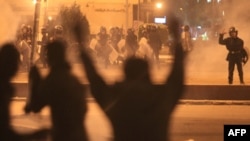
Egyptian protesters gesture as they clash with riot police on Cairo's landmark Tahrir Square in November 2011, nine months after demonstrations sparked longtime ruler Hosni Mubarak's ouster.
WASHINGTON -- The U.S.-based pro-democracy group Freedom House has called the popular uprisings that swept the Arab world in 2011 the greatest challenge to authoritarian rule since the collapse of Soviet communism, and said they have brought hope to people around the world who live in countries with oppressive governments.
The conclusions come in Freedom House's latest "Freedom in the World" index, which has been published annually since 1972 and measures the ability of people to exercise their political and civil rights in 195 countries and 14 territories.
"In the one region of the world -- the Middle East, which has been immune to the wave of democracy that affected every other region of the world back in the '70s, '80s, and '90s -- democracy is now a potential in that region," the group's vice president for research, Arch Puddington, told RFE/RL in connection with the report's publication.
He said the political upheaval that began in Tunisia and spread to Egypt and other Arab countries shows that democracy is possible even in the most repressive of societies. Puddington added that "people are no longer willing to accept the old despotic ways of rule, and for this reason, we see the year 2011 as one that is cause for optimism and not for despair."
The report assigns each country and territory a status of Free, Partly Free, or Not Free based on a scoring of their performance on key democracy indicators.
For 2011, 87 countries were designated "free" -- the same number as in 2010 -- representing 43 percent of the world's population.
But for the sixth consecutive year, the number of countries with declining levels of freedom (26) outnumbered those that improved (12).
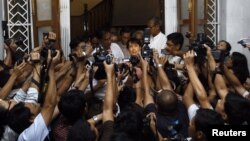
Pro-democracy leader Aung San Suu Kyi speaks to reporters after meeting with UN special envoy to Myanmar Vijay Nambiar in May.
Notable among the countries faring better was Myanmar, which for decades has ranked alongside North Korea as one of the world’s most closed societies. President Thein Sein's release of longtime opposition leader Aung San Suu Kyi and his government's allowance of more public discussion, press freedom, and more competitive elections signaled a major, positive shift in the southeast Asian country.
The report emphasizes that 2011 will stand out for being "the first time in some years [that] governments and rulers who mistreated their people were on the defensive."
But it also warns: "This continued pattern of global backsliding -- especially in such critical areas as press freedom, the rule of law, and the rights of civil society -- is a sobering reminder that the institutions that anchor democratic governance cannot be achieved by protests alone."
Puddington said oppressive governments that have been in power for a long time are especially difficult to replace.
"[The numbers show] that there are a lot of problems in the world, that the authoritarian gains that began a few years back have not reversed, that the antipathy to democracy remains in a number of parts of the world, and that authoritarian regimes have developed very sophisticated ways of enabling them to retain power, and they're not so easily dislodged," he said.
Azerbaijan President Ilham Aliyev (left) with Kazakh President Nursultan Nazarbaev in October
That was especially true in 2011 in Azerbaijan and Kazakhstan, which both stood out in the report for declines in overall freedom.
The report cites evidence that Azerbaijani President Ilham Aliyev used force to break up demonstrations, jailed opposition activists, tried to neutralize the international press, and misused state power "to evict citizens from their homes as part of grandiose building schemes."
"Aliyev, because of his energy wealth, is very self-assured and cocky about the system he's built," Puddington said, "and he's not in any frame of mind to be at all apologetic about his authoritarianism or inclined to consider reform."
Kazakhstan, Freedom House says, was ranked lower this year mainly because of a new law restricting religious beliefs. A violent crackdown on oil worker protests in December was evidence of a further deterioration in freedom.
And yet, Puddington said despite "a number of negative developments," President Nursultan Nazarbaev is largely left alone by Western governments.
"Nazarbaev has managed to fend off criticism from the West through superficial and very often meaningless changes in reforms, and promises of reform, and it's unfortunate the West has been perfectly happy to accept these promises and to accord him the kinds of honors most authoritarian leaders don't get," Puddington said.
Freedom House also cites what it calls "the troubling backslide" of "three of the world's most promising young democracies: South Africa, Hungary and Ukraine.
The government of Hungary, under the leadership of Prime Minister Viktor Orban and his Fidesz party, has passed what Freedom House calls "a new and problematic constitution without adequate input from the opposition, and a series of laws that are widely seen as threats to press freedom, judicial independence, and political pluralism."
Neighboring Ukraine suffered what the group calls "a major decline due to President Viktor Yanukovych's moves to crush the political opposition through a variety of antidemocratic tactics, including the prosecution of opposition political leader and former prime minister [Yulia] Tymoshenko."
Puddington said Ukraine has declined in freedom "more substantially than any other major country" that Freedom House surveys. There have been setbacks in the electoral process and press freedom, he warned, but the biggest backward slide was potentially more troubling.
Yulia Tymoshenko supporters demonstrate near the penal colony where the opposition leader is jailed.
"The real locus of setback has been in the rule of law, and I want to especially point to the persecution of Yulia Tymoshenko," Puddington told RFE/RL. "The charges that she's been imprisoned for just strike us as being spurious, and we regard the prosecution of the leader of a political opposition [group] for purposes of vengeance, as a very dangerous phenomenon."
Both Turkmenistan and Uzbekistan received the same ratings they have in previous years -- the category Freedom House calls "the worst of the worst."
Puddington said there was some hope that under Turkmenistan's relatively new president, Gurbanguly Berdymukhammedov, things might improve from the dark days of former President Saparmurat Niyazov.
"But the current leader is assembling a bit of a personality cult of his own," Puddington said, "and there's been no significant improvement in democratic standards."
In Uzbekistan, where President Islam Karimov has wielded his iron-fisted rule since 1990, Puddington said that like in Kazakhstan, the government gets away with oppressive policies because it has something the West needs: in this case, proximity to the NATO-led war in Afghanistan.
"[Karimov] gets a pass from the United States and from other countries because of his strategic location," Puddington said. "He has suppressed religion there on the grounds that he's dealing with Muslim terrorists, but in the course of doing that, he's basically throttled the legitimate expression of religion and the development of real Muslim religious imams and religious leaders, and that's going to come back to bite him sometime in the future because what it simply will mean is that Islam in Uzbekistan may take a consistently extremist line in the absence of normal religious development."
Meanwhile, Belarus under President Alyaksandr Lukashenka has once again landed near the very bottom of the freedom index. Puddington called 2011 "just another bad year for Belarus."
"Its score is so low that it's very difficult for it to move even further down our scale," he said. "It was a terrible year -- there were all kinds of political prisoner arrests, sentencing, and these preposterous laws against clapping in public and other manifestations of protests."
He said the "one positive thing" that happened last year is that Lukashenka's international isolation deepened. Perhaps at some point, Puddington speculated, Lukashenka's lack of friends and allies will reach the point "where he'll either have to make changes or be deposed."