




When Leon Panetta, the new United States defense secretary, declared on September 6 that it was only "a matter of time" before an Arab Spring-style revolution came to Iran, it seemed to smack of wishful thinking.
Such predictions, after all, are hardly new from Western decision-makers eager for Tehran's Islamic theocracy to be blown away by the winds of change and replaced by a more amenable government.
The hope had been strongly felt -- if largely unexpressed -- at the time of the mass street protests that followed President Mahmud Ahmadinejad's tainted reelection in 2009.


And since this year's outbreak of popular uprisings that have unseated dictatorships in Tunisia, Egypt, and Libya, and destabilized authoritarian regimes elsewhere in the Middle-East countries, there have been numerous expressions of desire for a "Persian Spring" to go with the Arab variety.
Fulfillment has been another matter. For all the upheavals convulsing its Arab neighbors, Iran has remained dormant -- not even the bloody six-month rebellion against its close ally Syria has inspired opposition groups to rise up en masse. Tentative attempts by the Green Movement, which spearheaded the 2009 protests, to organize mass demonstrations on the Egyptian model last March were comprehensively crushed by Iran's well-honed security forces.
Water Fight
Yet now opponents of the Tehran regime feel its nemesis may finally have arrived -- in the form of proliferating acts of civil disobedience.
"The Iranian regime faces a threat even more daunting than the 2009 Green Movement protests: a disparate yet potentially powerful civil disobedience movement motivated not just by politics, but by environmental, economic, and social issues," wrote Alireza Nader, an international policy analyst at the RAND Corporation, in a recent blog post.
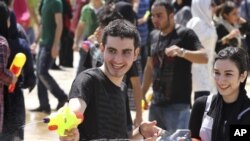
The first sign, according to Nader, appeared in July with an organized water pistol fight among young men and women in Tehran that triggered mass arrests and provoked angry questions in the Majlis, Iran's parliament, about an alleged assault on public morals and decency. Attempts to organize more water fights as a protest against the regime's social restrictiveness have subsequently been made on Facebook, leading to yet more arrests.
Then in late August, a wave of protests occurred over the drying up of Iran's biggest lake, Lake Orumieh, straddling West and East Azerbaijan provinces, which has lost more than half of its volume in recent years due to extensive dam-building projects and drought.
An initial demonstration by environmentalists on August 27 resulted in multiple arrests and brought the lake's plight to wider notice. It was followed a week later by much bigger protests in the cities of Orumieh and Tabriz -- footage from which was posted on YouTube -- that appeared to tap into wider discontent in Iran's Azeri-speaking regions and which were reportedly met by live fire from riot police.
RFE/RL's Radio Farda reported on September 15 that more activists had been arrested for trying to organize further protests over Lake Orumieh.
Nader argues that anger over the lake is mirrored by discontent over a multitude of other issues. "The Azeri demonstrators are not merely motivated by a drying lake or ethnic aspirations," he wrote. "They are driven by the anger, frustration, and indignity felt by Iranians regardless of race, religion, or gender. The Islamic Republic has left Iranians no choice but to disobey."
Trita Parsi, president of the National Iranian American Council, also believes the regime is peculiarly vulnerable to nonviolent disobedience.
"What's so interesting with these campaigns is that they probably have a much larger number of issues that they can focus on," he says. "Who would have expected a year ago that the issue of Orumieh would have reached essentially a national scale right now? I think there can be plenty of examples and I think the government rightly is far more concerned by these forms of nonviolent protest than they are concerned about efforts by certain groups to pursue violence. They know how to handle violence. They don't know how to handle nonviolence."

However, Scott Lucas, an Iran-specialist at Birmingham University in the U.K. and editor of the EA World View website, cautions that while such localized protests have the potential to grow, there is as yet no evidence that they can provide a bigger challenge to the regime than the Green Movement
"The regime has effectively disrupted the organizations behind a lot of that disobedience," argues Lucas. "They've disrupted the student organizations, they've disrupted the lawyers, they've disrupted women's rights activists and so their response on the Lake Orumieh protests is that they swept up, we've got estimates of up to 300 people."
"A lot of those were just general detentions. Some of those people, however, were journalists and some of them were activists. They will try to basically defang the movement. The question is whether they can defang a whole set of specific movements if they all pop up at the same time. We are not at that point yet to be able to answer that question," Lucas says.
Economic Hardship
Conventional wisdom suggests that the most fertile ground for mass discontent -- and, therefore, for civil disobedience -- is provided by a fragile economy. With inflation once again soaring above 20 percent and many Iranians reeling under rocketing utility bills following Ahmadinejad's abolition of subsidies last winter, the potential for protest seems obvious.
One suggestion, floated months ago on the opposition website Balatarin, (http://www.iranian.com/main/blog/balatarin/civil-disobedience-gas-bills) had been for the nonpayment of astronomical gas and electricity bills. Thus far, there has been little sign of such measures getting off the ground as a concerted campaign. One expression of economic discontent has made itself in Tehran's Grand Bazaar, however, where textile merchants have been on strike for the past month over plans to make them pay value added tax (VAT).
Yet as regime opponents such as Hadi Ghaemi, executive director of the International Campaign for Human Rights in Iran, acknowledge, economic hardships generally hit the poor -- who may not be the best-equipped to organize civil disobedience movements.
"It all depends on who would lead and organize such protests," says Ghaemi. "The Lake Orumieh one, it appears, was very well networked and the people behind it were very much focused on keeping it an environmental issue but holding the government officials accountable for what was happening to the lake. On the economic issues, I'm afraid it would be mostly the poor and the ones who are hurt most, the ones who are falling through the safety net. And whether they will have the capacity to network and organize in a peaceful way remains to be seen."
While the appetite for civil disobedience is high following the crushing of the 2009 street rallies, Ghaemi says, the state is well-equipped to counteract the networking required to organize them.
"Now we're in this post-protest moment, civil disobedience acts which do not target the political order directly but challenge it, I believe is what people are looking for," he says. "[But] for that you need a community of people to interact with each other around a common issue and that's what the Intelligence Ministry is so good at, preventing any formation of such networks."
The key to civil disobedience succeeding, observers like Parsi agree, is weight of numbers. Only if several different issues and protests to coalesce at the same time -- stretching the government security apparatus over a wide area and prolonged period -- can such tactics hope to dislodge an entrenched regime:
"Will it be done over one or two protests? Of course not," Parsi argues. "It's going to require a protracted effort that exhausts the government and also at the same time erodes any sense of moral right amongst the many elements within the government that are supposed to carry out the orders they have been receiving."
Whether the will for that protracted effort exists is the $64 million question. The answer may depend on more than just "a matter of time."