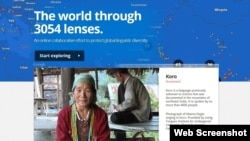
The website for Google's Endangered Languages Project
Type the term "endangered languages" into Google and click on a few of the links. It won't take long to come upon some cold, hard facts: There are between 6,000 and 7,000 languages in use around the world today, but half of them could be gone by the year 2100 -- victims of globalization and the dominance of languages like English, Chinese, and Spanish.
You'll also find stories of the linguists who are struggling to respond. They face an uphill battle to document and preserve these dying languages -- and the unique cultures they encode -- before silence sets in.
That Google search, however, will also likely lead you to the Endangered Languages Project, an initiative launched on June 21 by the U.S.-based Internet giant itself. It's an effort that linguists say shines a much-needed spotlight on a subject that gets little attention from the wider world.
"It's an historic moment," says Google project manager Jason Rissman. "We're aware that languages are going silent at an alarming and unprecedented rate. But at the same time, technology is available to those helping fight to document and strengthen endangered languages around the world. Being able to marry the challenge and that opportunity seemed to us an important way to be able to try to make a difference."
The goal of the Endangered Languages Project, Rissman says, is to create an online clearinghouse for material on the 3,054 languages profiled on its website.
Language Portraits
Funded by Google's philanthropic arm, the project was launched with the help of experts from the University of Hawaii, Eastern Michigan University, and more than two dozen other indigenous language and culture organizations. They've classified the languages as either "vitality unknown," "at risk," "endangered," or "severely endangered."
A map showing some of the endangered languages scattered around the world
The diverse collection, plotted using Google mapping technology, has members on every continent. They range from Shor, a relative of Tatar spoken by less than 10,000 people in Russia, to Putijara, an Australian aboriginal language classified as "critically endangered" with just four known speakers left.
Linguists -- but particularly ordinary people who speak the languages -- are encouraged to upload text, audio, and video using Google’s own video-sharing website YouTube to create a rich, multimedia portrait of each language.
This audio sample, submitted by linguists, features a woman reading basic words in Dungan, a Central Asian language classified as "vulnerable." According to the project website, some 42,000 speakers currently use the language on the Kyrgyz side of the country's eastern border with Kazakhstan:
Google hopes that with time, the project will not only memorialize and promote awareness of the languages but connect diaspora groups and help learning and revitalization efforts.
The user-generated part of the Google project, linguists say, will be the key to how far it can go toward reaching its goals. Several digital databases of rare language samples already exist and the community of experts working on endangered tongues is relatively tight-knit.
"What concerns me, really, is the vast distance between an interest in a language as a language to be recorded and as a feature, so to speak, of the human environment, and the language as used by real speakers who are using it for their own purposes," says Nicholas Ostler, the chairman of the U.K.-based Foundation for Endangered Languages, who is not involved in the Google project.
"And in order for 'self-created' materials to really throw light on a language, there will have to be a vast number of them. At the moment, the data which is there is fairly self-conscious."
Google Confers 'Credibility'
Ostler concedes, however, that the project is still in its infancy and has potential for growth.
Some have also pointed to what they say is the irony of Google's involvement. In spreading major languages – especially English – and in acting as a driving force of globalization, some say the company has sped up the marginalization of minority languages.
Ostler says attaching a name like Google to his and his colleagues' fight can only help draw attention to a trend that many are still not even aware of.
"They are a big name. They give credibility to projects that otherwise might take longer to get started off," he says. "I think they are a net positive benefit."