Herman Nackaerts, deputy director-general of the IAEA, is heading the Iran mission
Inspectors from the United Nations' International Atomic Energy Agency (IAEA) have arrived in Iran for three days of talks about that country's nuclear program, including signs of possible work on atomic weapons.
Reports said it was not immediately clear if the UN inspectors would be allowed to visit nuclear facilities or would be limited to technical discussions with Iranian officials.
It is the second visit to Iran by an IAEA team in the last three weeks, reflecting growing international concern about alleged nuclear weapons work by Tehran. After the first, the inspection team praised the meetings but said there was "still a lot of work to be done" to ease fears over Iran's nuclear activities.
Iran is forging ahead with its nuclear program, which Tehran says is for peaceful purposes, despite international sanctions and possible threats of an Israeli military strike.
Before departing from Vienna, IAEA team leader Herman Nackaerts said his five-member delegation hoped to have "a couple of good and constructive days in Tehran" that would lead to "some concrete results."
"The highest priority remains, of course, the possible military dimensions of Iran's nuclear program," Nackaerts said. "But we want to tackle all outstanding issues and this is, of course, a very complex issue that may take a while. But we hope it will be constructive."
Iranian state-run television said the IAEA team hopes to visit the Parchin military complex. That site has been suspected of housing a secret underground facility used for Iran's nuclear program -- a claim that Iranian authorities deny.
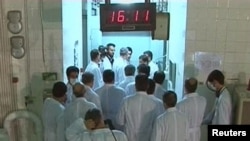
A group of Iranian scientists near the control room area at the Tehran Research Reactor in a February 15 photo.
IAEA inspectors visited Parchin in 2005 but went to only one of four areas of potential interest within the grounds. That visit did not result in reports of any unusual activities, and the IAEA has not mentioned Parchin in its reports since 2008.
The UN nuclear watchdog in November said Iran had carried out tests that appeared relevant to producing a nuclear weapon.
Last week, Iran announced that it had inserted its first domestically produced nuclear fuel rods into a research reactor in Tehran, demonstrating the technical ability to enrich uranium to near-weapons-grade levels. Iran says the reactor is for medical research.
Nuclear physicists have told RFE/RL that Iran could start amassing the weapons-grade material it would need to build a nuclear bomb by recycling spent uranium from the Tehran research reactor through a new generation of carbon-fiber centrifuges that it unveiled last week at its Natanz nuclear facility.
In response to tighter European Union sanctions -- including an oil embargo scheduled to go into effect in July and the freezing of assets of Iran's central bank -- Tehran on February 19 announced that it has stopped selling oil to British and French firms. That move sent global oil prices soaring on February 20 to their highest levels in nine months.
On February 19, Chairman of the U.S. Joint Chiefs of Staff Martin Dempsey and British Foreign Secretary William Hague made separate appeals for Israel to show restraint and allow the latest batch of sanctions to have an effect on Iran.
On February 20, Ahmad Qalebani, the head of Iran's state-run National Oil Company threatened that Iran will cut oil exports to more European Union countries if what he describes as their "hostile actions" continue.
Iran exports nearly 20 percent of its oil to the EU -- but France and Britain use little or none of it.
Qalebani mentioned Spain, Greece, Italy, Portugal, Germany and the Netherlands as countries which could face Iranian oil cuts.
On February 20, world oil prices surged to their highest level in nine months at around $105 a barrel.
In related news, Iranian state media announced on February 20 that two Iranian warships had docked at Syria's Mediterranean port of Tartus, a position to the north of Lebanon and Israel where Russia also maintains a base for nuclear-powered warships.
Iran's navy chief, Admiral Habibollah Sayari, said on February 18 that the supply vessel and destroyer had passed through the Suez Canal, the second time Iranian ships had done so since the country's 1979 Islamic Revolution.
Egypt's military rulers allowed Iranian ships to pass through the Suez Canal last year after the ouster of Hosni Mubarak, who had prevented Iranian ships from using the canal for more than three decades.
* CORRECTION: An earlier version of this story erroneously stated the IAEA delegation planned two days of talks. Reports say it will be a three-day visit.