Ahmad Chalabi at a 2005 appearance before the American Enterprise Institute for Public Policy Research (AEI) in Washington
He was once seen in Washington as a potential successor to Saddam Hussein to lead postwar Iraq.
But Ahmad Chalabi's star dimmed with the growing perception at home and abroad that he helped start the war on false pretenses.
That's because Hussein's alleged weapons of mass destruction -- the reason given by President George W. Bush's administration for the invasion -- never materialized. And it was Chalabi and his Iraqi National Congress (INC) that U.S. officials blamed as the source of false information on Iraq's purported weapons programs.
Even before the U.S.-led invasion of Iraq on March 19-20, 2003, there were many voices around the world who doubted claims by Bush and British Prime Minister Tony Blair that the Iraqi president was hiding chemical and nuclear weapons programs in violation of international law.
But when the CIA's top weapons inspector in Iraq ended the search in April 2005, saying the hunt had "gone as far as feasible" and found nothing, the original argument for going to war collapsed.
"Ahmad Chalabi's role was fundamental in convincing the American foreign-policy establishment -- particularly the neoconservatives -- that Saddam Hussein had chemical weapons and even nuclear weapons," Fawaz Gerges, director of the Middle East Center at the London School of Economics, says. "Many American politicians wanted to be convinced, and Ahmad Chalabi was the right person at the right moment for the right audience. And the American policy establishment naively bought his narrative."
De-Ba'athification Boss
Chalabi fell out of favor in Washington as the search for weapons of mass destruction stretched on. Having returned to Iraq in April 2003 after decades of self-imposed exile, Chalabi was positioning himself for leadership in the post-Hussein environment.
The son of a prominent Shi'ite family, Chalabi was put in charge of "de-Ba'athification" -- the removal from power of mostly Sunni Iraqi officials in Hussein's Ba'ath Party.
But he soon found that the funding his party had been receiving from the United States had been cut. In May 2004, U.S. troops raided Chalabi's Baghdad headquarters and the residences of other INC party members to search for evidence of fraud. Chalabi was subsequently charged with counterfeiting and leaking classified information to Iran.
Chalabi repositioned himself as a critic of the invasion and his party joined a coalition alliance of mainly Shi'ite groups ahead of Iraq's 2005 elections. He was appointed as Iraq's deputy prime minister in the subsequent government and returned to Washington in November 2005, where he had a closed-door meeting with senior officials in the Bush administration.
PHOTO GALLERY: Shock And Awe -- The 2003 Iraq Invasion:
Shock And Awe: Images Of The 2003 Invasion Of Iraq
1/21Smoke rises from the Iraqi Planning Ministry on the second day of U.S. raids on the Iraqi capital on March 20, 2003.
On March 19, 2003, U.S. forces carried out the first air strikes of the Iraq War, targeting top Iraqi officials at a compound on the outskirts of Baghdad. These photos document some of the most dramatic moments of the invasion that began 10 years ago. (21 PHOTOS)
2/21In the run-up to the invasion, the administration of U.S. President George W. Bush argued that Iraq was concealing weapons of mass destruction. Here, Secretary of State Colin Powell holds up a vial that he described as one that could contain anthrax during a presentation on Iraq to the UN Security Council on February 5, 2003.
On March 19, 2003, U.S. forces carried out the first air strikes of the Iraq War, targeting top Iraqi officials at a compound on the outskirts of Baghdad. These photos document some of the most dramatic moments of the invasion that began 10 years ago. (21 PHOTOS)
3/21U.S. Marines in combat gear take their positions during a last-minute exercise in northern Kuwait near the border with Iraq on March 18, 2003.
On March 19, 2003, U.S. forces carried out the first air strikes of the Iraq War, targeting top Iraqi officials at a compound on the outskirts of Baghdad. These photos document some of the most dramatic moments of the invasion that began 10 years ago. (21 PHOTOS)
4/21U.S. President George W. Bush announces the start of U.S. strikes in Iraq during a televised address from the Oval Office on March 19.
On March 19, 2003, U.S. forces carried out the first air strikes of the Iraq War, targeting top Iraqi officials at a compound on the outskirts of Baghdad. These photos document some of the most dramatic moments of the invasion that began 10 years ago. (21 PHOTOS)
5/21A U.S. Marine F18 jet takes off from a base in Kuwait to conduct a mission in Iraq on March 20, 2003.
On March 19, 2003, U.S. forces carried out the first air strikes of the Iraq War, targeting top Iraqi officials at a compound on the outskirts of Baghdad. These photos document some of the most dramatic moments of the invasion that began 10 years ago. (21 PHOTOS)
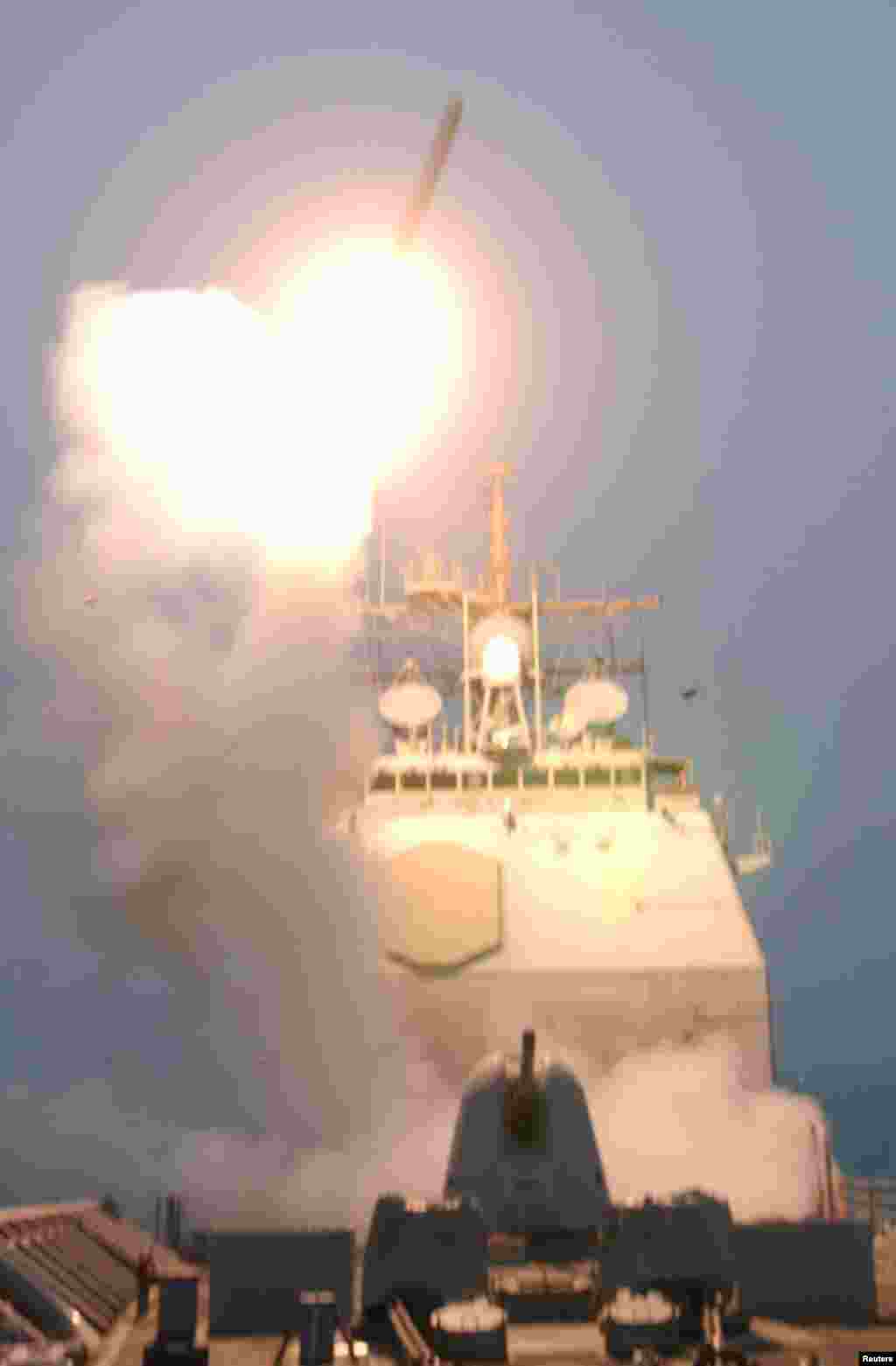
6/21The first Tomahawk missile to be fired into Iraq is launched from the USS Bunker Hill in the Persian Gulf early on March 20, 2003.
On March 19, 2003, U.S. forces carried out the first air strikes of the Iraq War, targeting top Iraqi officials at a compound on the outskirts of Baghdad. These photos document some of the most dramatic moments of the invasion that began 10 years ago. (21 PHOTOS)
7/21Iraqi President Saddam Hussein appears on state television just hours after the United States launched its invasion to overthrow him. In his speech, Saddam said, "The criminal little Bush has committed a crime against humanity."
On March 19, 2003, U.S. forces carried out the first air strikes of the Iraq War, targeting top Iraqi officials at a compound on the outskirts of Baghdad. These photos document some of the most dramatic moments of the invasion that began 10 years ago. (21 PHOTOS)
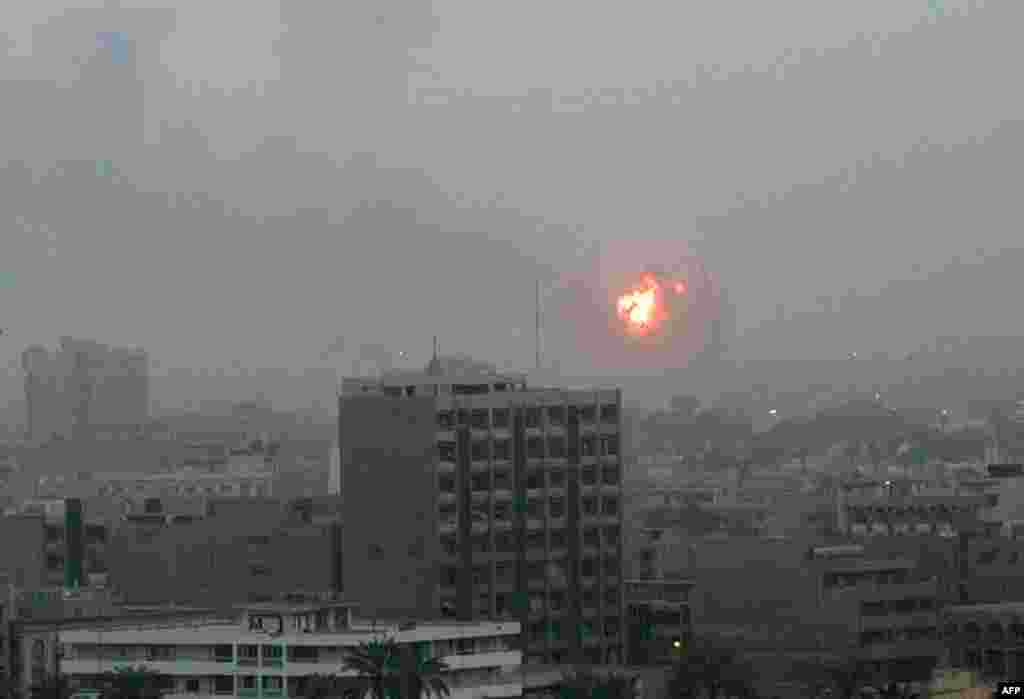
8/21An explosion is seen in Baghdad on March 20 during the early massive show of military force known as "shock and awe."
On March 19, 2003, U.S. forces carried out the first air strikes of the Iraq War, targeting top Iraqi officials at a compound on the outskirts of Baghdad. These photos document some of the most dramatic moments of the invasion that began 10 years ago. (21 PHOTOS)
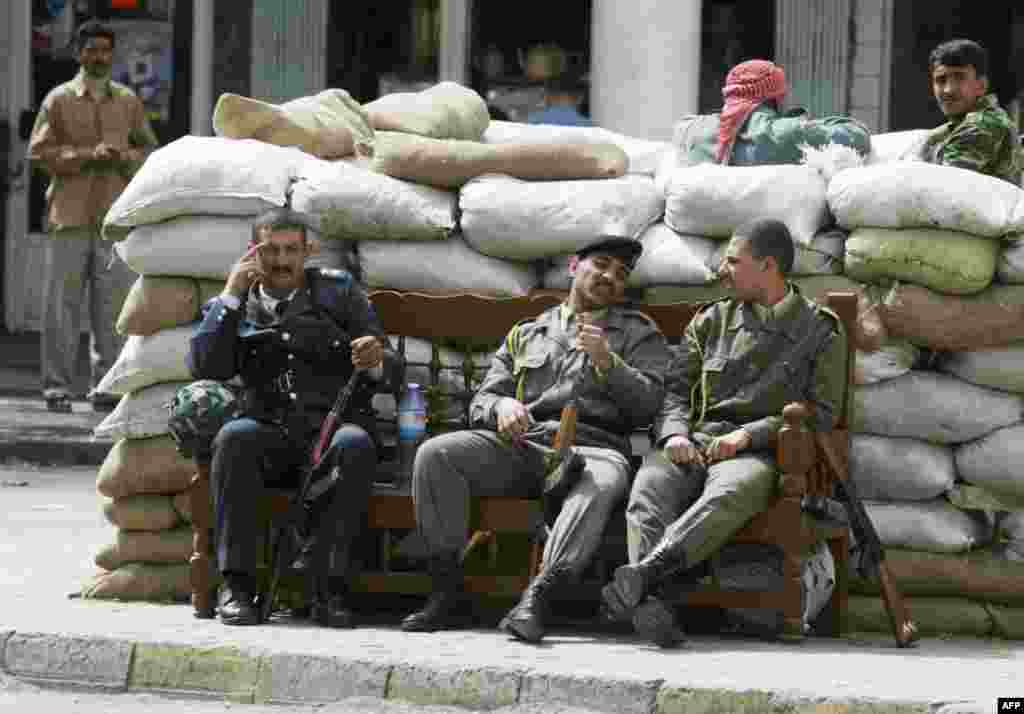
9/21Iraqi militiamen from the ruling Ba'ath party rest in Baghdad amid the U.S. strikes on March 20.
On March 19, 2003, U.S. forces carried out the first air strikes of the Iraq War, targeting top Iraqi officials at a compound on the outskirts of Baghdad. These photos document some of the most dramatic moments of the invasion that began 10 years ago. (21 PHOTOS)
10/21U.S. soldiers take up positions after Iraq fired missiles into Kuwait, setting off ground attack sirens in Kuwait City.
On March 19, 2003, U.S. forces carried out the first air strikes of the Iraq War, targeting top Iraqi officials at a compound on the outskirts of Baghdad. These photos document some of the most dramatic moments of the invasion that began 10 years ago. (21 PHOTOS)
11/21Smoke covers the presidential palace compound in Baghdad on March 21 during massive U.S.-led air raids.
On March 19, 2003, U.S. forces carried out the first air strikes of the Iraq War, targeting top Iraqi officials at a compound on the outskirts of Baghdad. These photos document some of the most dramatic moments of the invasion that began 10 years ago. (21 PHOTOS)
12/21U.S. Marines cross from Kuwait into Iraq as they prepare to capture the key Iraqi city of Al-Basrah.
On March 19, 2003, U.S. forces carried out the first air strikes of the Iraq War, targeting top Iraqi officials at a compound on the outskirts of Baghdad. These photos document some of the most dramatic moments of the invasion that began 10 years ago. (21 PHOTOS)
13/21A statue of President Saddam Hussein stands on Baghdad's Firdos Square as smoke billows from burning trenches filled with oil. The statue was toppled on April 9.
On March 19, 2003, U.S. forces carried out the first air strikes of the Iraq War, targeting top Iraqi officials at a compound on the outskirts of Baghdad. These photos document some of the most dramatic moments of the invasion that began 10 years ago. (21 PHOTOS)
14/21The body of an Iraqi soldier lies wrapped in a blanket following the British assault on the Al-Faw peninsula on March 22.
On March 19, 2003, U.S. forces carried out the first air strikes of the Iraq War, targeting top Iraqi officials at a compound on the outskirts of Baghdad. These photos document some of the most dramatic moments of the invasion that began 10 years ago. (21 PHOTOS)
15/21Armed members of the Women's Association linked to the ruling Ba'ath party stand at the entrance to their party's building in Baghdad on March 23.
On March 19, 2003, U.S. forces carried out the first air strikes of the Iraq War, targeting top Iraqi officials at a compound on the outskirts of Baghdad. These photos document some of the most dramatic moments of the invasion that began 10 years ago. (21 PHOTOS)
16/21U.S. Marines enter the southern city of Al-Nasiriyah on March 23.
On March 19, 2003, U.S. forces carried out the first air strikes of the Iraq War, targeting top Iraqi officials at a compound on the outskirts of Baghdad. These photos document some of the most dramatic moments of the invasion that began 10 years ago. (21 PHOTOS)
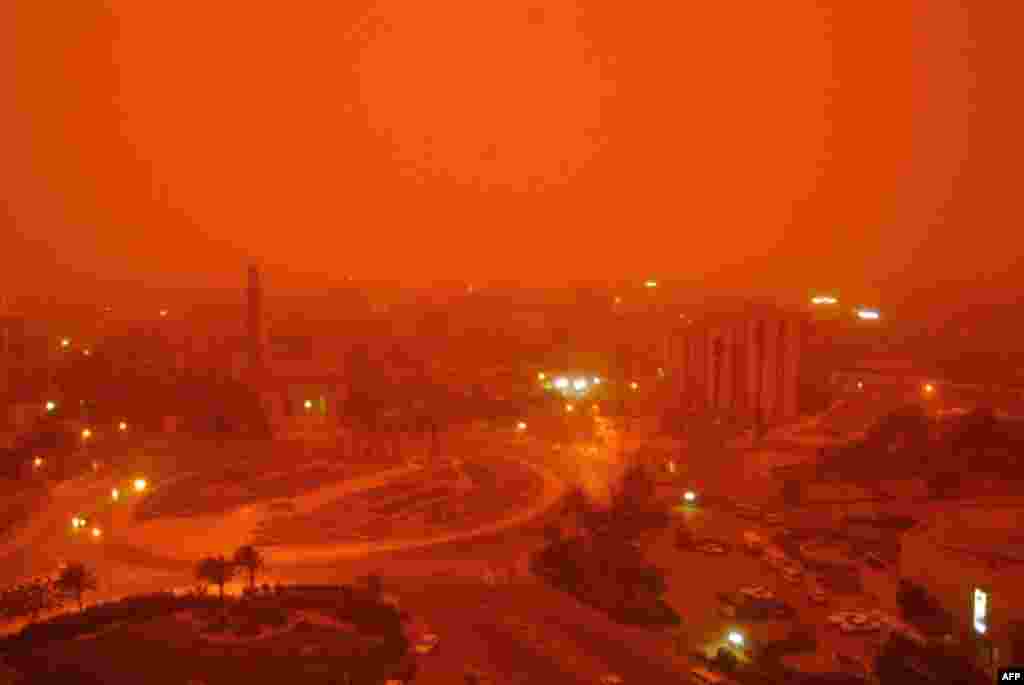
17/21A sand storm hits the center of Baghdad, which is also shrouded in smoke from burning oil trenches.
On March 19, 2003, U.S. forces carried out the first air strikes of the Iraq War, targeting top Iraqi officials at a compound on the outskirts of Baghdad. These photos document some of the most dramatic moments of the invasion that began 10 years ago. (21 PHOTOS)
18/21An Iraqi comforts a friend after missiles struck a Baghdad market, killing at least 14 people on March 26, 2003.
On March 19, 2003, U.S. forces carried out the first air strikes of the Iraq War, targeting top Iraqi officials at a compound on the outskirts of Baghdad. These photos document some of the most dramatic moments of the invasion that began 10 years ago. (21 PHOTOS)
19/21Residents flee the southern city of Al-Basrah, still held by the Iraqi military on March 28.
On March 19, 2003, U.S. forces carried out the first air strikes of the Iraq War, targeting top Iraqi officials at a compound on the outskirts of Baghdad. These photos document some of the most dramatic moments of the invasion that began 10 years ago. (21 PHOTOS)
20/21U.S. soldiers observe the reception room of a presidential palace near the international airport southwest of Baghdad.
On March 19, 2003, U.S. forces carried out the first air strikes of the Iraq War, targeting top Iraqi officials at a compound on the outskirts of Baghdad. These photos document some of the most dramatic moments of the invasion that began 10 years ago. (21 PHOTOS)
21/21A U.S. Marine watches as a statue of Iraqi President Saddam Hussein falls in Firdos Square in Baghdad on April 9, 2003.
On March 19, 2003, U.S. forces carried out the first air strikes of the Iraq War, targeting top Iraqi officials at a compound on the outskirts of Baghdad. These photos document some of the most dramatic moments of the invasion that began 10 years ago. (21 PHOTOS)
Previous slide
Next slide
Chalabi denied the allegations that he encouraged the war in order to remove Saddam Hussein from power so he could achieve his own political aspirations.
"As for the fact that I deliberately misled the American government, this is an urban myth," Chalabi said.
CIA intelligence from before the invasion had advised against relying on Chalabi and his sources to build a case for the war. One report said Chalabi was likely to inflame sectarian tensions between his own Shi'ite sect and Iraq's Kurdish and Sunni Muslim minorities.
In Government, Not Atop It
Today, Chalabi is a member of Iraq's parliament and is helping his party campaign for provincial elections in April.
When in Iraq, he stays at his family's palatial home in Baghdad's Green Zone, surrounded constantly by private bodyguards.
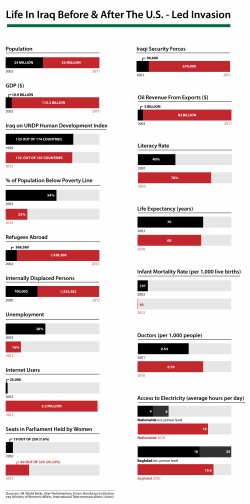
In Numbers: Iraq War Before And After (CLICK TO ENLARGE)
He also maintains a residence in Lebanon, where he launched an Arabic-language satellite television channel called AsiaSat TV that began broadcasting across the Middle East in 2012.
Chalabi still leads the INC, which is part of Shi'ite Prime Minister Nuri al-Maliki's governing alliance -- the National Coalition.
But political experts like Gerges at the London School of Economics say it is unlikely he will ever head Iraq's government.
"He has never, ever had a serious social base -- any power base -- in Iraq," Gerges says. "It was basically wishful thinking. It was part of his salesman narrative to the American policy makers [before the war]. He convinced American politicians that he did. The CIA knew better."
Chalabi refused to be interviewed by RFE/RL about his role in the events leading to the start of the Iraq war 10 years ago.
One of his aides told RFE/RL that Chalabi is concerned his words could be misconstrued in Iraq and fuel sectarian violence.