




Is a critical mass of Russia's ruling elite having second thoughts about managed pluralism? There are some signs that this might be the case.
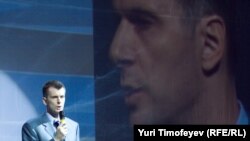
Suddenly, for example, Mikhail Prokhorov's Right Cause party is running into all sorts of problems.
On August 9, the entire political council of the party's Kamchatka branch -- as well as heads of local offices in Milkovo district and Petropavlovsk-Kamchatsky -- resigned en masse and joined Vladimir Putin's Popular Front, saying they disagreed with Prokhorov's personnel policies.
The Kamchatka exodus came after Prokhorov made waves by replacing the leadership of the party's St. Petersburg branch last week.
Also on August 9, Prokhorov accused the ruling United Russia party of orchestrating the removal of more than 200 of its billboards in Yekaterinburg, Novosibirsk, and Moscow.
All of this followed a conflict last week between him and Boris Nadezhdin, a senior member of the party, over whether nationalists should be included among its ranks. That mini-scandal broke out after an article appeared in the pro-Putin daily "Izvestia," prominently quoting Nadezhdin as saying the party was actively recruiting nationalist figures.
The article drew a quick denial from Right Cause officials. It also led to Prokhorov sharply -- and publicly -- rebuking Nadezhdin. "If he shares any of their views, there is no place in the party for him," he wrote on his blog on August 3, according to "The Moscow Times."
In Russia, a string of bad luck like this doesn't usually happen by accident. And one can't help but wonder if somebody very powerful is trying to undermine the whole "Right Cause project."
The idea of propping up a Kremlin-friendly center-right party has been in the works for a long time, had the support of the technocratic wing of the elite, much of which also favors President Dmitry Medvedev serving a second term, but was hotly opposed by the likes of Deputy Prime Minister Igor Sechin and other siloviki.
Right Cause's troubles coincide with an apparent shift in the conventional wisdom about who will run as the establishment's anointed presidential candidate in March 2012. In recent weeks, the punditocracy appears to sense that the a return to the Kremlin for Putin is increasingly likely. Some are also suggesting that Putin and Medvedev may even run against each other (a scenario I still find hardly likely, but not out of the question).
Here's Gleb Pavlovsky, head of the Effective Politics Foundation and a Medvedev supporter, speaking to "Nezavisimaya gazeta":
This all may be a temporary blip, it may be a diversion, or it could very well be a decisive shift away from where I have been assuming Russia is moving. As regular readers of this blog must know by now, I have long thought that Plan A was for Medvedev to serve a second term as president and for Putin to remain in charge as "national leader" and the senior member of the tandem.
I have also long thought that another part of Plan A was to rejuvenate the State Duma with fresh parties that gave the appearance of a pluralistic system, albeit one that is in fact tightly managed.
But Plan A can always be scrapped for Plan B, which may or may not be what is happening now.
-- Brian Whitmore
Suddenly, for example, Mikhail Prokhorov's Right Cause party is running into all sorts of problems.
On August 9, the entire political council of the party's Kamchatka branch -- as well as heads of local offices in Milkovo district and Petropavlovsk-Kamchatsky -- resigned en masse and joined Vladimir Putin's Popular Front, saying they disagreed with Prokhorov's personnel policies.
The Kamchatka exodus came after Prokhorov made waves by replacing the leadership of the party's St. Petersburg branch last week.
Also on August 9, Prokhorov accused the ruling United Russia party of orchestrating the removal of more than 200 of its billboards in Yekaterinburg, Novosibirsk, and Moscow.
All of this followed a conflict last week between him and Boris Nadezhdin, a senior member of the party, over whether nationalists should be included among its ranks. That mini-scandal broke out after an article appeared in the pro-Putin daily "Izvestia," prominently quoting Nadezhdin as saying the party was actively recruiting nationalist figures.
The article drew a quick denial from Right Cause officials. It also led to Prokhorov sharply -- and publicly -- rebuking Nadezhdin. "If he shares any of their views, there is no place in the party for him," he wrote on his blog on August 3, according to "The Moscow Times."
In Russia, a string of bad luck like this doesn't usually happen by accident. And one can't help but wonder if somebody very powerful is trying to undermine the whole "Right Cause project."
The idea of propping up a Kremlin-friendly center-right party has been in the works for a long time, had the support of the technocratic wing of the elite, much of which also favors President Dmitry Medvedev serving a second term, but was hotly opposed by the likes of Deputy Prime Minister Igor Sechin and other siloviki.
Right Cause's troubles coincide with an apparent shift in the conventional wisdom about who will run as the establishment's anointed presidential candidate in March 2012. In recent weeks, the punditocracy appears to sense that the a return to the Kremlin for Putin is increasingly likely. Some are also suggesting that Putin and Medvedev may even run against each other (a scenario I still find hardly likely, but not out of the question).
Here's Gleb Pavlovsky, head of the Effective Politics Foundation and a Medvedev supporter, speaking to "Nezavisimaya gazeta":
The tandem nominating Medvedev would be a good solution. But this scenario is no longer being considered, by all accounts. And competitive elections could be the sole solution permitting the avoidance of a crisis and the imparting of an open civic format to modernization. It would be possible to fairly evaluate the results of the past 12 years and also to afford the party of power an opportunity to openly separate into factions. Some members of which would under the conditions of an open election campaign go to Medvedev. Even more important is the fact that the supporters of a renewal of the state would acquire a political identity, and nothing could be done with them after the elections. Clearly, the Medvedev camp currently has considerably less bureaucratic and political potential, but this would enable it to save face and its positions.
This all may be a temporary blip, it may be a diversion, or it could very well be a decisive shift away from where I have been assuming Russia is moving. As regular readers of this blog must know by now, I have long thought that Plan A was for Medvedev to serve a second term as president and for Putin to remain in charge as "national leader" and the senior member of the tandem.
I have also long thought that another part of Plan A was to rejuvenate the State Duma with fresh parties that gave the appearance of a pluralistic system, albeit one that is in fact tightly managed.
But Plan A can always be scrapped for Plan B, which may or may not be what is happening now.
-- Brian Whitmore