



Accessibility links

Breaking News

Islamic State Group Blows Up Two Mausoleums In Syria's Palmyra

A year ago, all was quiet at Palmyra. This picture, from March 14, 2014, shows locals with bicycles at the ancient oasis city.
1/9 A year ago, all was quiet at Palmyra. This picture, from March 14, 2014, shows locals with bicycles at the ancient oasis city.
Syrian authorities say Islamic State militants have advanced to within 2 kilometers of Palmyra, an ancient city with outstanding architectural heritage dating from the first century. The militants have caused significant damage to similar sites they have overrun in Iraq, posting videos of themselves destroying antiquities. UNESCO includes Palmyra on its list of World Heritage sites, describing it as one of the most important cultural centers of the ancient world -- a crossroads for local, Persian, Greek and Roman influences.
The remains of the Roman theatre date back to the 2nd century. Until recently, it was host to the annual Palmyra Festival.
2/9 The remains of the Roman theatre date back to the 2nd century. Until recently, it was host to the annual Palmyra Festival.
Syrian authorities say Islamic State militants have advanced to within 2 kilometers of Palmyra, an ancient city with outstanding architectural heritage dating from the first century. The militants have caused significant damage to similar sites they have overrun in Iraq, posting videos of themselves destroying antiquities. UNESCO includes Palmyra on its list of World Heritage sites, describing it as one of the most important cultural centers of the ancient world -- a crossroads for local, Persian, Greek and Roman influences.
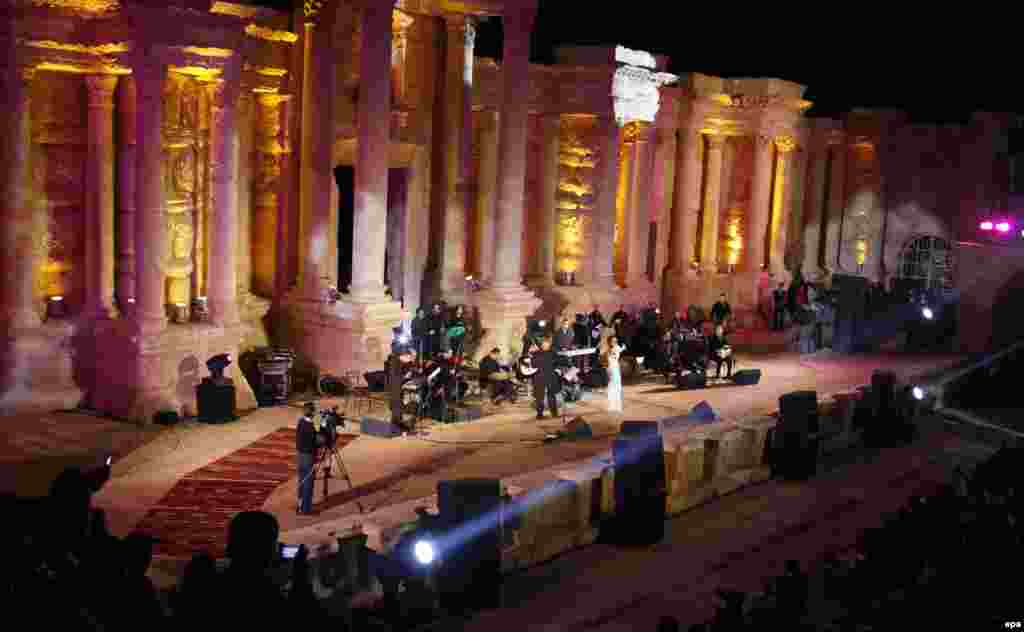
Lebanese singer Najwa Karam performs at the opening ceremony of the Palmyra Festival in 2010.
3/9 Lebanese singer Najwa Karam performs at the opening ceremony of the Palmyra Festival in 2010.
Syrian authorities say Islamic State militants have advanced to within 2 kilometers of Palmyra, an ancient city with outstanding architectural heritage dating from the first century. The militants have caused significant damage to similar sites they have overrun in Iraq, posting videos of themselves destroying antiquities. UNESCO includes Palmyra on its list of World Heritage sites, describing it as one of the most important cultural centers of the ancient world -- a crossroads for local, Persian, Greek and Roman influences.
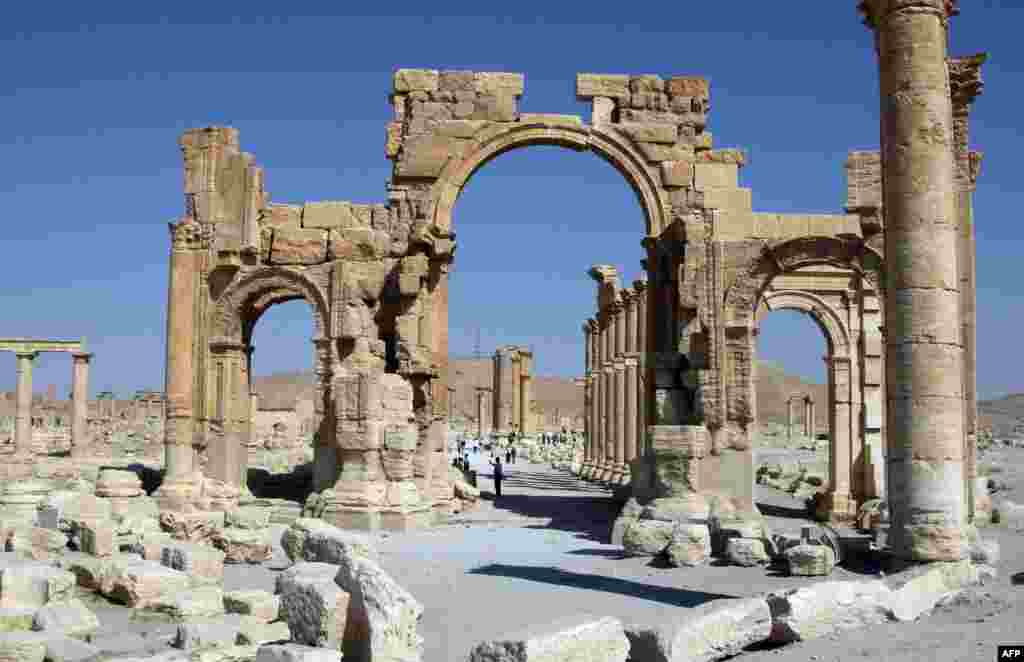
More Roman ruins. Palmyra became increasingly prosperous after the Romans took control at the beginning of the 1st century.
4/9 More Roman ruins. Palmyra became increasingly prosperous after the Romans took control at the beginning of the 1st century.
Syrian authorities say Islamic State militants have advanced to within 2 kilometers of Palmyra, an ancient city with outstanding architectural heritage dating from the first century. The militants have caused significant damage to similar sites they have overrun in Iraq, posting videos of themselves destroying antiquities. UNESCO includes Palmyra on its list of World Heritage sites, describing it as one of the most important cultural centers of the ancient world -- a crossroads for local, Persian, Greek and Roman influences.
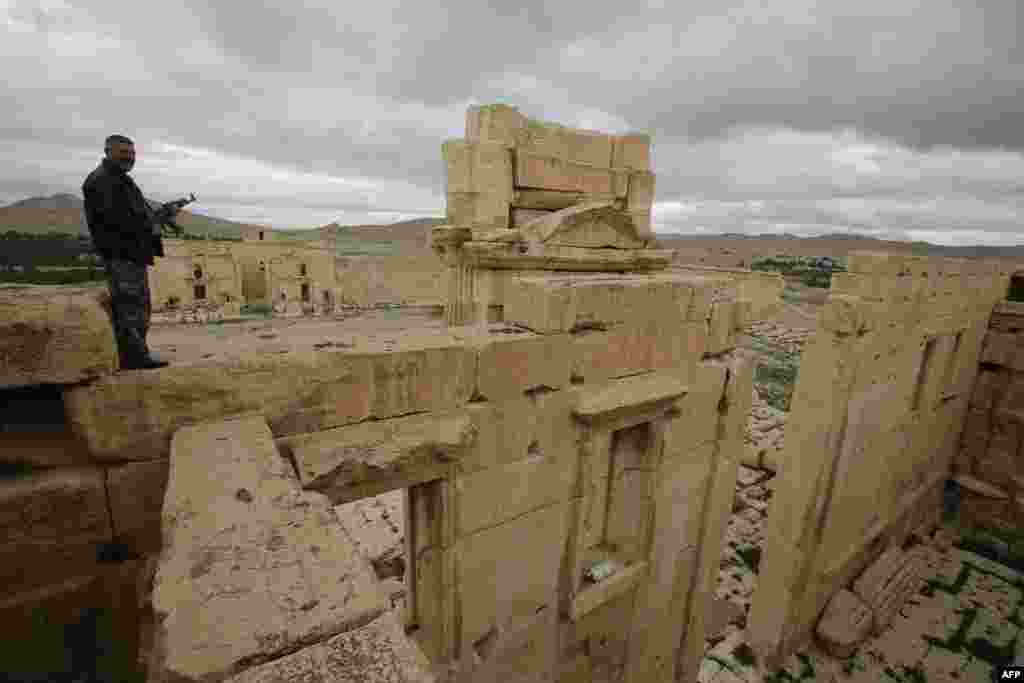
March 2014 - A Syrian policeman stands on the sanctury of Baal, one of three pagan gods worshipped in Palmyra in the 1st century.
5/9 March 2014 - A Syrian policeman stands on the sanctury of Baal, one of three pagan gods worshipped in Palmyra in the 1st century.
Syrian authorities say Islamic State militants have advanced to within 2 kilometers of Palmyra, an ancient city with outstanding architectural heritage dating from the first century. The militants have caused significant damage to similar sites they have overrun in Iraq, posting videos of themselves destroying antiquities. UNESCO includes Palmyra on its list of World Heritage sites, describing it as one of the most important cultural centers of the ancient world -- a crossroads for local, Persian, Greek and Roman influences.
Palmyra is believed to have been founded by King Solomon.
6/9 Palmyra is believed to have been founded by King Solomon.
Syrian authorities say Islamic State militants have advanced to within 2 kilometers of Palmyra, an ancient city with outstanding architectural heritage dating from the first century. The militants have caused significant damage to similar sites they have overrun in Iraq, posting videos of themselves destroying antiquities. UNESCO includes Palmyra on its list of World Heritage sites, describing it as one of the most important cultural centers of the ancient world -- a crossroads for local, Persian, Greek and Roman influences.
A 2nd century limestone relief excavated in 2008 from a cemetery in Palmyra. Shapes of 13 men and women, all from the same family, are engraved on it.
7/9 A 2nd century limestone relief excavated in 2008 from a cemetery in Palmyra. Shapes of 13 men and women, all from the same family, are engraved on it.
Syrian authorities say Islamic State militants have advanced to within 2 kilometers of Palmyra, an ancient city with outstanding architectural heritage dating from the first century. The militants have caused significant damage to similar sites they have overrun in Iraq, posting videos of themselves destroying antiquities. UNESCO includes Palmyra on its list of World Heritage sites, describing it as one of the most important cultural centers of the ancient world -- a crossroads for local, Persian, Greek and Roman influences.
From the same dig - the scene depicts two Palmyrian merchants and a child standing next to a camel.
8/9 From the same dig - the scene depicts two Palmyrian merchants and a child standing next to a camel.
Syrian authorities say Islamic State militants have advanced to within 2 kilometers of Palmyra, an ancient city with outstanding architectural heritage dating from the first century. The militants have caused significant damage to similar sites they have overrun in Iraq, posting videos of themselves destroying antiquities. UNESCO includes Palmyra on its list of World Heritage sites, describing it as one of the most important cultural centers of the ancient world -- a crossroads for local, Persian, Greek and Roman influences.
The sun sets behind ruined columns at Palmyra, November 2010.
9/9 The sun sets behind ruined columns at Palmyra, November 2010.
Syrian authorities say Islamic State militants have advanced to within 2 kilometers of Palmyra, an ancient city with outstanding architectural heritage dating from the first century. The militants have caused significant damage to similar sites they have overrun in Iraq, posting videos of themselves destroying antiquities. UNESCO includes Palmyra on its list of World Heritage sites, describing it as one of the most important cultural centers of the ancient world -- a crossroads for local, Persian, Greek and Roman influences.
Previous slide
Next slide

A Syrian official confirmed on June 24 that the Islamic State (IS) group has destroyed two mausoleums near the historic central town of Palmyra.

The IS on June 23 said it had blown up two ancient shrines near Palmyra.

Maamoun Abdulkarim, the head of the Antiquities and Museums Department in Damascus, said on June 24 that one of the tombs belongs to Mohammad Bin Ali, a descendant of Islam's Prophet Muhammad's cousin Imam Ali.

Abdulkarim said on June 24 that the tomb was just north of Palmyra.

He said the second tomb was of a Sufi scholar known as Nizar Abu Bahaa Eddine, who was in the town 500 years ago. The tomb is close to the Palmyra's famed archaeological site.

The Syrian Observatory for Human Rights, a London-based monitoring group, said this week that the militants had planted mines in Palmyra but that it was not clear whether it was preparing to destroy the site or wanted to deter government forces from advancing towards it.

The IS captured Palmyra last month.

Based on reporting by AP and Reuters
XS
SM
MD
LG