



Saturday, May 26, 2012


Features

Why Is The North Caucasus An Unholy Mess?

TEXT SIZE - +
PHOTO GALLERY: The Eight Horsemen Of The North Caucasus Apocalypse (click photo above)

By Liz Fuller

Over the past 15 years, Russia's North Caucasus has become a byword for war, destruction, human rights abuses, extrajudicial killings, corruption, economic collapse, and Islamic terrorism. Last year, 754 people were killed in ongoing low-level hostilities -- two a day on average.

On August 12, gunmen killed two police officers after Friday Prayers at a mosque in Khasavyurt, Daghestan, near the border with Chechnya. A day later, in the nearby village of Kurush, a local fire chief was shot and killed while driving his car.

The region is variously compared to a tinderbox ready to erupt, a cancer on the body of the Russian Federation, and a financial black hole that absorbs without trace billions of rubles intended to promote stabilization and desperately needed economic development.

How did a predominantly rural, mountainous region of fewer than 10 million people degenerate so swiftly into chaos, misery, endless bloodshed, and religious and social polarization?

That process was triggered and perpetuated by the short-sighted, misguided, self-serving and amoral actions of a small handful of men. On the one hand, Russia's leaders and their local satraps pinned their careers and reputations to retaining control initially over Chechnya, and then over the North Caucasus as a whole. On the other, the local population took up arms against them, first in the name of Chechen independence, but now increasingly under the banner of Islam.

'Restore Constitutional Order'

The struggle began when then Russian President Boris Yeltsin sent the Russian Army into Chechnya in December 1994 to "restore constitutional order." In November 1990, Chechnya's mercurial president, former Soviet Air Force General Dzhokhar Dudayev, had signed a sovereignty declaration that the population construed as cementing the republic's emergence as an independent state. And for almost three years after the collapse of the USSR in December 1991, Chechnya indeed functioned independently of Moscow.  

Yeltsin's Defense Minister Pavel Grachev boasted that Dudayev could be ousted and Chechnya brought to heel by a "small victorious war." But the Chechens, collectively psychologically scarred by the memory of the entire nation's deportation by Stalin to Central Asia in 1944, mobilized en masse and fought back, David against the Russian Goliath. Dudayev was killed in April 1996, but in August that year several hundred Chechen fighters succeeded in retaking the capital, Grozny, and forced Moscow to sign a peace agreement and withdraw its defeated troops.  
But the peace was short-lived. True, in May 1997 Yeltsin signed an agreement with Dudayev's successor as president, Aslan Maskhadov, which referred to the Chechen Republic Ichkeria as a "state" with which Moscow pledged to structure relations "in accordance with the universally accepted principles and norms of international law." But Moscow failed to provide funds to restore the republic's devastated infrastructure and create new jobs. That neglect played into the hands of rival bands of demobilized Chechen fighters who turned to banditry and hostage-taking and, increasingly, came under the influence of purist Salafi Islam.

The radical Islamist faction was headed by field commander Shamil Basayev, the mastermind of the June 1995 seizure of hundreds of civilian hostages in the south Russian town of Budyonnovsk, and Saudi jihadist Khattab. Having sidelined the secular nationalist Maskhadov, they invaded neighboring Daghestan in August 1999 and proclaimed an independent North Caucasus state. That incursion furnished the Russian authorities with the excuse they needed to launch a second war and paved the way for the election of Vladimir Putin to succeed the ailing and ineffective Yeltsin as Russian president.

'Stabilizing' Chechnya

The second time around, the Russian Army avoided the tactical errors it had made during the first war. Within months, the Chechen resistance forces retreated from Grozny at night through a snow-covered minefield, losing hundreds of men, and headed for the southern mountains. They are still entrenched there, sallying forth at intervals from a network of well-equipped underground bases to attack Russian troops.

Putin's plan for "stabilizing" Chechnya hinged on tasking pro-Moscow Chechen officials headed by former mufti Akhmed-hadji Kadyrov with stamping out the last vestiges of resistance and providing virtually unlimited funds for postconflict reconstruction. When Kadyrov was killed in May 2004, Putin continued to back his son, Ramzan Kadyrov.

Since his formal confirmation as Chechen Republic head in March 2007 at the age of 30, Kadyrov has successfully overseen large-scale reconstruction that has transformed Grozny from a rubble-strewn battlefield into a functioning city. But his continued reliance on brute force against anyone suspected of sympathizing with the Islamic insurgency and his opulent lifestyle in the face of chronic poverty and deprivation have made him the most hated and feared man in Chechnya.

Meanwhile, "preventive strikes" against suspected Islamist fighters outside Chechnya impelled more and more angry and alienated young men to join the insurgency ranks, and thus contributed to the spillover into neighboring republics of what had begun in 1994-95 as a battle to defend Chechen independence.

In Ingushetia, Putin's former FSB crony Murat Zyazikov gave the green light for the abduction and summary execution of hundreds of blameless young men whose brothers retaliated by flocking to fight under Basayev's banner. They killed nearly 80 police and security personnel in one night of revenge attacks in June 2004.

Further west in Kabardino-Balkaria, local police systematically harassed, detained, and tortured young practicing Muslim men. Basayev recruited them, too. In a wakeup call to Moscow, his fighters launched similar attacks in Nalchik, the republican capital, in October 2005.

Islam As New Ideology

As the flames of insurgency spread, Islam gradually superseded the original ideology of national liberation. In late 2007, then Chechen president and insurgency commander Doku Umarov formally abjured the cause of Chechen independence and proclaimed himself head of a virtual Caucasus Emirate. More recently, he has pledged to "liberate" Russian regions far from the Caucasus that have historically been populated by Muslims.

Umarov's positioning of the insurgency as part of a global jihad enabled Moscow to rationalize the ongoing indiscriminate reprisals in the North Caucasus as part of the war on terror. So, too, did the terrorist attacks launched by new recruits to the militants' ranks. Aleksandr Tikhomirov (aka Said Buryatsky) a convert to Islam from Buryatia and a hugely popular ideologist of jihad, staged two car bombings in Ingushetia in 2009, one of which narrowly missed killing Zyazikov's successor as president, Yunus-Bek Yevkurov. Daghestani Magomed Vagapov (aka Seyfullakh Gubdensky) recruited the two women from Daghestan who blew themselves up in the Moscow metro in March 2010, killing 40 people and injuring a further 95.

Yevkurov and Daghestan's President Magomedsalam Magomedov have both appealed repeatedly to young fighters to lay down their arms and return to peaceful civilian life. But only a few dozen have availed themselves of that offer, far fewer than continue to "head for the forest" to join the insurgents' ranks. Ninety-six fighters were killed in Daghestan during the first six months of this year, compared with 53 in Kabardino-Balkaria and 27 in Chechnya. As Magomedov complained last month: "You kill two fighters and four more spring up to take their place."

The insurgency is certainly not the only problem the North Caucasus faces. But as the most visible one, it eclipses the others, which is one reason why for years the Kremlin channeled into fighting it funds that could otherwise have been spent on badly needed economic and infrastructure development and creating new jobs.

Shift In Focus

When Dmitry Kozak, Putin's intelligent and perceptive point man for the North Caucasus from 2004-07, argued the need to address other problems plaguing the region -- entrenched corrupt elites, crime, human rights abuses, interethnic tensions, disputes over the use of land, economic stagnation, unemployment -- he was ignored.

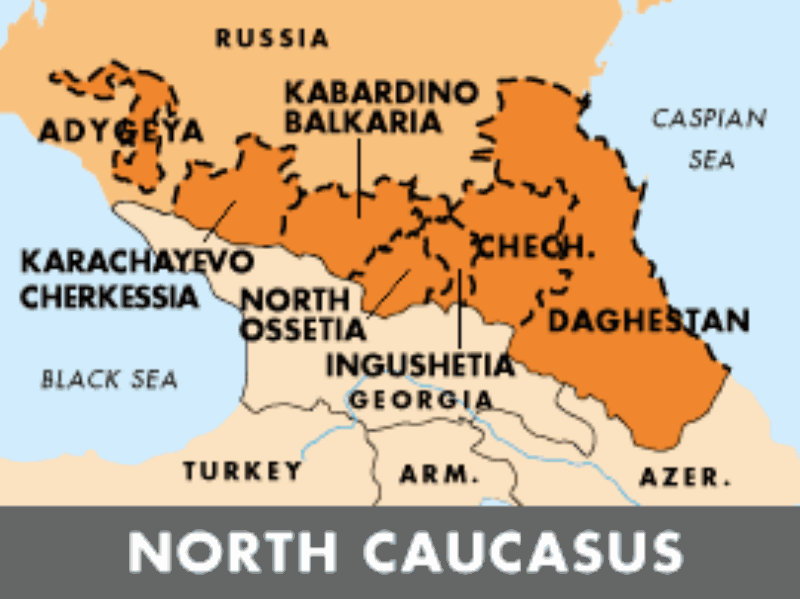
Only when Dmitry Medvedev succeeded Putin as Russian president did the focus shift. Many observers doubt, however, whether the grandiose 15-year plan to exploit the region's tourism potential recently unveiled by Deputy Prime Minister and North Caucasus Federal District head Aleksandr Khloponin can turn the tide. The specter of terrorism already deters most investors from financing projects even in those republics (North Ossetia, Karachayevo-Cherkessia, Adygeya) where the insurgency has made only minimal inroads to date. Moreover, the maladies afflicting the region are immune to a "quick fix," even if large-scale investment could provide one.

Russian nationalists increasingly advocate allowing the North Caucasus to secede. But that would play into the hands of the Islamic militants fighting to transform the virtual Caucasus Emirate into a functioning state. Those fighters have reportedly already threatened to inflicting the maximum carnage on spectators and participants in the 2014 Winter Olympic Games in Sochi on the Black Sea coast.  

At least for the next few years, Moscow has no choice but to continue the struggle to retain its grasp on the region. But that struggle is motivated more by prestige and a residual imperial mindset than by concern for the fate of the millions of Russian citizens for whom it is home.
This forum has been closed.
Comment Sorting
Comments page of 2
    Next 
by: Ingush from: Ingushetia
August 15, 2011 16:01
Dear RFE/RL you ask "How did a predominantly rural, mountainous region of fewer than 10 million people degenerate so swiftly into chaos, misery, endless bloodshed, and religious and social polarization?"

It didn't degenerate. Since Russian invasion the war goes on. It has its peaks when thousads of Russian troops killed a day, and calm periods when only two cops killed daily.

" Aleksandr Tikhomirov (aka Said Buryatsky) a convert to Islam from Buryatia and a hugely popular ideologist of jihad, staged two car bombings in Ingushetia in 2009, one of which narrowly missed killing Zyazikov's successor as president, Yunus-Bek Yevkurov."

I do not think you can tie Said with the attack on yevkurov. There were multiple attacks on the Russian high profile targets in Ingushetia long before Said Buryatsky. Such as: execution of Tsar's namestnik (viceroy) of Ingushetia colonel Mitnik or an execution of Russian Communist party leader Ivanov, or execution of the Russian head of Ingushetia Chernoglaz by the way two of him bodyguards were left unharmed and let go by the Ingush assasins.
In Response

by: andrei from: usa
August 15, 2011 19:06
I predict that All of Russia will be in a huge Ethnic conflict someday. Fighting between Russians and Kavkaz will escalate across the country. I blame the Kremlins failed polices.
In Response

by: Ingush from: Ingushetia
August 15, 2011 21:02
It was always in some form of ethnic conflict. Russia will always hate the Caucasus because the conquest of the North Caucasus was very bloody and it stayed like that till modern days. There were several attempts to pacify the North Caucasus there was deportation of the Caucasians to the Ottoman Empire - failed the guns were still shooting and Russian troops were dying, that wave of deportees later became the backbone of the financial support and propaganda (e.g. www.nosochi2014.com). At this moment there are more Caucasians living in the Middle East, and Europe than in the Caucasus itself. There was another attempt in 1944 to deport Ingush and Chechens to Central Asia and Siberia - failed again some people escaped during the deportation and formed what the Soviets called "band groups" in Ingushetia: like Tsitskiev brothers, Laysat Baisarova, Khuchbarov. I speak for Ingushetia because I know my history very well but there were many others in the neighboring regions they formed alliances and resisted to the Soviet occupation together. The Soviet propaganda stated that the last "Chechen bandit" abrek Khasukha was killed in the 70-s. That wasn't true because the Ingush female-sniper Laisat Baisarova was never captured or killed. Recently, she even managed to give an interview from some unknown location in the Caucasus. Modern events are the continuation and they shouldn't be viewed like something which came from nowhere like "Why Is The North Caucasus An Unholy Mess?" Yes, the war will continue and yes, it will claim many Russian and Caucasian lives. Experience shows that the Caucasians are ready to accept heavy losses in human life even over 90% when Mongols invaded the Caucasus. The future holds grim perspectives: with the improvement in technology both sides will master the instruments of murder, Russians will have to keep killing civilians because they cannot really distinguish between their friends and foes, and the Caucasians will kill in retaliation because vendetta is part of our culture.

by: eric d from: IF Idaho USA
August 15, 2011 23:24
RFERL is to be commended for a good brief summary of the North Caucasus disaster. But as Ingush points out, the North Caucasus didn't just suddenly degenerate into a terrorist battleground. The Russians (& Turks) have attempted to colonize & subjugate the North Caucasus for centuries; & Russia will continue to do so, partly because of the NC's strategic geopolitical importance (as in "The Great Game") & partly because "Great Russian" imperialist ambitions won't tolerate a non-ethnic Russian state on the borders (whether in Georgia or elsewhere). But the Putin regime's (& the FSB's) terrorist war game is something crueller, more criminal, & more immoral even than previous Great Russian imperialist campaigns (although Comrage Stalin's deportation of the entire Chechen nation certainly ranks high on the "cries against humanity" scale...). It's unfortunate RFERL neglects to mention Anna Politkovskaya & Alexander Litvinenko's whistleblowing exposes of Vladimir Putin & the FSB's clandestine staging of bogus Chechen "terror attacks" like the Moscow Apartment Bombings; and the FSB's infiltration of Chechen "freedom fighters" ranks to stage further fake "terror attacks" to keep the FSB's terrorist game-plan working in the North Caucasus. Chechenpress also offers evidence that even arch-Chechen jihadi Doku Umarov (like Ramzan Kadarov) is an FSB double agent; & that conjecture is supported by the fact that it was Vladimir Putin who first attempted to discredit the Chechen cause by claiming it was linked to international Muslim terrorism (the Wahabbis, Al Qaeda etc.). It's in the FSB's interests to promote an endless North Caucasus terrorist war; & the self-perpetuating cycle of revenge killings in Chechen & Ingush cultures (per "Ingush") only contributes to the endless bloodshed & terror. In the 1990s, the White House & State Dept. used to criticize the Putin regime & FSB for their "crimes against humanity" in the Chechen War(s). But that was before the White House adopted Vladimir OPutin's "war against international terrorism" as a rationale for post-Sept. 11th attacks on Iraq & Afghanistan. So now the US has its own "unholy (war) mess" to deal with & can;t take the moral high ground against Russia until "we"stop our own unholy "war on terror"...
In Response

by: Ingush from: Ingushetia
August 16, 2011 06:58
Two digits IQ how is the three-letter government service nowadays? Did they promote you or are you still a low level clerc?

"Neither bullets nor gas chambers were needed in Stalin's death camps. A third of the prisoners died each year from cold, starvation or disease in the concentration camps. In all, some 2.5 million Soviet Muslims were murdered by Stalin, 'the Breaker of Nations,' including half of the entire Chechen people.
In my new book, American Raj, I entitle the section on the Chechen, "Genocide in the Caucasus."
Gulag survivors filtered back to Chechnya. When the Soviet Union collapsed in 1991, Chechen demanded independence like the Soviet republics.
Instead, Boris Yeltsin's government invaded Chechnya, killing some 100,000 Chechen civilians through massive carpet bombing and shelling. Chechen leader Dzhokar Dudayev was assassinated, reportedly thanks to telephone homing equipment supplied Moscow by the US National Security Agency.
President Bill Clinton actually lauded Boris Yeltsin's as "Russia's Abraham Lincoln." - By Eric Margolis.

Lets read it again "Dzhokar Dudayev was assassinated, reportedly thanks to telephone homing equipment supplied Moscow by the US National Security Agency". Wasn't that BEFORE 9/11???????? The great "democratic" union where everybody is equal except Muslims who are "pumped full of heroin".
In Response

by: eric d from: IF Idaho USA
August 17, 2011 19:15
@ Ingush: It's unfortunate you are so blinded by hate that you don;t even see when others are on your side... And it's unfortunate that hate also dictates that the Chechen War(s) & the North Caucasus terror attacks will continue (as you apprently wish...) for the indefinite future, with the loss of many Chechen, Ingush, & Russian lives. As long as hate rules the North Caucasus & Russia, this whole "unholy mess" will continue & will help no-one... Not Chechens, not Ingush, & not Russians. If you really wish to stop the massacres & torture & free the future Chechen & Ingush children from this self-perpetuating cycle of vengence & murder, you should at least try to communicate with sympathetic readers & the international community on some calm & rational manner, rather than making slanderous attacks on your (no longer?) sympathetic public...

by: Andrei from: USA
August 15, 2011 23:40
Don't forget that the behavior of many Kavkaz people in Russian cities is unacceptable. Russians youth get angry like what happened last year of Manezhnya square in Moscow.
In Response

by: Ingush from: Ingushetia
August 16, 2011 06:35
Caucasus didn't invade Russia. What goes around comes around.
In Response

by: Russian from: Russia
August 16, 2011 13:12
Dear Ingush,

Please read your history a bit more carefully. Ingushetya joint Russia on its own will, just as Georgia did (though they are now trying to deny this fact which is 100% true). Ingush nobles (just as Georgian nobles) were recognized by Russian nobles as equal, and lands along Terekh were left for Ingush nobles in accordance with an agreement with Russia, which does not look like invasion, does it?
It is a shame to see that in 200 years we have this sensless fight for the sake of elite's interests.
In Response

by: Anzor from: USA
August 17, 2011 00:30
Russian you are so stupid. You Russians wrote the history and all of it is a huge lie. Ingushes did not join Russia because there were no Ingushes in 1810, and here is the proof for my words the map of 1856 which was made by German geographers. There are no Ingushes there. The people who live near Wladikaukas are Chechens. Enough said http://upload.wikimedia.org/wikipedia/commons/5/5d/Karte_des_Kaukasischen_Isthmus_-_Entworfen_und_gezeichnet_von_J-Grassl_-_1856.jpg
In Response

by: Marine from: USA
August 17, 2011 01:13
"Ingushetya joint Russia on its own will, just as Georgi"
Lets reexamine the statement with some historical facts:
"Russian historians claim that Ingush willingly came under Russian rule in 1810 (most of the information sources are based on a report of General-Major Delpotso 13 June 1810 No.48). However, Russian Barron Rozen on 29 June 1832 reported in letter No.42 to Count Chernishevski that "on the 23rd of this month I exterminated eight Ingush villages. On the 24th near Targim I exterminated nine more villages." In letter No.560 on 12 November 1836 Barron Rozen claimed that highlanders of Dzheirkah, Kistin, and Ghalghai were "partially subdued". Ingush people call themselves Ghalghai don't they?
I don't blame Georgians for what they are saying about you Bolsheviks.
In Response

by: Andrew from: Auckland
August 17, 2011 06:12
Actually "Russian from Russia" you realize that the "voluntary" accession of the Kingdom of Imereti (West Georgia) in 1804 and the Kingdom of Kartli-Kakheti (East Georgia) in 1800 were not "voluntary unions with Russia" at all, in both cases the respective kings wanted to form alliances with Russia to resist Turkish (West Georgia) or Persian (East Georgia) attacks.

What they got was quite different, Russian unilateral annexation, destruction of the Georgian Orthodox Church, serfdom, rape and pillage, banning of the Georgian language etc etc etc, all in violation of solemn and signed agreements.

The Kingdom of Imereti rebelled in 1810 and rebellions in west Georgia against Russian rule continued regularly, and were put down with massive bloodshed by Russian troops, until the end of the Tsarist Empire in 1917, when Georgia chose independence from Russia until 1921 when Russia again invaded ushering in a new wave of mass repression, followed by rebellions that lasted until the late 30's, in addition, all 6 attempts on Stalin's life were carried out by Georgians.

So "Russian" get an education. Nobody in the Caucasus wants you.
In Response

by: Marine from: USA
August 17, 2011 17:43
"Ingush nobles (just as Georgian nobles) were recognized by Russian nobles"
Russian from Russia, considering that Ingushes never had social rankings where the hell did the Ingush nobles come from???
"Customs, Social Organization. Chechen-Ingush society has always been egalitarian, unstratified, and classless. Traditionally there was no formal political organization and no political or economic ranking. Clans differed in size but not in prestige."
http://linguistics.berkeley.edu/~ingush/ingush_people.html#CUST

by: Ray F. from: Lawrence, KS
August 16, 2011 03:07
I don’t know this for a fact, but I’m guessing that the peoples of the North Caucasus were fighting among each other before the first Russians ever arrived. From my ignorant, western perspective, I think that too many people in the region profit in some way from violence. It would appear to be a growth industry. Until we find some way to make conflict less profitable, this planet is going to remain a ‘unholy mess.’ (I know that the RFE editors don’t like comparisons with the US, but for a little perspective, over 15,000 Americans were murdered in this country last year [over 40 a day], yet many still consider this country to be the greatest.)
In Response

by: Ingush from: Ingushetia
August 16, 2011 06:37
You are right you are dumber than dirt in the Caucasian matters. Caucasians were not fighting with each other. It was the policy of Russia to divide and conquer.
In Response

by: Ray F. from: Lawrence, KS
August 16, 2011 18:36
Thank you for your brilliant comment. Yes, it's all the Russians fault. The locals in the N. Caucasus have always been paragons of goodness and virtue, impervious to corruption and vanity. Is it true that the original Garden of Eden was in Ingushetia? Will it re-blossom when the Russian snakes are removed? Inshallah!

by: Alex from: USA
August 16, 2011 19:17
There are many more cruel figures than these eight horsemen,who led to the actual disaster. Remember the Yamadayev-brothers,whose endemic kidnappings were part of the provocations for the Second war in 1999!
Remember mafia-bosses like Bislan Gantamirov,who stole chechen oil. Remember the russian generals Shamanov and Troshev,who were pure mass-murderers. Remember the numerous russian officers like Budanov,who massacred innocent civilians. Remember the dagestani police chief and interior minister Magomedtagirov,whose ruthless police-terror in Dagestan led to the creation of the powerful Sharia-Jamaat. Etc..... etc......
In Response

by: Reid from: Boston, USA
August 17, 2011 03:49
Don't forget Arbi Barayev and I would also add Aslan Maskhadov. While there was no doubt Maskhadov was in an extraordinarily difficult situation as president since he was stuck between rival warlords as well as the rise of radical Islam, the bottom line is that by not being decisive he lost all control of the situation in Chechnya and the conditions were there that allowed Basayev and Khattab to organize so many fighters and then cross in Dagestan in '99. Although exceedingly difficult and most likely a move that would have cost him his life, Maskhadov should have eliminated Basayev and (if possible) Khattab as well, because by not doing so they were able to trigger the second war through their own reckless actions, a conflict that ended up costing Maskhadov his life anyway.

by: Steve from: New Zealand
August 16, 2011 20:00
Today one more policeman was killed in Dagestan. This republic is a hopeless mess. Every day there are killings in Dagestan. Dagestan will never again come back under tight russian control. These times have past. Colonial empires like the Russian Federation cannot survive in the 21. century!!! Great Britain wisely granted independence to my country New Zealand long time ago,feeling the "Wind of change". The dumb Kremlin-leaders will only retreat under blood and tears.They are not able to learn from history!!!
In Response

by: Marine from: USA
August 17, 2011 17:45
Some nations are not as smart as the UK.

by: Mladen from: Finland
August 16, 2011 22:24
IMHO, main Russian concern is not Caucasus but keeping control over sparsely populated Siberia with vast mineral riches. So, once they are sure Siberia will not secede, they can let Caucasus go. Of course, all potential terrorists (practically all people from Caucasus) need to be repatriated if you hope to achieve anything. Then build 12ft high electric fence and forget that area exists...
So, Caucasus gets freedom coupled with economical isolation from Russia. And what then? Go to work in Gulf for living, because EU will not open it's door and neither will USA?
In Response

by: Marine from: USA
August 17, 2011 17:57
When they get their independence the pipeline from Grozny-Chechnya and Malgobek-Ingushetia will be connected to Baku–Tbilisi–Ceyhan pipeline bypassing Baku-Novorossiysk pipeline or via Dagestan using the same Baku-Novorossiysk pipeline but in the direction to Baku. You are right the Russians will put the economic pressure but they will not be able to buy Azerbaijani oil which will completely remove Russia from the Caucasus. Drill baby, drill.

by: Andrei from: USA
August 17, 2011 00:22
The biggest problem is that Kavkaz people only behave when they are sleeping. If they go to Russian cities and behave like gangsters then hopefully there will be a mass uprising agaisnt them. Like what happened in Kondopoga.

by: Targim from: London
August 17, 2011 08:44
A Fish Rots From The Head Down - The time will come when Russians will leave and Caucasus will be free and only time will show if it was good or bad for the region. People there are wise, interprinurial and with huge self-esteem, if they are left alone rest assured they will take care of themselves.
In Response

by: Marine from: USA
August 17, 2011 18:01
I agree, you guys have a potential.

by: Adam from: Canada
August 17, 2011 12:23
It´s a shame to include Dokka Umarov and Shamil Basayev into the list of these "eight horsemen". What should Basayev and Umarov have done in 1999????? Simply surrender to the drunken russian killer-army???? Umarov´s father was killed by sticking out his eyes,while he was alive. Basayev´s children were burnt alive in their house! It´s a shame to blame these two chechen commanders only because they are muslims. The history will prove,that Basayev and Umarov were heroic freedom-fighters,who helped to bring down one of the bloodiest empires in world-history,the terrorist "Russian Federation".

By the way. It´s simply a lie,that the Second Chechen war was provoked by Basayev with his Dagestan-raid. In reality the russian army already infiltrated Northern Chechnya´s steppe-districts constantly in spring and summer 1999,killing farmers,cows and sheeps!!! But no one is talking about this!!!!
In Response

by: Marine from: USA
August 17, 2011 17:48
Good point. For England George Washington was a terrorist.
In Response

by: Andrew from: Auckland
August 18, 2011 09:24
Actually for many people in Britain during the US war of independence, George Washington was considered to be a British citizen fighting for the rights he and the colonists were entitled to by birth.

The leader of the Whig opposition in parliament would address parliament wearing a continental congress uniform during debates.
In Response

by: Marine from: USA
August 19, 2011 17:34
"Actually for many people in Britain during the US war of independence, George Washington was considered to be a British citizen fighting for the rights he and the colonists were entitled to by birth."
What are you smoking? I want it too.
In Response

by: Andrew from: Auckland
August 20, 2011 06:23
Try reading a bit about the history of the period.

I see you get all your history lessons from Hollywood mate, but the reality was a lot more complicated, and there was a lot of support for the colonists in Britain, both public and parliamentary, for example Britains top generals refused to serve in North America against their ethnic kin, and as I said, the leader of the parliamentary opposition supported Washington.

Try reading some proper examinations of the period, you might learn something.
In Response

by: Marine from: USA
August 20, 2011 22:48
"I see you get all your history lessons from Hollywood mate"
Don't call me mate. When you say mate you sound English. Soooooo that's why you write all this junk about the USA.
Comments page of 2
    Next 

Most Popular


Being Discussed Now

Chechen Leader Names New Premier

Latest Comment (5 total)

M: Ingush human rights defender Magomed Khazbiev: "Kremlin needs slaves in the Caucasus":
http://pik.tv/ru/shows/vasha-pravda/video/86/4437 More

Kingsley As Karzai?

Latest Comment (1 total)

M: they put the dictators in power and they make fun of them More

Moldova Sentences 3 On Uranium Charge

Latest Comment (1 total)

Ionas Aurelian Rus:
One should not only salute the capture of these officials by the Moldovan ... More