




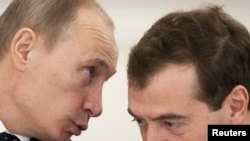
Is there an overarching strategy to the dizzying machinations of the Russian elite as election season approaches? Or are we just seeing the usual jockeying of Kremlin clans positioning themselves for the post-2012 situation?
Lauren Goodrich at Stratfor.com has written a well-reasoned piece that argues the former. I have been meaning to blog it for a couple weeks now (it came out on July 5 and is well worth a read), not least of all because it largely mirrors my understanding of the current political dynamic.
"Interesting shifts are under way this election season," Goodrich writes. "While on the surface they may resemble political squabbles and instability, they actually represent the next step in the Russian leadership's consolidation of the state."
Goodrich argues that upon coming to power, Putin's first priority was to restore the authority of the Russian state which had deteriorated during Boris Yeltsin's presidency.
Putin largely achieved this goal using authoritarian means during his eight years in the Kremlin, which gave him the confidence to turn the presidency over to Dmitry Medvedev -- while remaining in firm control of the country as prime minister.
Putin's next priority, which he is undertaking in tandem with Medvedev, is to modernize the country's economy and infrastructure. But this, Goodrich writes, requires some adjustments in policy:
In order to achieve these goals, Putin and Medvedev not only need to improve Russia's investment climate and ease up the state's role in the economy (which explains Medvedev's moves to move siloviki like Igor Sechin out of the chairmanship of state corporations), they also need to create what Goodrich calls "the appearance of democracy."
Enter Mikhail Prokhorov and Right Cause:
But the tandem (and the larger ruling elite) also wants to make sure the appearance of democracy doesn't turn into the real thing.
Enter the Popular Front:
And as I have been blogging for months, the mechanism to keep the current elite firmly in control with the appearance of a more democratic system is "managed pluralism":
Igor Yurgens , chairman of the Kremlin-connected Institute of Modern Development, recently said he expected Medvedev to remain president for a second term, adding that Putin would remain the country's most powerful figure.
"Vladimir Putin is a more powerful player. He will probably become a kind of father of the nation, allowing the president to promote the thoughts and ideas he regards as priorities," Yurgens told Interfax.
My only quibble with Goodrich's conclusions is that I don't think this is just about Putin. It is about keeping the inner sanctum of the current ruling elite, what Andrew Monaghan of the NATO Defense College calls "The Team" (and what I would call the Deep State -- but that is a subject for a future piece I am working on), in power as well.
-- Brian Whitmore
Lauren Goodrich at Stratfor.com has written a well-reasoned piece that argues the former. I have been meaning to blog it for a couple weeks now (it came out on July 5 and is well worth a read), not least of all because it largely mirrors my understanding of the current political dynamic.
"Interesting shifts are under way this election season," Goodrich writes. "While on the surface they may resemble political squabbles and instability, they actually represent the next step in the Russian leadership's consolidation of the state."
Goodrich argues that upon coming to power, Putin's first priority was to restore the authority of the Russian state which had deteriorated during Boris Yeltsin's presidency.
Putin largely achieved this goal using authoritarian means during his eight years in the Kremlin, which gave him the confidence to turn the presidency over to Dmitry Medvedev -- while remaining in firm control of the country as prime minister.
Putin's next priority, which he is undertaking in tandem with Medvedev, is to modernize the country's economy and infrastructure. But this, Goodrich writes, requires some adjustments in policy:
With elections approaching, the ruling tandem seems even more at odds as Medvedev overturns many policies Putin put into place in the early 2000s, such as the ban on certain political parties, the ability of foreign firms to work in strategic sectors and the role of the FSB elite within the economy. Despite the apparent conflict, the changes are part of an overall strategy shared by Putin and Medvedev to finish consolidating Russian power.
These policy changes show that Putin and Medvedev feel confident enough that they have attained their first imperative that they can look to confront the second inherent problem for the country: Russia's lack of modern technology and lack of an economic base. Even with Russian energy production at its height, its energy technologies need revamping, as do every other sector, especially transit and telecommunication. Such a massive modernization attempt cannot be made without foreign help.
These policy changes show that Putin and Medvedev feel confident enough that they have attained their first imperative that they can look to confront the second inherent problem for the country: Russia's lack of modern technology and lack of an economic base. Even with Russian energy production at its height, its energy technologies need revamping, as do every other sector, especially transit and telecommunication. Such a massive modernization attempt cannot be made without foreign help.
In order to achieve these goals, Putin and Medvedev not only need to improve Russia's investment climate and ease up the state's role in the economy (which explains Medvedev's moves to move siloviki like Igor Sechin out of the chairmanship of state corporations), they also need to create what Goodrich calls "the appearance of democracy."
Enter Mikhail Prokhorov and Right Cause:
Right Cause is intended to support foreign business and the modernization efforts. The party at first was designed to be led by Medvedev's economic aide, Arkady Dvorkovich, or Finance Minister Aleksei Kudrin. However, the Kremlin thought that having a Kremlin member lead a new "independent" political party would defeat the purpose of showing a new democratic side to Russian's political sphere. Prokhorov has rarely shown political aspirations, but he has a working relationship with the Kremlin. He clearly received orders to help the Kremlin in this new display of democracy, and any oligarch who survives in Russia knows to follow the Kremlin's orders.
But the tandem (and the larger ruling elite) also wants to make sure the appearance of democracy doesn't turn into the real thing.
Enter the Popular Front:
On the surface, the Popular Front has attempted to remain vague to avoid revealing how such an organization supersedes political parties and factions. It creates a system in which power in the country does not lie in a political office ¬ such as the presidency or premiership ¬ but with the person overseeing the Popular Front: Putin.
And as I have been blogging for months, the mechanism to keep the current elite firmly in control with the appearance of a more democratic system is "managed pluralism":
It is managed pluralism underneath not a president or premier, but under a person more like the leader of the nation, not just the leader of the state. In theory, the new system is meant to allow the Kremlin to maintain control of both its grand strategies of needing to reach out abroad to keep Russia modern and strong and trying to ensure that the country is also under firm control and secure for years to come.
Igor Yurgens , chairman of the Kremlin-connected Institute of Modern Development, recently said he expected Medvedev to remain president for a second term, adding that Putin would remain the country's most powerful figure.
"Vladimir Putin is a more powerful player. He will probably become a kind of father of the nation, allowing the president to promote the thoughts and ideas he regards as priorities," Yurgens told Interfax.
My only quibble with Goodrich's conclusions is that I don't think this is just about Putin. It is about keeping the inner sanctum of the current ruling elite, what Andrew Monaghan of the NATO Defense College calls "The Team" (and what I would call the Deep State -- but that is a subject for a future piece I am working on), in power as well.
-- Brian Whitmore