




You'd think nothing at all has changed over the past six months. President Vladimir Putin has appointed three new governors and named another old KGB crony as a Kremlin aide. And, of course, longtime "energy tsar" and siloviki stalwart Igor Sechin is back in the saddle as CEO at the state-owned oil giant, Rosneft.
As I blogged earlier this week, the recent spate of appointments in Russia suggest that Putin would like to turn the clock back to 2007, with the same cabal of a couple dozen figures calling all the shots and the formal institutions of governance serving as window dressing.
There's just one problem. As political analyst Nikolai Zlobin pointed out in a recent piece in the daily "Vedomosti," Russian society has moved on:
Skeptics have pointed out that the phenomenon Zlobin describes is largely confined to Moscow and, to a lesser extent, other large cities.
This is true as far as it goes. But as Kirill Kobrin, managing editor of RFE/RL's Russian Service, pointed out in last week's Power Vertical podcast, this is where most of the money, power, and influence in Russia is located -- and it is from Moscow and other urban centers where change in Russia always emanates.
Moreover, whether you call it the creative class, the urban middle class, or the entrepreneurial class, this increasingly self-assured sector of the population is also the fastest growing part of society. They are young, cosmopolitan, confident, and believe the future belongs to them. They are belying all the tired old stereotypes about Russian servility and passivity and they are growing increasingly impatient with the system they inherited.
"The business community has long outgrown the economic system in Russia," Zlobin wrote. "The lack of the proper laws defending the right of private property as well as lack of rule of law, combined with unspeakable systematic corruption and unlawful practices of officials, turns any holder of private property in Russia into a political vassal."
Late last year, when the protest movement that sprung up in the wake of the disputed State Duma elections was just picking up steam, I asked veteran Russia-watcher Nikolas Gvosdev, a professor of international politics at the U.S. Navy War College, if it was possible for Putin to put this genie back into the bottle.
"The genie can go partially back in, but the bottle will have to change its shape. You can't force everything back into the pre-2008 mold because that's where you'll get an explosion," Gvosdev told me.
Nearly half a year later, we are beginning to see the bottle change shape.
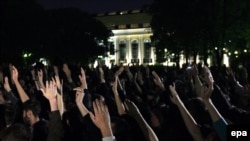
Lacking representation in the halls of power, the urban middle class is becoming increasingly creative in making its voice heard on the streets. In a piece in Politcom.ru this week, political analyst Tatyana Stanovaya illustrated how protesters are exploiting loopholes in the law to stage demonstrations that are very difficult -- if not impossible -- for the authorities to squash.
When police disperse an "Occupy-style" camp, for example, another one quickly pops up in another location. Some of these have won support from newly elected opposition deputies in municipal councils, giving them a semi-official stamp of approval. So-called "strolls" by writers and artists -- and a planned one for musicians -- don't violate any laws and the authorities have been reluctant to use force against nationally known celebrities.
"The Kremlin has found itself in a trap of its own making," Stanovaya wrote. "The Kremlin had well-ordered mechanisms for combating the opposition that worked according to the party principle, with known leaders and weak support from below. But the authorities simply have no effective mechanisms against a permanent protest from below, one which does not depend on the already familiar leaders."
Creative street protests are not the only way the new opposition is making its presence felt. As I have blogged repeatedly, they have become very skilled at contesting local and municipal elections as well. This tendency, Stanovaya wrote, threatens to pull local government "out from under the control of the 'power vertical.'"
An excellent piece by my colleague Tom Balmforth illustrated how this is beginning to happen in practice in Moscow, where new municipal council deputy Sasha Andreyeva -- a former English teacher -- successfully halted a construction project that would have destroyed a local park in the capital's Lefortovo district.
The "managers" and "technocrats" in the elite seem to understand the peril this rebellion below the decks poses for the regime and the viability of Russia's "Deep State" in its current form. But for the time being they appear to have been outmaneuvered by the "shareholders" and the "siloviki."
But the grassroots insurgency shows no signs of abating any time soon. On the contrary, it only appears to be growing.
-- Brian Whitmore
As I blogged earlier this week, the recent spate of appointments in Russia suggest that Putin would like to turn the clock back to 2007, with the same cabal of a couple dozen figures calling all the shots and the formal institutions of governance serving as window dressing.
There's just one problem. As political analyst Nikolai Zlobin pointed out in a recent piece in the daily "Vedomosti," Russian society has moved on:
There is a rapidly increasing contrast between the social maturity of the Russian public and the current political system. Russian society is beginning to resemble a postmodernist society more and more Russians are quickly becoming a part of the global community, leaving the "sovok" mind-set behind and losing the traditional unquestionable fear of authority. Young and middle-aged members of Russian society are among the first ones in Russia who, while retaining specific national features, manage to combine it with the system of values and traditions of their peers from well-developed countries. However the political system that the Russian government is offering them today is strictly premodernist. It's becoming more apparent by the day that this system only operates to serve its own interests and is incapable of satisfying the political vision of people outside of the government machine.
Skeptics have pointed out that the phenomenon Zlobin describes is largely confined to Moscow and, to a lesser extent, other large cities.
This is true as far as it goes. But as Kirill Kobrin, managing editor of RFE/RL's Russian Service, pointed out in last week's Power Vertical podcast, this is where most of the money, power, and influence in Russia is located -- and it is from Moscow and other urban centers where change in Russia always emanates.
Moreover, whether you call it the creative class, the urban middle class, or the entrepreneurial class, this increasingly self-assured sector of the population is also the fastest growing part of society. They are young, cosmopolitan, confident, and believe the future belongs to them. They are belying all the tired old stereotypes about Russian servility and passivity and they are growing increasingly impatient with the system they inherited.
"The business community has long outgrown the economic system in Russia," Zlobin wrote. "The lack of the proper laws defending the right of private property as well as lack of rule of law, combined with unspeakable systematic corruption and unlawful practices of officials, turns any holder of private property in Russia into a political vassal."
Late last year, when the protest movement that sprung up in the wake of the disputed State Duma elections was just picking up steam, I asked veteran Russia-watcher Nikolas Gvosdev, a professor of international politics at the U.S. Navy War College, if it was possible for Putin to put this genie back into the bottle.
"The genie can go partially back in, but the bottle will have to change its shape. You can't force everything back into the pre-2008 mold because that's where you'll get an explosion," Gvosdev told me.
Nearly half a year later, we are beginning to see the bottle change shape.
Lacking representation in the halls of power, the urban middle class is becoming increasingly creative in making its voice heard on the streets. In a piece in Politcom.ru this week, political analyst Tatyana Stanovaya illustrated how protesters are exploiting loopholes in the law to stage demonstrations that are very difficult -- if not impossible -- for the authorities to squash.
When police disperse an "Occupy-style" camp, for example, another one quickly pops up in another location. Some of these have won support from newly elected opposition deputies in municipal councils, giving them a semi-official stamp of approval. So-called "strolls" by writers and artists -- and a planned one for musicians -- don't violate any laws and the authorities have been reluctant to use force against nationally known celebrities.
"The Kremlin has found itself in a trap of its own making," Stanovaya wrote. "The Kremlin had well-ordered mechanisms for combating the opposition that worked according to the party principle, with known leaders and weak support from below. But the authorities simply have no effective mechanisms against a permanent protest from below, one which does not depend on the already familiar leaders."
Creative street protests are not the only way the new opposition is making its presence felt. As I have blogged repeatedly, they have become very skilled at contesting local and municipal elections as well. This tendency, Stanovaya wrote, threatens to pull local government "out from under the control of the 'power vertical.'"
An excellent piece by my colleague Tom Balmforth illustrated how this is beginning to happen in practice in Moscow, where new municipal council deputy Sasha Andreyeva -- a former English teacher -- successfully halted a construction project that would have destroyed a local park in the capital's Lefortovo district.
The "managers" and "technocrats" in the elite seem to understand the peril this rebellion below the decks poses for the regime and the viability of Russia's "Deep State" in its current form. But for the time being they appear to have been outmaneuvered by the "shareholders" and the "siloviki."
But the grassroots insurgency shows no signs of abating any time soon. On the contrary, it only appears to be growing.
-- Brian Whitmore