




The Russian government this week released the first preliminary results from last year's census, so far confirming a long-running demographic crisis and sparking debate about the latest headcount's accuracy and the government's response.
The initial, bare-bones results contained few surprises, and appear to bear out a UN report that projects a significant depopulation of Russia in the next four decades.
Russia's population dropped by 2.2 million -- or 1.6 percent, to 142.9 million -- since the last census in 2002. A disproportion in favor of women continues to grow as well, with 53.7 percent of the population female.
Aleksandr Surinov, the head of the Rosstat state statistics agency, told "Rossiiskaya gazeta" that the growing gender imbalance is due primarily to "the high incidence of premature death among men."
The census also shows that 73.7 percent of Russians live in urban areas.
Just 20 of the country's 83 regions saw population increases, many of them the so-called ethnic republics.
Raising Questions
Complete final results of the census -- including crucial information on mortality and birthrates -- is expected in early 2013.
In 2009, a UN report forecast that Russia's population would fall to 116 million by 2050.
"The demographic process today -- and I mean the decline in population -- is fantastically powerful, and it is connected not only with the allocation or nonallocation of budget resources, but also with the problem of culture," Mark Urnov, head of the politics department of Moscow's Higher School of Economics, says. "We have become a hedonistic consumer culture and, as is always the case in these situations, the birthrate is in decline. This is also happening in Europe and, to a lesser extent, the United States."
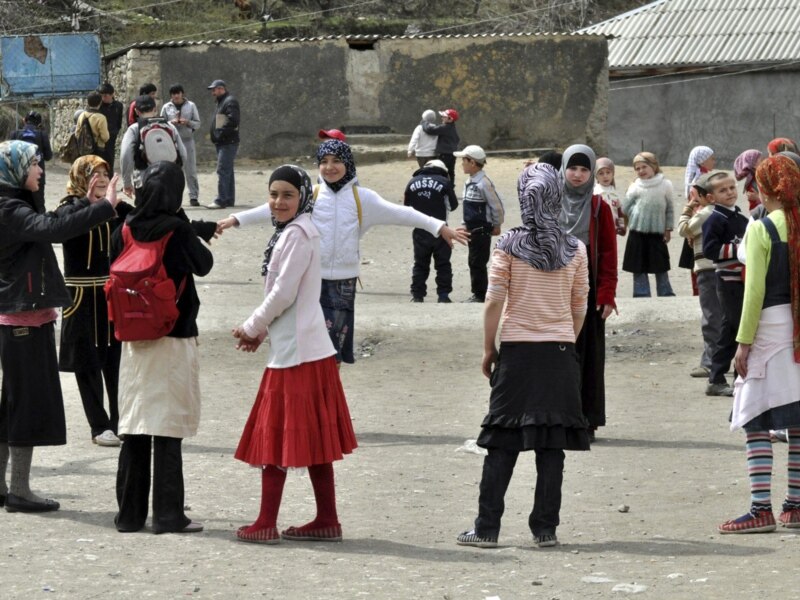
 Children play near a local school in the village of Balakhani, Daghestan.
Only a few regions of Russia are bucking the overall downward trend. The prosperous major cities of Moscow and St. Petersburg recorded increases, as did many of the "ethnic republics," particularly in the violence-riddled North Caucasus. The primarily Muslim regions of Chechnya and Daghestan recorded the largest increases.
But Usama Baisayev, an activist in the North Caucasus with the Memorial human rights group, disputes the latest figures. For one thing, he notes that the 2002 census was carried out under difficult conditions in the region and so makes a poor baseline for comparison.
"I remember well how the 2002 census was conducted [in Chechnya] -- in some places, the census takers simply didn't go, particularly in the mountain villages," Baisayev says. "At that time, representatives of the authorities were afraid to show up there because these villages were controlled -- particularly at night -- by Chechen fighters."
In addition, Baisayev says both local authorities in these regions -- which are almost entirely dependent on the budget subsidies from the central government -- and the government in Moscow have strong incentives to inflate their numbers.
"I don't think you can trust the results of this census, because the authorities in Chechnya today believe that the more people there are, the better," Baisayev says. "There are reasons for this connected with the budget, with money. The Russian authorities also don't object to this because human rights organizations are asserting that in Chechnya they are still killing people and producing evidence of this; but if the population figures show more residents of Chechnya, then that would mean the statistics contradict the reports of the activists."
Drains And Holes
The census has once again stirred up discussion of Russia's demographic challenges, with supporters of the ruling tandem of President Dmitry Medvedev and Prime Minister Vladimir Putin arguing that the birthrate has stabilized following the demographic catastrophe of the 1990s and has even begun rising over the last couple of years. They attribute the uptick to the government's family-promotion policies.
 Russian President Dmitry Medvedev meets with a group of mothers of large families on the eve of International Women's Day at the Barvikha presidential residence outside Moscow on March 7.
Other specialists, however, argue that the recent small increases in birthrates are due to the fact that the generation born in the late 1980s is now at its child-bearing peak. As that generation is replaced by the smaller and more traumatized cohort that was born in the 1990s, these specialists expect the birthrate to take another sharp downturn in the coming years.
"The population has increased [in the last few years], but there will be a decrease because those who were born in the 1990s will be having children soon," says Flura Ildarkhanova, the head of a demographic research center of the Tatarstan Academy of Sciences in Kazan. "[Then] the population will decrease again and there will be a 'demographic hole.'"
Political scientist Urnov notes that the demographic problem is further exacerbated by out-migration, particularly of educated young people, in what he describes as "the monstrous brain drain, the drain of energetic and enterprising people."
"There was a recent study of the middle class in the regions of [Russia], and it found that those who are oriented toward small or medium-sized business in production prefer to save up some money, pack their bags and go somewhere else. And who remains?"
All of these issues -- low birthrates, rural depopulation, out-migration -- can be coped with, Urnov argues, but doing so will take dedicated effort.
"If we fundamentally -- sharply and deeply -- change our long-term budget policies and bring consistent spending to education, to childcare, to kindergartens, to schools, to culture and if we form a system of values that is oriented toward the long term, maybe something will come of it," Urnov says.
RFE/RL's Russian, Tatar-Bashkir, and North Caucasus services contributed to this report
The initial, bare-bones results contained few surprises, and appear to bear out a UN report that projects a significant depopulation of Russia in the next four decades.
Russia's population dropped by 2.2 million -- or 1.6 percent, to 142.9 million -- since the last census in 2002. A disproportion in favor of women continues to grow as well, with 53.7 percent of the population female.
Aleksandr Surinov, the head of the Rosstat state statistics agency, told "Rossiiskaya gazeta" that the growing gender imbalance is due primarily to "the high incidence of premature death among men."
The census also shows that 73.7 percent of Russians live in urban areas.
Just 20 of the country's 83 regions saw population increases, many of them the so-called ethnic republics.
Raising Questions
Complete final results of the census -- including crucial information on mortality and birthrates -- is expected in early 2013.
In 2009, a UN report forecast that Russia's population would fall to 116 million by 2050.
"The demographic process today -- and I mean the decline in population -- is fantastically powerful, and it is connected not only with the allocation or nonallocation of budget resources, but also with the problem of culture," Mark Urnov, head of the politics department of Moscow's Higher School of Economics, says. "We have become a hedonistic consumer culture and, as is always the case in these situations, the birthrate is in decline. This is also happening in Europe and, to a lesser extent, the United States."
Only a few regions of Russia are bucking the overall downward trend. The prosperous major cities of Moscow and St. Petersburg recorded increases, as did many of the "ethnic republics," particularly in the violence-riddled North Caucasus. The primarily Muslim regions of Chechnya and Daghestan recorded the largest increases.
But Usama Baisayev, an activist in the North Caucasus with the Memorial human rights group, disputes the latest figures. For one thing, he notes that the 2002 census was carried out under difficult conditions in the region and so makes a poor baseline for comparison.
"I remember well how the 2002 census was conducted [in Chechnya] -- in some places, the census takers simply didn't go, particularly in the mountain villages," Baisayev says. "At that time, representatives of the authorities were afraid to show up there because these villages were controlled -- particularly at night -- by Chechen fighters."
In addition, Baisayev says both local authorities in these regions -- which are almost entirely dependent on the budget subsidies from the central government -- and the government in Moscow have strong incentives to inflate their numbers.
"I don't think you can trust the results of this census, because the authorities in Chechnya today believe that the more people there are, the better," Baisayev says. "There are reasons for this connected with the budget, with money. The Russian authorities also don't object to this because human rights organizations are asserting that in Chechnya they are still killing people and producing evidence of this; but if the population figures show more residents of Chechnya, then that would mean the statistics contradict the reports of the activists."
Drains And Holes
The census has once again stirred up discussion of Russia's demographic challenges, with supporters of the ruling tandem of President Dmitry Medvedev and Prime Minister Vladimir Putin arguing that the birthrate has stabilized following the demographic catastrophe of the 1990s and has even begun rising over the last couple of years. They attribute the uptick to the government's family-promotion policies.

Other specialists, however, argue that the recent small increases in birthrates are due to the fact that the generation born in the late 1980s is now at its child-bearing peak. As that generation is replaced by the smaller and more traumatized cohort that was born in the 1990s, these specialists expect the birthrate to take another sharp downturn in the coming years.
"The population has increased [in the last few years], but there will be a decrease because those who were born in the 1990s will be having children soon," says Flura Ildarkhanova, the head of a demographic research center of the Tatarstan Academy of Sciences in Kazan. "[Then] the population will decrease again and there will be a 'demographic hole.'"
Political scientist Urnov notes that the demographic problem is further exacerbated by out-migration, particularly of educated young people, in what he describes as "the monstrous brain drain, the drain of energetic and enterprising people."
"There was a recent study of the middle class in the regions of [Russia], and it found that those who are oriented toward small or medium-sized business in production prefer to save up some money, pack their bags and go somewhere else. And who remains?"
All of these issues -- low birthrates, rural depopulation, out-migration -- can be coped with, Urnov argues, but doing so will take dedicated effort.
"If we fundamentally -- sharply and deeply -- change our long-term budget policies and bring consistent spending to education, to childcare, to kindergartens, to schools, to culture and if we form a system of values that is oriented toward the long term, maybe something will come of it," Urnov says.
RFE/RL's Russian, Tatar-Bashkir, and North Caucasus services contributed to this report